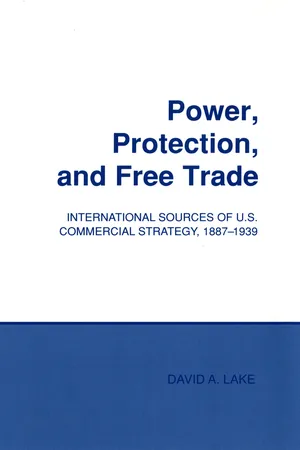
Why do nations so frequently abandon unrestricted international commerce in favor of trade protectionism? David A. Lake contends that the dominant explanation, interest group theory, does not adequately explain American trade strategy or address the contradictory elements of cooperation and conflict that shape the international economy. Power, Protection, and Free Trade offers an alternative, systemic approach to trade strategy that builds on the interaction between domestic and international factors. In this innovative book, Lake maintains that both protection and free trade are legitimate and effective instruments of national policy, the considered responses of nations to varying international structures.
eBook - ePub
Power, Protection, and Free Trade
International Sources of U.S. Commercial Strategy, 1887–1939
- 264 pages
- English
- ePUB (mobile friendly)
- Available on iOS & Android
eBook - ePub
Power, Protection, and Free Trade
International Sources of U.S. Commercial Strategy, 1887–1939
About this book
Trusted by 375,005 students
Access to over 1.5 million titles for a fair monthly price.
Study more efficiently using our study tools.
Information
Part I
STRUCTURE AND STRATEGY
Chapter One
A Theory of International Economic Structures
Many statesmen have been introduced to the benefits of free trade in undergraduate economics courses or, in earlier periods, through the writings of Adam Smith and David Ricardo. But over the last two centuries, the teachings of liberal trade economists have been followed only sporadically. The law of comparative advantage is one of the basic tenets of economics. Yet in perhaps no other area is the gap between economic theory and political practice so large.
As noted in the Introduction, the most widely accepted explanation of this anomaly is interest-group or, in public choice parlance, endogenous tariff theory. Government leaders, this theory maintains, are under pressure from highly organized, rent-seeking societal groups. Dependent upon such groups for support, politicians have little choice but to grant protection to claimants, thereby benefiting selected producers at the expense of consumers. This theory is attractive, and I build on it in Chapter 2.
Yet even within the advanced industrialized democracies, governmental forms vary in their degree of centralization and autonomy—factors that should allow for differential insulation from society and rent-seeking pressures.1 All of the major economic powers have maintained extensive protectionist systems at some stage in history despite clear differences in domestic structures. Great Britain in the seventeenth and eighteenth centuries, the United States in the late eighteenth and nineteenth centuries, France and Germany in the late nineteenth century, and Japan in the twentieth century have all vigorously pursued protectionist policies. These same countries, with the possible exception of Japan, have all pursued free trade at other times with almost equal vigor and often without a significant change in domestic structure.
Moreover, politicians and political economists have articulated important rationales for protection based on the “public interest.” Jean Baptiste Colbert’s mercantilism, Alexander Hamilton’s “infant industry” argument, the German historical school, and MITI technocrats in Japan all maintain that protection is in the national interest at certain stages in a country’s economic development. This economic philosophy has often dominated the political agenda in the past and may do so again in the future. At other times, the teachings of economic trade theorists have gained prominence and greater support. The current allegiance of politicians in the United States to the principle of free trade (but not necessarily the practice) provides ample evidence: even protectionist policies have to be couched in liberal rhetoric and framed in terms of reciprocity, or the opening of foreign markets to American exports. In each case, protection or free trade has been generally espoused as being in the “national interest.”
Finally, free trade and protection appear to be contagious and cyclical. The brief era of European free trade in the mid-nineteenth century rapidly gave way to near universal protectionism by the end of the century, only to be superseded by a period of free trade among the advanced industrialized democracies following World War II. Specific explanations for each country’s policy vary widely: France adopted free trade in 1860 in an attempt to secure British support for its northern Italy policy,2 the United States maintained its highly protectionist system because Republicans, who formed the dominant party after the Civil War, had declared themselves to be the “party of protection,”3 and so on. As Kenneth Waltz has persuasively argued in a slightly different context, this proliferation of explanations indicates the need for a systemic-level theory of trade policy which abstracts from national-level characteristics.4
From Adam Smith on, economists have struggled to make the real world of trade policy conform to their model, with limited success. In doing so, they have often ignored the systemic incentives for free trade and protection and the very real political issues at stake. I start here with the assumption that the political process is at least partly rational, that means relate to ends, and that the beliefs of statesmen have some basis in reality. Accordingly, I seek to explain the trade strategies adopted by nation-states. Furthermore, given the apparent presence of contagion and cyclical processes, the wide variance in unit-level explanations of national trade policies, and the public interest rationales developed by both protectionists and free traders, I attempt to build a systemic-level theory of national trade interests and strategy.
International Politics and International Trade
The international system is anarchic and based upon the principle of self-help.5 This is the basic fact of modern international relations.6 Anarchy is defined here as the absence of any centralized political authority higher than the nation-state. The absence of central authority does not necessarily indicate a lack of “order” within the international system.7 Anarchy is also compatible with strong international regimes, defined as “principles, norms, rules, and decision-making procedures around which actor expectations converge,”8 or other patterns of behavior recognized as legitimate by the community of nation-states. Regimes and order, however, are problematic under anarchy. Nationstates themselves must choose whether to participate in the global arena and what rules they will observe. In a self-help system, nation-states are responsible only to themselves. They are, in other words, the sole judge of their national interests.
Anarchy renders the construction of a stable, liberal, and open international trading order difficult. In the construction of free markets within countries, governments must provide the basic economic infrastructure, for example, property rights, transportation networks, and a stable currency, and they must coerce or induce the compliance of citizens whose interests are harmed or at least not benefited by the functioning of market processes.9 Governments succeed at home because their authoritative nature is backed by a monopoly of the legitimate use of violence.10 Within a society, for instance, thieves are imprisoned, taxes are levied for highway construction, and disadvantaged groups are compensated. In the international arena, nation-states must also provide a basic infrastructure and obtain the compliance of countries that gain less from free trade than others.11 Yet, in the absence of centralized authority, nation-states face a problem of collective action: each prefers that others bear the burden of providing the infrastructure and coercing or compensating the relatively disadvantaged. Free riding, for reasons developed below, can be overcome only by large and possibly middle-sized countries.
Anarchy and the principle of self-help also shape national interests in a second way. Self-help implies, first, that countries are concerned only with their national advantage and not with global welfare. The gains and losses to their own country capture the attention of central decision makers. Thus the reliance on self-help necessitates what Friedrich List termed a “political” rather than a “cosmopolitical” economy.12
Self-help also implies that a country will be concerned not only with its own absolute gain from trade but also with its relative gain, or the difference between its gain and the gains of others. Power, the pursuit of which follows from anarchy, is a relational concept. To the extent that one country is strong, others must be weak. Wealth, on the other hand, is an absolute trait. All countries gain from free trade, but—as John Stuart Mill first demonstrated—not necessarily to the same degree or extent. This simultaneous concern with both absolute and relative gains from trade and the contradiction between them has three implications for trade strategy. First, those countries that gain absolutely and relatively from free trade will have a stronger interest in such trade than those that gain only absolutely. Second, countries that gain absolutely and relatively will seek to construct regimes or other mechanisms of control to reinforce their advantageous positions. Third, disadvantaged countries will seek to strengthen their relative positions within the international division of labor and may be willing to bear considerable short-term absolute costs to accomplish this aim.
This chapter makes two other assumptions regarding the character of the “units” or nation-states.13 First, it is assumed that nation-states are unitary actors, that is, they act within the international system as single individuals. Thus, this chapter abstracts up from divisions within the state, between the state and society, and within society. This assumption is relaxed in Chapter 2 and the case study below. Second, it is assumed that nation-states are rational, that they make means-ends calculations and choose the policy with the greatest net return. This assumption has engendered a wave of legitimate criticism in the broader international relations and social science literatures.14 It has been proposed that nation-states, like individuals, may be satisficers or cybernetic decision makers.15 Individuals and, even more, nation-states are clearly not rational; few are able to make the means-ends calculations necessary for full or partial rationality to hold. Yet the assumption of rationality is useful and adopted here because it is the only decision principle that allows explanations or predictions to be derived from the international system without examining the internal decision processes of the individuals involved and the nation-state more generally (for example, the threshold of the satisficer and the order in which she encounters options, or the variables the cybernetic decision maker is tracking). Thus, despite its shortcomings, the assumption of rationality remains the only alternative available for the construction of systemic-level theories of international politics. Of course, to the extent that the predictions of systemic theories are incorrect, it may then be appropriate to introduce questions of misperception and cognition.16 Nonetheless, the assumption of rationality remains useful as a first approximation. When the unitary actor assumption is waived in Chapter 2, this rationality assumption is also partly relaxed.
Lessons from International Economics
Classical international trade theories demonstrate that nearly all countries are absolutely better off under free trade than in autarky or under protection.17 Adam Smith criticized the mercantilist trade restrictions predominant in his era for restricting the market, raising prices, and interfering with the division of labor, but he did not possess a fully developed theory of international trade. It was in the early nineteenth century that David Ricardo first demonstrated that the gains from trade did not depend upon absolute differences in productivity between countries, as was commonly believed. Even if one country is more productive in the manufacture of all goods (absolute advantage), Ricardo showed that as long as commodity prices differ in autarky, two countries will still gain from trade by specializing in the production of those goods in which they are relatively most productive (comparative advantage) and exchanging through international trade. The Heckscher-Ohlin theory of international trade confirms Ricardo’s insights but relates comparative costs and prices and, in turn, the pattern of trade to differences in factor (typically capital and labor) endowments. Accordingly, a country will export goods relatively intensive in the use of those factors it possesses in relatively abundant supply. Thus we can predict that a capital-rich country will specialize in capital-intensive goods and export them in exchange for relatively labor-intensive commodities, thereby increasing its welfare. Within this theoretical framework, any government intervention that inhibits the free exchange of goods across national boundaries reduces the gains from trade, introduces social deadweight losses into the economy, and decreases the utility of the country.
As all countries are believed to benefit from free trade, classical theories of international trade offer little guidance for a systemic theory that seeks to explain variations in national trade strategies across countries and over time. Moreover, although the propositions on the pattern of trade are relatively robust,18 the conclusion that all countries maximize their welfare over time under free trade is based on several restrictive assumptions. This classical model, though insightful, does not necessarily yield a complete understanding of the complex reality of international trade and trade policy making. Three more recent schools of thought relax the assumptions of classical theories, however, and provide an alternative view of the optimality of free trade.
First, the classic argum...
Table of contents
- Preface
- Introduction
- Part I. Structure and Strategy
- Part II. American Trade Strategy
- Conclusion
- Appendix: Relative Labor Productivity: Definitional and Operational Considerations
- Index
Frequently asked questions
Yes, you can cancel anytime from the Subscription tab in your account settings on the Perlego website. Your subscription will stay active until the end of your current billing period. Learn how to cancel your subscription
No, books cannot be downloaded as external files, such as PDFs, for use outside of Perlego. However, you can download books within the Perlego app for offline reading on mobile or tablet. Learn how to download books offline
Perlego offers two plans: Essential and Complete
- Essential is ideal for learners and professionals who enjoy exploring a wide range of subjects. Access the Essential Library with 800,000+ trusted titles and best-sellers across business, personal growth, and the humanities. Includes unlimited reading time and Standard Read Aloud voice.
- Complete: Perfect for advanced learners and researchers needing full, unrestricted access. Unlock 1.5M+ books across hundreds of subjects, including academic and specialized titles. The Complete Plan also includes advanced features like Premium Read Aloud and Research Assistant.
We are an online textbook subscription service, where you can get access to an entire online library for less than the price of a single book per month. With over 1.5 million books across 990+ topics, we’ve got you covered! Learn about our mission
Look out for the read-aloud symbol on your next book to see if you can listen to it. The read-aloud tool reads text aloud for you, highlighting the text as it is being read. You can pause it, speed it up and slow it down. Learn more about Read Aloud
Yes! You can use the Perlego app on both iOS and Android devices to read anytime, anywhere — even offline. Perfect for commutes or when you’re on the go.
Please note we cannot support devices running on iOS 13 and Android 7 or earlier. Learn more about using the app
Please note we cannot support devices running on iOS 13 and Android 7 or earlier. Learn more about using the app
Yes, you can access Power, Protection, and Free Trade by David A. Lake in PDF and/or ePUB format, as well as other popular books in Economics & North American History. We have over 1.5 million books available in our catalogue for you to explore.