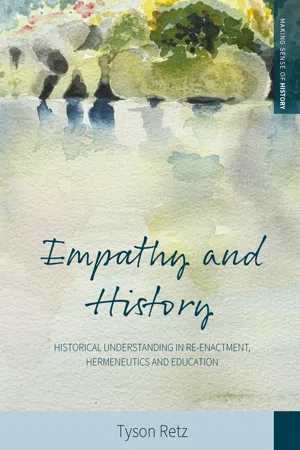
Empathy and History offers a comprehensive and dual account of empathy's intellectual and educational history. Beginning in an influential educational movement that implanted the concept in R.G. Collingwood's re-enactment doctrine, the book goes back to reveal the fundamental role that empathy played in the foundation of the history discipline before tracing its reception and development in twentieth-century hermeneutics and philosophy of history. Attentive to matters of practice, it illuminates the distinct character of the historical context that empathetic understanding seeks to capture and sets out a new approach to empathy as a special variety of historical questioning.
Trusted by 375,005 students
Access to over 1.5 million titles for a fair monthly price.
Amid the growing claims of natural science it is difficult to find a place for the teaching of history.
—James Bryce, 1907
CHAPTER 1
Reforming the Past
‘Foreigners tell us that in education, as in all else, we have no care for method’, wrote a founding member of the Historical Association, C.H.K. Marten, in an early symposium on the teaching of history.1 The foreigners he had in mind were Germans, where the rise of historicism and the nationalist proclivities of the Romantic movement had imbued history education with an anthropological purpose to discover the origins of humankind and human institutions.
In the spirit of British gradualism, by contrast, the so-called great tradition of history teaching in England worked under the assumption that a shared story, filled with moral and patriotic examples and drawn from a relatively agreed set of historical facts, could equip students with the knowledge needed for civic life and participatory democracy. As a record of good and evil done on the world, history supplied the content for a kind of moral training, where students found examples to emulate or abjure from the great men and women who lived in the past. The role of history teachers consisted in placing before the student instances of exemplary conduct and exploits. Delivered mostly in the style of an edifying homily, they had small reason to extend their practice beyond a drilling in dates, names and events. It was a tradition in which teachers didactically transmitted the facts of historical knowledge to passive students who demonstrated their mastery through repeated short tests. Indeed, for the first two-thirds of the twentieth century, W.C. Sellar and R.J. Yeatman’s caricature of English history, 1066 and All That, spoke a certain truth: ‘History is not what you thought. It is what you can remember.’2 The content to remember was mainly political history, with some social and economic aspects; it was mainly English, with some European, from Julius Caesar to the First World War.3
A sense that the subject was not meeting the demands of contemporary education began to seize history teachers in the 1960s. Martin Booth, the head of history at a Harlow comprehensive school, conducted a pioneering study inside four schools that suggested students had the ability to structure historical knowledge in ways that could make the subject ‘vital and relevant’. Booth worried that as the teachers of other school subjects appealed for more teaching time, the danger would grow that a ‘utilitarian society’ would treat the ‘impractical discipline of history with mild contempt’. He drove home the message that teaching methods required as much consideration as teaching content. For history to contribute to ‘creative, divergent thought’, learning in the subject had to be based on ‘independent activity’ rather than ‘unthinking receptivity’.4
Booth’s appeal for methodological innovation in school history came at a time when the practice of history in universities was becoming increasingly interdisciplinary. Historians since the interwar period had expressed their dissatisfaction with the nominalist individualism of mainstream English history. The rise of social history in the 1960s was fuelled by a recognition that history was richer and more explanatory when social theories were brought to bear on its subject matter.
Much of the initial impetus came from economic historians. R.H. Tawney argued in his inaugural lecture at the London School of Economics (LSE) in 1932 that individual historical phenomena contained elements in common with other phenomena and that generalization in the manner of the social sciences was therefore possible. ‘The generalisations of the historian, like those of the anthropologist and sociologist, take the form . . . not of propositions claiming universal validity, but of statements of the relations between phenomena within the framework of a specific epoch or civilisation.’5
Tawney’s LSE colleague, Eileen Power, in her own inaugural lecture the following year, pleaded further for historians to dispose of the view that historical facts could be known by purely inductive, intuitive reasoning, and to look forward instead to ‘a social science par excellence’ built upon a cooperation between anthropology, sociology, economics and history, open to deductive analysis and able to find ‘dependable uniformity and regularity’ in society.6 Her future husband and Cambridge economic historian, M.M. Postan, had reservations about the intellectual calibre of historians of ‘cautious and painstaking disposition’, whose ‘critical attitude to minutiae’ and the ‘unique and unrepeatable’ came at the expense of theoretical synthesis and scientific generalization. His target were the neo-Kantian philosophers of history, those who had ‘succeeded in spreading the view of history as an impregnable stronghold of non-scientific knowledge’ by defining it as a ‘vehicle of specific forms of cognition’.7 Though Postan did not name his neo-Kantian philosophers, he almost certainly had in mind Benedetto Croce, R.G. Collingwood and, particularly, Michael Oakeshott, whose Experience and its Modes spoke of historical experience as an abstract and defective ‘arrest’ of the totality of experience, which entailed a descriptive and nontheoretical historical practice. ‘History’, held Oakeshott, ‘is the narration of a course of events which, in so far as it is without serious interruption, explains itself . . . the method of the historian is never to explain by means of generalization but always by means of greater and more complete detail.’8
Marxist historians held similar concerns. Christopher Hill took aim at the Whig-liberal tradition of locating the source of historical explanation in the free will of the individual, admitting of ‘flights of fancy’, he believed, by divesting history of ‘ponderable, analysable, material factors’. It was a tradition worth exposing for Hill not because it any longer held respect in the academic world, but because it still informed most of the history taught in English schools: ‘the history, that is to say, of all but the specialist historians’.9 He articulated a moderate version of Marxism that could ‘help contemporary historians to preserve a sense of proportion between social forces and the men through whom they work, between statistics and poetry, necessity and freedom’.10 History could be reduced neither to the will of individuals, ‘great’ or otherwise, nor to the economic forces that produce political results. Maurice Dobb made the same point when he argued that Marxist materialism was an aid to research, a guide to problem-solving, a general hypothesis, not a substitute for history itself. ‘That the shaping of individuals by their social milieu and of social groups by their relations to the mode of production is a simple formula which can yield a direct answer to every historical problem’, he wrote, ‘no serious Marxist has ever maintained.’11
The vastly altered intellectual landscape of the 1960s was one in which a new generation of Marxist historians sensed a new optimism about history’s relevance for the present. This is part of the story told by Geoff Eley in his reflection on the state of historiography over the past four or five decades: ‘We saw it not only as an aid to effective political thinking but also as a tool for honing a critical social consciousness and for making our way toward a workable political ethos.’12 Critics of the empiricist tradition such as Gareth Stedman Jones wrote of a profession in ‘arrested intellectual development’, conceptually bankrupt and impervious to the syncretic advances in theory and practice transforming historiography elsewhere, particularly in France under the Annalistes and social thought of Althusser and Lévi-Strauss. Stedman Jones excoriated ‘the legacy of a tenacious and antique liberal individualism’ in English historical culture, the ‘scientific sermon’ that was history when accumulated facts provided the basis for moral lessons, the belief that theory or interpretations came to light after all facts had been collected, and in cases where sociological structures had been acknowledged as exercising an influence on individuals’ behaviour, that no concomitant attempt had been made to formulate the concepts for an expanded methodological repertory. He credited Carr with having finally made clear that the composition of facts appears differently depending upon the angle from which they are approached, but found his conception of history accounted inadequately for the ‘differential temporality of linked historical structures’, by which he concluded that it failed to illustrate how a heterogeneous theoretical practice, up to the task of dislodging the liberal orthodoxy, might look.13
However slow it was to take hold, methodological heterogeneity had entered the mainstream by 1971. It was ‘a good moment to be a social historian’, Eric Hobsbawm famously proclaimed.14 A ‘general historization’ of the social sciences had taken place in response to the immensely changed global circumstances that marked this period of human history. The struggles for political and economic emancipation in colonial and semicolonial countries drew the attention of governments, international and research organizations, and along with them social scientists, to what were problems of historic transformation. Hobsbawm celebrated the fact that these problems, previously at the margins of academic orthodoxy in the social sciences, were being taken up by a new generation of politically engaged social historians.15
In a separate essay appearing alongside a reprint of Stedman Jones’ assault on British empiricism, Hobsbawm attempted to correct the conventional errors of a pervasive ‘vulgar Marxism’.16 A crude economic determinism, a simple base-superstructure model of society, a view of history simply as the story of class struggle, a penchant for historical laws and a presumption of historical inevitability had to yield to a more sophisticated Marxism that brought history and the social sciences together to account for both stability and disruption, one that accommodated the individual by showing how human agency was at work in individuated societies, which sometimes controlled or refashioned economic determinants while at other times were controlled and refashioned by them. ‘It is equally important that internal tensions may sometimes be reabsorbed into a self-stabilizing model by feeding them back as functional stabilizers, and that sometimes they cannot.’17
Yet the view that each society had its own dynamic was not incompatible with the view that social history had a generalizing or totalizing potential, captured in the title of Hobsbawm’s Dædalus article, ‘From Social History to the History of Society’. Theory was needed to pull together its various modes and sites of social explanation. For the British Marxist historians assembled around Hobsbawm and the journal Past and Present, launched in 1952, this had been pursued by strengthening the international networks initiated at the 1950 International Historical Congress in Paris, where a Social History Section had been created, and made possible by the recent translation of classic and modern European theory, which was being integrated into undergraduate and graduate curricula. Eley understood while a student at Oxford in the late 1960s that history was insufficient by itself; it needed ‘theory’ enlisted from other disciplines. A core feature of the intellectual conjuncture that brought history into dialogue with the social sciences was its ecumenicism, an open-endedness of intellectual discovery also characteristic of the radical political movements of the time.18
The ferment of new ideas and approaches in economic, urban, social and family history spurred a considerable increase in the number of university-employed practitioners and PhD-inspired scholarship. Looking back on this period from an educational perspective, Alaric Dickinson has called it the ‘golden age’ of British history and British historians.19 Important works by professional historians included Christopher Hill’s The Century of Revolution 1603–1714 (1961), Asa Briggs’s Victorian People (1954), E.P. Thompson’s The Making of the English Working Class (1963), and Lawrence Stone’s The Crisis of the Aristocracy 1558–1614 (1965). These books appealed to a wide audience and, by Dickinson’s analysis, inspired many teachers and senior secondary school students. Significantly for school history, they challenged the traditional supremacy of political history that had long provided structural coherence to school history courses, and the shift in subject matter in general led to an upsurge of interest in the scholarly techniques of history.
These developments in historical practice and theorization affected the way teachers entering the profession imagined their task in the 1960s and 1970s.20 The installation of an enlarged methodological armoury made possible by the new openness to influences from sociology and anthropology, as well as an interest in the everyday experiences of the oppressed and dispossessed, transformed the concerns of academic historians and thus the content base of history degrees. Those graduates who went on to become history teachers entered the profession with a substantially different knowledge and conceptual set from those who had formed an understanding of history’s purpose and procedures in previous decades.
Particularly influential was the historian E.P. Thompson. His celebrated ambition to rescue the everyday person ‘from the enormous condescension of posterity’ enunciated a met...
Table of contents
Cover
Title Page
Copyright Page
Contents
Acknowledgements
List of Abbreviations
Introduction
Part I. Education
Part II. Origins
Part III. Consequences
Conclusion
Bibliography
Index
Frequently asked questions
Yes, you can cancel anytime from the Subscription tab in your account settings on the Perlego website. Your subscription will stay active until the end of your current billing period. Learn how to cancel your subscription
No, books cannot be downloaded as external files, such as PDFs, for use outside of Perlego. However, you can download books within the Perlego app for offline reading on mobile or tablet. Learn how to download books offline
Perlego offers two plans: Essential and Complete
Essential is ideal for learners and professionals who enjoy exploring a wide range of subjects. Access the Essential Library with 800,000+ trusted titles and best-sellers across business, personal growth, and the humanities. Includes unlimited reading time and Standard Read Aloud voice.
Complete: Perfect for advanced learners and researchers needing full, unrestricted access. Unlock 1.5M+ books across hundreds of subjects, including academic and specialized titles. The Complete Plan also includes advanced features like Premium Read Aloud and Research Assistant.
Both plans are available with monthly, semester, or annual billing cycles.
We are an online textbook subscription service, where you can get access to an entire online library for less than the price of a single book per month. With over 1.5 million books across 990+ topics, we’ve got you covered! Learn about our mission
Look out for the read-aloud symbol on your next book to see if you can listen to it. The read-aloud tool reads text aloud for you, highlighting the text as it is being read. You can pause it, speed it up and slow it down. Learn more about Read Aloud
Yes! You can use the Perlego app on both iOS and Android devices to read anytime, anywhere — even offline. Perfect for commutes or when you’re on the go. Please note we cannot support devices running on iOS 13 and Android 7 or earlier. Learn more about using the app
Yes, you can access Empathy and History by Tyson Retz in PDF and/or ePUB format, as well as other popular books in Education & Education Theory & Practice. We have over 1.5 million books available in our catalogue for you to explore.