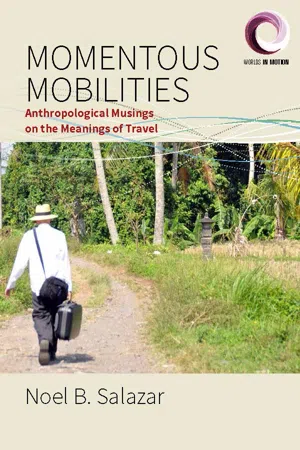
Grounded in scholarly analysis and personal reflection, and drawing on a multi-sited and multi-method research design, Momentous Mobilities disentangles the meanings attached to temporary travels and stays abroad and offers empirical evidence as well as novel theoretical arguments to develop an anthropology of mobility. Both focusing specifically on how various societies and cultures imagine and value boundary-crossing mobilities "elsewhere" and drawing heavily on his own European lifeworld, the author examines momentous travels abroad in the context of education, work, and spiritual quests and the search for a better quality of life.
- 194 pages
- English
- ePUB (mobile friendly)
- Available on iOS & Android
eBook - ePub
About this book
Trusted by 375,005 students
Access to over 1.5 million titles for a fair monthly price.
Study more efficiently using our study tools.
Information
PART I
IMAGINING MOBILITY
CHAPTER
1
Chile
Traveling to and from the End of the World
I spent the very end of the previous millennium in the Southern Hemisphere. My Chilean partner and I traveled to Patagonia, at the southern tip of the Americas. We landed in Punta Arenas, a city that had functioned as an important refueling port for the steamships that traveled between the Atlantic and Pacific Oceans through the Strait of Magellan, until the opening of the Panama Canal in 1914. Today, it is used mostly by tourism cruises and as a jumping-off point for scientific expeditions to Antarctica. Having just read Adrien de Gerlache’s Fifteen Months in the Antarctic ([1902] 1998), I thought about the Belgian Antarctic expedition that had departed from Punta Arenas one century earlier. The legendary research ship Belgica had had on board, among others, the anthropologist-explorer Frederick Cook (whose later claim of having reached the geographic North Pole earlier than Robert Peary is disputed still today). The Belgica became trapped by surrounding pack ice and was the first vessel to stay over the winter months in the Antarctic, after which it safely returned to Punta Arenas for repairs. Numerous testimonies of explorers and traders alike helped to create the image of Chile as a “cold” place (as opposed to the stereotypical representation of South America as “tropical”).
Like most people visiting Patagonia nowadays, my partner and I were there as tourists. We traveled along the Chilean shore, inspired by Michael Palin’s voyage around the rim of the Pacific Ocean (aired as the 1997 BBC documentary television series Full Circle). We boarded a cargo ship in Puerto Montt for a four-day trip down south to Puerto Natales. Like Palin, we hiked through the Torres del Paine National Park. The desolate landscapes along the coastline reinforced my own image of Chile as being at the “end of the world.” However, this interpretation had to be qualified when on the second day of the boat journey somebody tapped on my shoulder as we were queuing in the galley to have breakfast. I could not believe my eyes when I saw one of my Belgian classmates from university. She was also touring the region. Chile immediately became much less “end of the world”-ish for me.
***
As my own travel experience in Patagonia illustrates, people seldom journey to terrae incognitae anymore, but to places they already virtually “know” through the widely circulating imaginaries that exist about them (Salazar 2010a; 2012). According to Edward Said (1994), “imagined geographies” refer to how places are imagined, how meanings are ascribed to physical spaces, how knowledge about these places is produced, and how these representations make various courses of action possible. Historically laden imaginaries—socially shared and transmitted representational assemblages that are used as meaning-making devices—are the “energetic source” (M. Baeza 2008: 24) that inspires social life, including physical travels to distant destinations. One of the central characteristics of such imaginaries is the lack of correspondence between the projected ideals and aspirations on the one hand and the perceived and experienced reality on the other (e.g., the “American dream”).
In this chapter, I discuss historical as well as contemporary examples to illustrate the power of imaginaries in shaping people’s (im)mobility. I carried out fieldwork and archival research in Chile in December 2009–January 2010 (supplemented with data and experiences from previous visits to the country since 1998, including the one reported above). The method used involved various types of free-flowing interviews with key informants and other significant actors in the broad field of transnational mobility. Ancillary data gathered include secondary sources, audiovisual data, news media, documents, archives, websites, etcetera. In addition, I took exhaustive notes and made personal diary entries to record all my findings. A female Chilean graduate student in anthropology from the University of Chile helped as my local research assistant, both in the phase of data gathering (e.g., conducting interviews) and data analysis (e.g., coding interviews).
Chile is a long (2,670 miles/4,300 kilometers) and narrow (on average 108 miles/175 kilometers) strip of land between the Andes Mountains to the east and the Pacific Ocean to the west, the Atacama Desert in the north and the icebergs of Patagonia in the south. This “crazy geography” (Subercaseaux 1973) has not only determined its territorial borders, but also influenced the imaginaries that people, Chileans and foreigners alike, have about this Latin American country and the mobilities to and from it (Salazar 2013b). My findings reveal the remarkable influence that dated outsider imaginaries of Chile as “the end of the world” have on how contemporary Chileans participate in and frame their perceived exclusion from a plethora of contemporary mobilities, regardless of whether they have the actual means and freedom to cross imaginary boundaries and physical borders or not. The recent historical episode of Chileans in exile further complicates the story.
The End of the World (as People Know It)
Ours is a land far away, the farthest of the Western Hemisphere, a real Finisterrae. This remoteness … turned our land a long time ago into a fertile ground for legends in the eyes of Europeans.
—Luis Oyarzún, in Cecilia García-Huidobro Mac Auliffe, Tics De Los Chilenos
Prior to the arrival of the Spanish colonizers in the sixteenth century, northern Chile was under Inca rule, while various Mapuche groups inhabited the central lands and southern islands. The origin of the word Chile is contested. One among many possible linguistic genealogies is the Aymara concept chilli (where the world ends). For the Aymara, an indigenous group living in the Andes and the Altiplano, it made sense to denote the lands southwest of theirs as the end of their lifeworld. The Spanish had done the same in Europe, calling the westernmost point of the Iberian Peninsula Cabo Fisterra (Cape Finisterre). However, these geographical imaginaries drastically changed when Iberians discovered in the fifteenth century that, far beyond their western “edge of the world,” there was another land: America. From that moment onward, the so-called New World became one of the most popular places onto which Europeans could project their wildest images and ideas of paradise on earth (Fernández Herrero 1994; Scott 2010).
In the age of these discoveries, the whole of the Americas fulfilled the legendary role of the “end of the world.” As the conquest progressed, North and Central America gradually lost their mythical qualities, and the European imaginary of the end of the world moved from the “Far West” to the “Far South” (Franz 2000). The Captaincy General of Chile (part of the Viceroyalty of Peru), established by Spanish conquistadors in the 1540s, developed as a small and neglected agrarian colony on the fringe of the Spanish American empire (Collier and Sater 2004) (see figure 1.1). As Ana Maria Stuven (2007: 47) writes, “For the Spanish Empire, Chile was one of the least important colonies; it was extremely far from the centers of power and it was a region of intermittent warfare. Who wanted to go to Chile? Very few. And this inevitably influenced and still influences the Chilean character.”
The Spanish conquistadors were among the first migrants arriving in Chile, but they are not usually acknowledged and named as such (Cano and Soffia 2009). During the sixteenth and seventeenth centuries, Chile received many Spanish migrants, together with a small group of slaves of African descent. British and French traders only started arriving in the eighteenth century. Most scholars, however, start employing the concept of migration only when Chile gains independence and starts welcoming European soldiers and maritime traders, which in turn facilitated the spontaneous arrival of other Europeans. Many European governments sponsored permanent relocation to Chile. The waves of migrants who left Europe between 1850 and World War I helped to reinvigorate the “foundational spirit” of the Promised Land.
Despite these historical mobilities, Chile developed as a socially and culturally insular country unaccustomed to the presence of large numbers of “foreigners.” Many of the descriptions of Chile refer to the extreme south for the simple reason that, prior to the opening of the Panama Canal in 1914, the Strait of Magellan was the main route for steam ships traveling from the Atlantic Ocean to the Pacific. The first Chilean governments had two main motives in attracting European migrants: the colonization of the inhospitable south of the country (finishing the task that the Spanish colonizers had begun) and the widespread belief that Europeans, as hard workers, would automatically bring development in tow (including “improving the race” and modernization). The years between the 1907 and 1952 censuses are notable for the growth of a migrant population of Arabs (fleeing conflicts in the Ottoman Empire, which then included Syria, Palestine, and Lebanon) and Asians, arriving more spontaneously. Responding to a changed context—the industrialization of the 1940s and the end of World War II—Chile no longer needed colonizers but sought specific types of economic migrants. Politics, however, would drastically change the course of the country.

Figure 1.1: The beginning of the “end of the world.” An Andean border crossing between Bolivia and Chile. (Photographer: Noel B. Salazar)
The (Im)Mobility of Exile
In my luggage from exile, I bring fraternal friendship from other lands.
I leave behind sorrow and sleepless nights. I return to live wholly again.
I leave behind sorrow and sleepless nights. I return to live wholly again.
—Vuelvo para Vivir (Illapu, 1991)
Through the relatives and acquaintances of my Chilean spouse, I have been confronted directly with Chile’s issue of political exile. Señora Consuelo, for example, was leading a quiet life in the southern city of Concepción, without any interest in what was happening outside her geographically limited lifeworld. At the age of twenty, she got married to Jorge, who was very engaged locally as a member of the Communist Party. In 1974, a year after the military coup, Consuelo and Jorge came to know that Jorge was on a black list and at risk of being thrown in jail, so the family decided to escape. Their children, Patricio and Elizabet, were respectively one and three years old at the time. The family spent three years in Argentina, but as state violence was on the rise there too, they had to move again. After spending a short time in Venezuela, they finally arrived in Canada. They felt very welcomed by both the Canadian people and the government and settled down. The contact with family and friends in Chile was minimal because phone calls were very expensive and snail mail was not very trustworthy. In 1983, with the Chilean borders opening a little again, they traveled back to their native country. What officially looked like a holiday was in practice a trip to check whether it was at all feasible for them to return permanently. They hesitated, but felt the time was not ripe yet.
In 1989, the year that democracy was reinstalled in Chile, Consuelo regained her personal freedom and was granted a divorce from Jorge. A year later, when Patricio and Elizabet had both finished high school, the three of them returned to Chile. Elizabet could not settle emotionally and almost immediately returned to Canada; Patricio stayed with an uncle in Santiago while studying at university; and Consuelo moved back to her beloved Concepción. Patricio never finished his studies and stayed with his mother in Concepción for a couple of years before moving back to Canada. Consuelo felt torn between two worlds: the one in Canada that was inhabited by her children (and, as time passed, grandchildren) and the one occupied by her family and friends in Chile. She tried to move her permanent residence once more to Canada but felt socially isolated and too dependent on Patricio and Elizabet. Today, Consuelo leads an “international” lifestyle: she officially lives in Chile but keeps on shuttling back and forth regularly between the two countries. I met her or her children on various occasions in both countries.
***
The dramatic political changes of the early 1970s turned Chile from an immigrant to an emigrant nation. During the economic and political crisis that followed the 1973 coup, hundreds of thousands of Chileans chose to flee the repressive political regime of General Augusto Pinochet or were forced into leaving.1 In fact, Chile became known internationally not for the flow of people into its borders (never more than two per cent of the total population) but in relation to the many Chileans who left (Martínez Pizarro 2003).
During the first years, thousands of people sought refuge nearby (in Argentina and Peru, but also in Paraguay and Uruguay), expecting to be able to return before long. The passage of time erased the illusion of a brief dictatorship, but even in former times, neighboring countries proved unsuitable for most Chileans (Wright and Oñate Zúñiga 2007). For those forced to leave, the main determinant of their exile destination was chance: international agencies paired these refugees with willing host countries, some of them real terrae incognitae about which the exiles knew little or nothing. Exiles were sent to over a hundred countries, spread over every continent. Many ended up in Canada, Sweden, Italy, France, Australia, and the United States. During the period 1973–85, between 500,000 and 1,000,000 Chileans, around 10 per cent of the population, left the country (Jedlicki 2001). While around 250,000 people were forced to move, others left voluntarily.2 This diaspora radically changed the relation Chile developed with the wider world “out there” (see below).
While even as early as 1983 lists were published with Chileans who could return, forced exile officially ended only in 1988. Until that time, exile was characterized by a double flow of people entering and leaving the country. Exiles kept the dream of return alive and, as the period of exile was extended, Chile became a mythical “homeland.” For the first generation, living abroad involved drastic shifts in status, often in the form of downward social mobility. The inability to return progressively changed the experience of temporary asylum to a state of prolonged exile. As Chilean exiles in Brussels and elsewhere told me, the feeling of displacement, as a hallmark of exile, has both spatial and temporal dimensions. During the military regime, they felt uprooted, as if they were living between two places simultaneously: “here” (the country of exile) and “there” (the imagined homeland). At the same time, they had the sensation that time had been suspended and exile was just a liminal phase they had to undergo prior to their returning home. Most Chileans, like other people in exile, had their suitcases ready to make the return trip at a moment’s notice (Rebolledo and Acuña 2001).3
From a mobility perspective, exiles are a special case. They are mostly forced to leave their country (“involuntary mobility”) and are not allowed to return (“involuntary immobility”). However, if the period of exile lasts long enough, many opt for not returning (“voluntary immobility”) or for moving on to new destinations (“voluntary mobility”).4 Although envisioned as highly desirable, the (attempted) return often leads to a clash between the imagined “homeland” and the transformed reality on the ground. Many retornados, for instance, upheld the image of the mythical Chile after their return, despite t...
Table of contents
- Cover
- Title Page
- Copyright Page
- Dedication
- Contents
- List of Illustrations
- Foreword
- Preface
- Introduction Mapping Mobility
- Part I. Imagining Mobility
- Part II. Enacting Mobility
- Conclusion Mobile Futures
- References
- Index
Frequently asked questions
Yes, you can cancel anytime from the Subscription tab in your account settings on the Perlego website. Your subscription will stay active until the end of your current billing period. Learn how to cancel your subscription
No, books cannot be downloaded as external files, such as PDFs, for use outside of Perlego. However, you can download books within the Perlego app for offline reading on mobile or tablet. Learn how to download books offline
Perlego offers two plans: Essential and Complete
- Essential is ideal for learners and professionals who enjoy exploring a wide range of subjects. Access the Essential Library with 800,000+ trusted titles and best-sellers across business, personal growth, and the humanities. Includes unlimited reading time and Standard Read Aloud voice.
- Complete: Perfect for advanced learners and researchers needing full, unrestricted access. Unlock 1.5M+ books across hundreds of subjects, including academic and specialized titles. The Complete Plan also includes advanced features like Premium Read Aloud and Research Assistant.
We are an online textbook subscription service, where you can get access to an entire online library for less than the price of a single book per month. With over 1.5 million books across 990+ topics, we’ve got you covered! Learn about our mission
Look out for the read-aloud symbol on your next book to see if you can listen to it. The read-aloud tool reads text aloud for you, highlighting the text as it is being read. You can pause it, speed it up and slow it down. Learn more about Read Aloud
Yes! You can use the Perlego app on both iOS and Android devices to read anytime, anywhere — even offline. Perfect for commutes or when you’re on the go.
Please note we cannot support devices running on iOS 13 and Android 7 or earlier. Learn more about using the app
Please note we cannot support devices running on iOS 13 and Android 7 or earlier. Learn more about using the app
Yes, you can access Momentous Mobilities by Noel B. Salazar in PDF and/or ePUB format, as well as other popular books in Social Sciences & Cultural & Social Anthropology. We have over 1.5 million books available in our catalogue for you to explore.