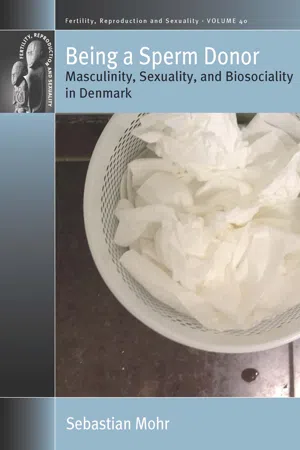
What does it mean to be a man in our biomedical day and age? Through ethnographic explorations of the everyday lives of Danish sperm donors, Being a Sperm Donor explores how masculinity and sexuality are reconfigured in a time in which the norms and logics of (reproductive) biomedicine have become ordinary. It investigates men's moral reasoning regarding donation, their handling of transgressive experiences at the sperm bank, and their negotiations of gender, sexuality, intimacy, and relatedness, showing how the socio-cultural and political dimensions of (reproductive) biomedicine become intertwined with men's intimate sense of self.
Trusted by 375,005 students
Access to over 1.5 million titles for a fair monthly price.
Before men are accepted as sperm donors by Danish sperm banks, they have to undergo various tests. Among those are, of course, assessments of semen quality but also blood and genetic tests, physical exams, and not least evaluations of their personal integrity through a series of interrelated interviews. While these tests and personal meetings serve the purpose of reassuring sperm banks that a sperm donor candidate will comply with what is expected of him and that he exhibits the responsibility that is deemed necessary in order to be a sperm donor (Graham, Mohr, and Bourne 2016; Mohr 2010), going through these tests and evaluations might also be understood as a more formal process of initiation into becoming a sperm donor and thereby an important part of biosocial subjectivation. Understood as a rite of passage in Arnold van Gennep’s sense of a set of practices that ensures the successful change of a person’s affiliation and belonging (Van Gennep 2004), this initial testing and evaluation could be comprehended as calling the biosocial self into being. It is at this stage before actually being accepted as a sperm donor that men might be thought of as undergoing a transformation of their sense of self, identification, and belonging.
To give you an idea of what this process looks like and to provide you with ethnographic grounding for the conceptual pathways that will follow, I want to present you with a rather lengthy note from my fieldwork at Danish sperm banks describing a meeting between a donor coordinator and a sperm donor candidate. These meetings take place before men are accepted as sperm donors and represent formal interviews during which men have to answer questions in regard to their medical and genetic history, and during which staff tests men’s commitment to being a sperm donor. What is of importance here are the ways in which the biosocial self is called into being during these interviews—a careful and continuous invocation of the subject in terms of biomedical registers and biopolitical valuations:
Stine, the donor coordinator, sits at the table across from Jonas, a donor-candidate in his early twenties. Jonas had been called in for an interview because his initial semen sample had passed the required threshold for semen quality. As with all other donor applicants, his ejaculate needed to have a sperm count of at least 200 million sperm cells per milliliter, since it is not very likely that enough sperm cells will survive the freezing process at a sperm count lower than that, as I have been repeatedly told by laboratory staff. While these technical details are not necessarily part of conversations between staff and donor-candidates, the awareness that only a few men’s semen samples make the grade certainly is.
Stine tells Jonas that his first semen sample had turned out to be of good quality; a piece of information that Jonas accepts with visible appreciation saying: “That is great!” Stine starts the question and answer section of the interview with an inquiry about Jonas’ educational background. Jonas tells her that he is currently working as a volunteer in a social work project after having finished his so-called studentereksamen, a formal secondary school degree giving access to university education, and that he has applied for a business administration program at a local university. Going through the questionnaire, which Jonas had filled out before the interview, item by item, Stine moves on to Jonas’ eye color. Jonas leans in over the table and Stine checks the color of his eyes. “You have green eyes! That is very rare,” she exclaims.
Moving further in the questionnaire, Stine then asks about sexually transmitted diseases: “You state here that you have had chlamydia. Is that correct?” “Yes,” says Jonas, explaining that that had been the result of teenage carefreeness. Not probing his explanation any further, Stine moves on to Jonas’ visits to foreign countries. As certain destinations are categorized as having higher rates of infectious diseases, especially sexually transmittable ones, men who travel frequently to these destinations are thought to be at risk of exposure and thus make rather unreliable candidates. “I have been in Greenland and in New Zealand,” says Jonas, locations which do not spark a reaction from Stine.
She then wants to know whether Jonas wants to be an anonymous or non-anonymous donor. “Originally, I had thought about being anonymous but now I think I want to be an open donor,” Jonas explains. Stine then provides more details about the open donor program, pointing out that the children conceived with his semen would be able to contact him when they are eighteen years of age, a situation which could potentially be uncomfortable, she adds. “What does that contact look like,” asks Jonas now seemingly less sure about his decision than just a moment ago. Stine answers with an explanation that I have heard her giving also to other donor applicants in similar situations: “Well, what the contact looks like really depends on how the children and the individual donor handle the situation.” In a more reassuring tone, she then adds: “But the contact would be arranged through us,” to which Jonas obviously relieved replies: “Oh, okay, it is just one contact.”
Without dwelling any further on the subject of possible contact to donor-conceived individuals, Stine moves on to elaborate on the more practical arrangements, which Jonas has to adhere to as a sperm donor: he would have to respect a period of abstinence of last at least forty-eight hours in between semen samples. However, he would be able to donate whenever he pleases during business hours as long as he donates at least once a week or four times within one month. In case he wants to go on vacation, he should inform the staff so that they know not to expect any samples from him during that time. He would also have to supply blood samples on a regular basis so that his semen samples can be released from quarantine. Blood samples would be taken every three months. For each semen sample, he would get 300 Danish krone (about 40 euros), 200 whenever he stops by to provide a sample and the rest once the samples have been approved and released through blood tests. Should the blood tests show any irregularities, he would be contacted: “If there is anything out of the ordinary, we will let you know.” Stine then explains what Jonas would be tested for: HIV, HTVL (human T-lymphotropic virus), hepatitis, syphilis, gonorrhea and “of course also chlamydia, which you already have experience with.” They would also do a full karyotype, Stine continues, and they would specifically test for cystic fibrosis.
Jonas’ only reactions throughout all of these elaborations are an occasional “Yes” or “That’s fine,” reactions that I have seen most other donor-candidates exhibit as well. Stine then mentions the donor profile and the extended information that Jonas needs to supply so that future customers can get an idea of what kind of man he is, and lets him know that he can fill out that specific paperwork at home. “And make sure that you save all your health and medical information since we will be asking for it again.” As a donor Jonas would have to regularly answer questions about his health and medical status: “We are evaluating you as a donor at all times.” Stine then turns to Jonas’ family medical history: “I am assuming that you are well and healthy,” she wants to know. “There has never been anything wrong with me,” Jonas replies. He adds that his sister is overweight. Stine wants to know by how much. He explains that his sister would not have any problems in her daily life; she would just weigh more than other people. Jonas answers all of Stine’s questions in regard to his family members’ individual medical history and possible causes of death with the help of a piece of paper that contains information about his relatives and which he must have prepared at home on the computer and then printed out to take with him to the interview. He looks at this piece of paper again and again and then checks what Stine enters into her computer by looking at the screen in front of him and Stine. Jonas mentions that his mother has an allergy: “But neither my sister nor I have had any symptoms,” he reassures Stine. His uncle has had heart problems: “But he was a drug and alcohol addict, so this was clearly due to his lifestyle,” Jonas explains and adds that a genetic test which his mother has had done revealed that this heart problem was not hereditary. “It could very well be that our geneticist will want to know more about this,” Stine says. “That is absolutely fine,” Jonas answers.
At the end of the family medical history, Stine goes over each of Jonas’ answers one more time to make sure that all the information she entered into her computer is correct. Once this is done, Jonas folds the piece of paper he has been using to answer all the questions and puts it back into his pocket. Stine then takes two pictures of Jonas, one from the front and one from the side, which would be used in case staff would have to match Jonas phenotypically to the partner of a future customer. A test for whether Jonas is colorblind is next. With the help of a small book that contains images consisting of different colored dots representing lines, figures, and numbers, Stine asks Jonas to identify the specific representation on each page. Jonas is apparently not colorblind since he gives only right answers.
Finally, Stine reminds Jonas that it would be his responsibility to declare the compensation he receives for his semen samples to the tax authorities. Jonas nods and then signs a form declaring that he has received this information. He also signs all of the other paperwork: consent forms, the contractual agreement, and release forms. At the end of the interview, Stine says to Jonas that she will be in touch with him once the geneticist has gone through all of his medical information and once the semen sample he has delivered today has been assessed: “And in case it shouldn’t be as good as the first one, you will hear from us.”
While these interviews can vary in length, and even though their details might change depending on the individual donor applicant’s history and the questions he has, the above fieldnote nevertheless shows what such first encounters between men applying to be a sperm donor and staff interviewing them usually look like. I provided this rather lengthy fieldnote because these first encounters give an understanding of what men who become sperm donors face for the rest of their lives: a continuous process of biosocial subjectivation, that is, the careful and persistent invocation of their subjectivity in terms of biomedical registers and biopolitical valuations. As becomes clear in the meeting between Stine and Jonas, it is not so much Jonas’s possible interests in computer games, art history, or horseback riding or his potential melancholic or cheerful self-perception that are of interest, but rather biomedical registers such as his infection status, his disease history, and his genetic makeup. It is through registers such as these that Jonas becomes a recognizable subject at the sperm bank, someone who is identifiable within the organizational and biomedical logic of contemporary reproductive medicine.
These kinds of registers are certainly not the only ones at play when becoming a sperm donor. However, they definitely determine whether a man can become a sperm donor in the first place, and whether he is allowed to continue to donate semen for a longer period of time. As Stine points out to Jonas during the interview, he will be continuously evaluated as a sperm donor, among other things by means of blood and genetic tests, assessments of his semen quality, regular medical exams, and recurring checks of his medical history, with the measurable results of these tests providing the evidence base for the continuous evaluation of Jonas’s performance as a sperm donor. What is more, the importance of biomedical knowledge about Jonas and the need to carry out tests of his biomedical condition are connected to the invocation of his subjectivity in terms of biopolitical valuations. Providing access to his bodily fluids, his medical history, and his genetic makeup are regarded as necessary steps if the protection of life—the children conceived with the help of Jonas’s semen—is to be guaranteed, and it is Jonas’s willingness to participate in the protection of life—by signing consent and release forms—that is seen as an expression of his commitment to the value of reproduction. As a sperm donor Jonas is expected to take responsibility for his actions—sticking to the abstinence period, staying away from risky behavior, and living a healthy life—thereby signaling his commitment to the value of life itself (Rose 2001).
Understanding this first encounter between men who want to become sperm donors and staff at Danish sperm banks as a rite of passage into sperm donor selfhood and thus as an important part of biosocial subjectivation, I am building on insights into processes of subjectivation and the formation of subjects in biomedical contexts within feminism (Franklin 1997; Martin 2001; Rapp 1999), medical anthropology (Heath, Rapp, and Taussig 2004; Petryna 2002; Rabinow 1996), medical sociology (Conrad 1992; Rosenfeld and Faircloth 2006; Zola 1972), and science and technology studies (Clarke et al. 2003; Hoeyer 2013; Rose 2007) as they have developed since the 1970s. While it will be impossible to cover the vast literature on what could be summarized as biosocial subjectivation or biosocial subjects, I nevertheless want to retrace how I understand biosocial subjectivation by laying out some of this literature in more detail. Following these attempts to map how I think of biosocial subjectivation, I want to bring this scholarship on biosociality into discussion with theories of gender and sexuality in order to explicate what I mean by the enticement of gender, what it has to do with biosocial subjectivation, and how it plays out in the lives of Danish sperm donors.
Biosocial Subjectivation
Within ethnographic scholarship the idea of biosociality developed at the end of the 1980s and the beginning of the 1990s, a time when molecular genetics and reproductive biomedicine had made their way into public consciousness as medical technologies with the possibility of altering the course of life itself (Flower and Heath 1993; Franklin and McNeil 1988; Rabinow 1994; Rapp 1988). This was a time when the use of reproductive biomedicine was still framed as a novel approach to building a family (Edwards et al. 1993; Strathern 1992) and when the ready availability of personal genetic testing (Klotz 2016; Palsson 2012; Richards 2010) had not yet become an ordinary part of people’s identities and social relations. When biosociality made its debut as a conceptual term in the writing of Paul Rabinow (Rabinow 1996), scholarly discussions concerned the potential of medico-technological developments to do away with onto-epistemological truth claims such as nature being the unaltered opposite sphere of culture and human social relations representing a naturally gendered and sexualed order of the world (Haraway 1991; Latour 1993; Strathern 1995). While Paul Rabinow was thus surely not the first to invoke the idea of a possible new way of living due to developments in science and technology, he did offer a conceptual term—biosociality—that captured both the societal and cultural changes in light of these medico-technological advancements as well as their repercussions for how people would come to understand themselves and their social relations.
In his well-known essay “Artificiality and Enlightenment: From Sociobiology to Biosociality,” first published in 1992, Rabinow makes the argument that molecular genetics will reshape society in a fundamental way by becoming part of “the social fabric at the micro level” and by giving rise to “a circulation network of identity terms and restriction loci” (Rabinow 1996: 98–99). In this society, sociality would no longer be a representation of nature (sociobiology), but rather sociality would itself be an ordering dimension of nature; that is, nature would be remade through sociality (biosociality), and biosociality would become “a prime locus of identity—a biologicalization of identity . . . understood as inherently manipulable and re-formable” (Rabinow 1999: 13). Developing his argument through a discussion of the Human Genome Initiative, Rabinow suggests that biosociality would constitute itself through, for example, groups of people developing social collectives around certain genetic conditions, a way of socializing based on an awareness of the social potency of biological states and on a will to act on this awareness (e.g., Finkler 2000; Gibbon 2007; Gibbon and Novas 2008; Trundle and Scott 2013). Influenced by Michel Foucault’s idea of biopower (Foucault 1990), Rabinow offers the term biosociality “as an initial attempt at framing the issues of a re-problematization of ‘life’” (Rabinow 2008: 188), a perspective that focuses on a new form of power “that exerts a positive influence on life, that endeavors to administer, optimize, and multiply it, subjecting it to precise controls and comprehensive regulations” (Foucault 1990: 137). From such a perspective, contemporary sociality becomes understandable both in terms of its biomedical registers and biopolitical valuations and in terms of its particular mode of subjectivation, that is, the making of subjects committed to an improvement of life and health on behalf of themselves, those whom they associate with, and not least the social body as a whole. This mode of subjectivation is central to the workings of biopower since it exerts its efficacy by bringing individuals “to work on themselves, under certain forms of authority, in relation [to] truth discourses, by means of practices of the self, [and] in the name of . . . life or health” (Rabinow and Rose 2006: 197).
Following Rabinow’s initial use of biosociality, a concept that he never intended to describe a universal truth (Rabinow 2008), a number of terms appeared within anthropology, sociology, and Science and Technology Studies that in one way or another capture similar dimensions of what Rabinow alluded to with biosociality: bioidentity (Waldby et al. 2004), genetic citizenship (Heath, Rapp, and Taussig 2004), biological citizenship (Petryna 2002; Rose and Novas 2005), biomedicalization (Clarke et al. 2010; Clarke et al. 2003), bio-objectification (Vermeulen, Tamminen, and Webster 2012), bioconstitutionalism (Jasanoff 2011), and the biofinancial subject (French and Kneale 2012) only to name a few. While each of these terms has its own specific origin and analytical focus, what they have in common with the concept of biosociality is an interest in the dynamics of biopower in contemporary society as Foucault initially developed it and, as a result, also an interest in the ramifications of biopower for the development of individual and collective identity. I want to go into detail with two of these terms—biomedicalization and biological citizenship—since they lend themselves for a further elaboration of what I mean by biosocial subjectivation.
While biomedicalization as a term had already made its debut at the end of the 1980s and the beginning of the 1990s (Cohen 1993; Estes and Binney 1989; Vertinsky 1991), conceptually it was more fully developed by Adele Clarke and colleagues at the beginning of the 2000s (Clarke and Olesen 1999; Clarke et al. 2003). Biomedicalization describes “the transformations of both the human and the nonhuman made possible by . . . technoscientific innovations” understood as “multisited, multidirectional processes of medicalization” (Clarke et al. 2003: 162). What comes into focus here is biomedicine’s role as an institution of social control and regulation as well as its potential to transform contemporary sociality and processes of identity formation. In light of the importance of biomedicine and biotechnology in contemporary society, Clarke and colleagues offer biomedicalization as a reformulation of the medicalization thesis as it has developed within medical sociology since the early 1970s (Conrad 1975; Zola 1972). Medicalization describes the processes by which social phenomena are understood, defined, and treated as problems in need of medical attention. Even though medicalization is more often than not used as a descriptive term for the (negatively positioned) extension of medicine’s power in all of social life, the original proposition of medicalization as an analytical pathway in medical sociology encompassed both the authoritative incorporation of social issues under the umbrella of medical responsibility and the willingness of individuals and society to expand medical expertise on everyday life. In his now classical text on medicine as an institution of social control, Irving Zola writes that the “‘medicalizing of society’ is as much a result of medicine’s potential as it is of society’s wish for medicine to use that potential” (Zola 1972: 500). In the original conceptualization of medicalization, the expansion of medical influence was thus not conceived of as being only the result of authoritative power, but rather as a consequence of a dispersion of medical potentiality as part of (self-)governance.
This notion of dispersing medical potentiality is important for an understanding of biosocial subjectivation. Whereas much of the literature on biomedicalization tends to focus on the negative effects of medicalization and is inclined to draw a picture of an all-encompassing medical jurisdiction over contemporary sociality (Brubaker and Dillaway 2009; Rafalovich 2013), it is important to recognize that biomedicalization is never complete and that medicalizing dynamics are very likely to be accompanied by demedicalizing counter currents (Conrad 1992, 2007). Moreover, biomedicalization is not inherently negative as some of the literature seems to suggest, nor does it only work through a top-down power model. Rather, biomedicalization is probably most likely to be effective when it incites new kinds of agencies within individuals and provides them with new possibilities to take on authoritative positions in their own life courses (Earp, Sandberg, and Savulescu 2015; Petersen, Nørgaard, and Traulsen 2015), since that is what biopower is all about, namely, the incitement to discourse as Michel Foucault termed it and not the subordination to it. In this sense, then, the production of what Clarke and colleagues call technoscientific identities, that is, identities “produced through the application of sciences and technologies to our bodies” (Clarke et al. 2003: 182), rests on the performative effects of biosocial subjectivation—the continuous invocation of a subject position through an incitement to discourse in terms of biomedical registers and biopolitical valuations.
Similar points are made in the literature on biological citizenship as it emerged at the beginning of the 2000s (Novas and Rose 2000; Petryna 2002, 2004; Rose 2001, 2007; Rose and Novas 2005). In her ethnography of nuclear disaster survival in Ukraine, Adriana Petryna coins the term biological citizenship to describe the mobilization of Ukrainian Chernobyl survivors around “radiation-induced injuries” reflecting “a massive demand for but [simultaneously also] selective access to a form of social wel...
Table of contents
Cover
Title Page
Copyright Page
Contents
Acknowledgments
Introduction: Being a Sperm Donor
Chapter 1. Becoming a Sperm Donor: Conceptual Pathways
Chapter 2. Regimes of Living: Donating Semen and the Pleasure of Morality
Chapter 3. Affective Investments: Masturbation and the Pleasure of Control
Chapter 4. Biosocial Relatedness: Being Connected and the Pleasure of Responsibility
Chapter 5. The Limits of Biosocial Subjectivation: Male Shame and the Displeasure of Gender Normativity
Conclusion: Biosocial Subjectivation Reconsidered
Bibliography
Index
Frequently asked questions
Yes, you can cancel anytime from the Subscription tab in your account settings on the Perlego website. Your subscription will stay active until the end of your current billing period. Learn how to cancel your subscription
No, books cannot be downloaded as external files, such as PDFs, for use outside of Perlego. However, you can download books within the Perlego app for offline reading on mobile or tablet. Learn how to download books offline
Perlego offers two plans: Essential and Complete
Essential is ideal for learners and professionals who enjoy exploring a wide range of subjects. Access the Essential Library with 800,000+ trusted titles and best-sellers across business, personal growth, and the humanities. Includes unlimited reading time and Standard Read Aloud voice.
Complete: Perfect for advanced learners and researchers needing full, unrestricted access. Unlock 1.5M+ books across hundreds of subjects, including academic and specialized titles. The Complete Plan also includes advanced features like Premium Read Aloud and Research Assistant.
Both plans are available with monthly, semester, or annual billing cycles.
We are an online textbook subscription service, where you can get access to an entire online library for less than the price of a single book per month. With over 1.5 million books across 990+ topics, we’ve got you covered! Learn about our mission
Look out for the read-aloud symbol on your next book to see if you can listen to it. The read-aloud tool reads text aloud for you, highlighting the text as it is being read. You can pause it, speed it up and slow it down. Learn more about Read Aloud
Yes! You can use the Perlego app on both iOS and Android devices to read anytime, anywhere — even offline. Perfect for commutes or when you’re on the go. Please note we cannot support devices running on iOS 13 and Android 7 or earlier. Learn more about using the app
Yes, you can access Being a Sperm Donor by Sebastian Mohr in PDF and/or ePUB format, as well as other popular books in Social Sciences & Cultural & Social Anthropology. We have over 1.5 million books available in our catalogue for you to explore.