This book develops procedural contextualism, an original framework designed to strengthen the contextualist response to skepticism. At its core is the concept of procedure: community-sanctioned methods for justifying propositions. On this view, epistemic standards are deter-mined by the set of procedures recognized in a given context, offering a more precise account of how knowledge claims are assessed.
The first part of the book surveys existing contextualist approaches, focusing on the influential accounts of Lewis and DeRose. While these theories advanced the debate on knowledge attribu-tion, they face serious challenges. Chief among them is a persistent indeterminacy about how epistemic standards are fixed, as well as the difficulty of resolving conflicts between competing presupposed standards. Lewis's reliance on the rule of attention, for example, seems arbitrary in its priority over conservatism, while DeRose's account struggles with Gettier-style puzzles and other problematic scenarios. These shortcomings illustrate the need for a more robust model.
The second part introduces and develops procedural contextualism as such a model. By rooting epistemic standards in identifiable community procedures, this theory removes the arbitrariness that undermines earlier contextualist frameworks. It also allows for clearer evaluation of contex-tualist examples, distinguishing those that genuinely illustrate contextual variation from those that do not. The framework proves especially effective in addressing well-known epistemological cases such as the fake barns and lottery scenarios, where traditional contextualism falters.
The book further engages with prominent objections to epistemic contextualism, both semantic and epistemic in nature. It shows how many criticisms either rely on misunderstandings or can be met convincingly within the procedural contextualist framework. This dual function—critical and constructive—positions the theory as both a refinement of and an advance beyond earlier contextualist accounts.
Situated within the analytic tradition, with particular emphasis on linguistic analysis and clarity of thought, the book combines rigorous critique with theoretical innovation. It demonstrates how procedural contextualism not only clarifies the mechanics of epistemic standards but also en-hances the broader contextualist response to skepticism.
In offering this framework, the book provides an original contribution to contemporary episte-mology: a theory that is at once more determinate, more explanatory, and better equipped to engage with enduring philosophical puzzles.
- 168 pages
- English
- PDF
- Available on iOS & Android
eBook - PDF
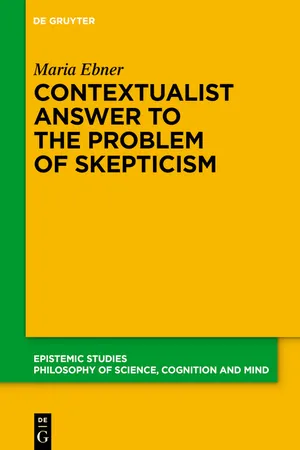
Contextualist Answer to the Problem of Skepticism
About this book
Table of contents
- Frontmatter
- Acknowledgements
- Contents
- Introduction
- Part I Contextualism and skepticism
- Chapter 1 Contextualism – Basic Issues
- Chapter 2 Problem of Skepticism
- Chapter 3 Lewis’s and DeRose’s Contextualist Theories
- Chapter 4 Contextualism and Relativism
- Chapter 5 Contextualism Versus Subject-Sensitive Invariantism
- Chapter 6 Contextualism as a Semantic Theory
- Chapter 7 Tests for Occasionality and Tests for Ambiguity
- Chapter 8 Critique of Contextualism
- Chapter 9 Critique of Contextualism as a Reaction to the Problem of Skepticism
- Chapter 10 Conclusions from Part I
- Part II Procedural contextualism as an anti-skeptical strategy
- Chapter 11 Characterization of Procedural Contextualism
- Chapter 12 Procedural Contextualism’s Answer to the Problem of Skepticism
- Chapter 13 Epistemological Puzzles and Procedural Contextualism
- Chapter 14 Critique of Contextualism and Procedural Contextualism
- Chapter 15 The Difficulties of Procedural Contextualism and Ways to Overcome Them
- Chapter 16 Conclusions from Part II
- Conclusions
- Bibliography
- Index
Trusted by 375,005 students
Access to over 1.5 million titles for a fair monthly price.
Study more efficiently using our study tools.
Information
Publisher
De GruyterEdition
1Year
2026Topic
PhilosophyPrint ISBN
9783112232514
Subtopic
Epistemology in PhilosophyeBook ISBN
9783112232521
Frequently asked questions
Yes, you can cancel anytime from the Subscription tab in your account settings on the Perlego website. Your subscription will stay active until the end of your current billing period. Learn how to cancel your subscription
No, books cannot be downloaded as external files, such as PDFs, for use outside of Perlego. However, you can download books within the Perlego app for offline reading on mobile or tablet. Learn how to download books offline
Perlego offers two plans: Essential and Complete
- Essential is ideal for learners and professionals who enjoy exploring a wide range of subjects. Access the Essential Library with 800,000+ trusted titles and best-sellers across business, personal growth, and the humanities. Includes unlimited reading time and Standard Read Aloud voice.
- Complete: Perfect for advanced learners and researchers needing full, unrestricted access. Unlock 1.5M+ books across hundreds of subjects, including academic and specialized titles. The Complete Plan also includes advanced features like Premium Read Aloud and Research Assistant.
We are an online textbook subscription service, where you can get access to an entire online library for less than the price of a single book per month. With over 1.5 million books across 990+ topics, we’ve got you covered! Learn about our mission
Look out for the read-aloud symbol on your next book to see if you can listen to it. The read-aloud tool reads text aloud for you, highlighting the text as it is being read. You can pause it, speed it up and slow it down. Learn more about Read Aloud
Yes! You can use the Perlego app on both iOS and Android devices to read anytime, anywhere — even offline. Perfect for commutes or when you’re on the go.
Please note we cannot support devices running on iOS 13 and Android 7 or earlier. Learn more about using the app
Please note we cannot support devices running on iOS 13 and Android 7 or earlier. Learn more about using the app
Yes, you can access Contextualist Answer to the Problem of Skepticism by Maria Ebner in PDF and/or ePUB format, as well as other popular books in Philosophy & Epistemology in Philosophy. We have over 1.5 million books available in our catalogue for you to explore.