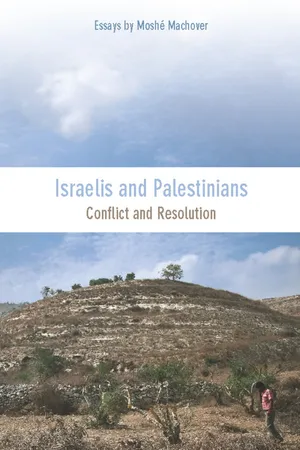
These essays, written between 1966 and 2010 by lifelong Israeli activist and theorist Moshé Machover, cover diverse aspects of Israeli society and the Israeli-Palestinian conflict. Elaborating on the ideas of the Socialist Organization in Israel (Matzpen), two interrelated themes appear throughout the collection: the necessity of understanding the Israeli-Palestinian conflict in a regional context and the connection between Palestinian liberation and the struggle for socialism throughout the Middle East.
- 300 pages
- English
- ePUB (mobile friendly)
- Available on iOS & Android
eBook - ePub
About this book
Information
1
Why I Am Not an Israeli Peace Activist*
As the desultory “peace process” meanders from pointless appointment to meaningless meeting between heads of the Israeli settler state and the authority-less Palestinian Authority, with the United States playing the part of dishonest broker, there can no longer be any lingering doubt that this is a charade staged by charlatans.
But behind and beyond this fairly obvious confidence trick there is a much more subtle deception or self-deception: it is widely assumed—even taken for granted—that “peace” is what it would take to resolve the Israeli-Palestinian conflict. In other words: that what is needed is a genuine peace process instead of the present fake one.
This belief is held by almost all decent enlightened Israelis (the so-called Israeli left)—which is why they refer to themselves collectively as “the peace camp” and individually as “peace activists”—and it is shared by their friends and supporters in the West.
The “left” Zionists of Peace Now as well as the “soft” Zionists and semi-Zionists of Gush Shalom (the Peace Bloc) display this self-deception on their name tags. The non-Zionist Stalinist-turned-reformist Israeli CP insists on giving top prominence to peace slogans. Many of the activities in which these good people engage are highly commendable: dissent from oppressive policies and actions of the Israeli authorities, and in particular opposition to the post-1967 occupation. Some of them show real moral and physical courage in various acts of solidarity with the oppressed Palestinians.
Nevertheless, their self-description as “peace activists” reveals a profound misapprehension of the nature of the Israeli-Palestinian conflict and a delusion as to how it might be resolved. The image it evokes is essentially symmetric: two sides, two nations, at war with each other, locked in a series of battles over a piece of disputed turf. To end the conflict, the two sides need to end the war, sit down together, and make peace.
In fact, this is also the image promoted by Israeli hasbarah (propaganda). It likes to speak the symmetric language of “war” and “peace.” Thus, Israel and its friends describe the assault on Gaza in the winter of 2008–09, code-named Operation Cast Lead, as a “war.”1 In reality, it was not a war: there was virtually no fighting. It was a one-sided massacre. Similarly, Israeli diplomacy insists on referring to the territories seized by Israel in 1967 as “disputed”—a deliberately symmetric description—rather than occupied.
As for peace: none wish for it more ardently than most of Israel’s leaders. I am saying this with hardly a trace of irony. It is the truth. Only very few people—psychopaths, arms dealers, and other war profiteers, as well as some cynical careerist demagogues and military officers eager for fast-track promotion—actually prefer war per se to any kind of peace. I suppose that a few Israeli political and military leaders do belong to each of these exceptional categories. But most Israeli leaders genuinely wish for peace—peace on Israel’s terms: their cherished wish is that the Palestinian people, dispossessed and subjugated, would peacefully accept their lot and give up the struggle.
Colonial Conflict
The key to a proper understanding of the conflict is that it is an extremely asymmetric one: between settlers-colonizers and the indigenous people. It is about dispossession and oppression. As was the case in other colonial conflicts, the Israeli-Palestinian conflict has involved real wars between Israel and the neighboring states; but these were spin-offs, consequences of the fundamental cause: the Zionist colonization of Palestine. As this colonization proceeds and expands, Israel will need to maintain its regional hegemony as Western imperialism’s local subcontractor, and new wars will no doubt be provoked.
In colonial conflicts, the colonizers always regard themselves as coming in peace, bearing the gifts of enlightenment and progress. It is the benighted natives who are the aggressors, resorting to violence against their benefactors. This compels the colonizers to use their superior force in order to put down the native aggressors.2 The latter have only themselves to blame.
I suppose this is the kind of thing my late friend, the socialist poet Erich Fried, had in mind when he wrote this poem:
Clean Sweep
The causes
now fight
their effects,
so that one can no longer
hold them
responsible for the effects;
for even
to make them responsible
is part of the effects
and effects are forbidden
and punished
by the causes themselves.
They do not wish
any longer
to know about such effects.
Anyone who sees
how diligently
they pursue the effects
and still says
that they are
closely connected with them
will now have to
blame
only himself.
While the colonizers’ aim is to impose peace—on their own terms and, if necessary, by force—the indigenous people tend to have a rather different view of the matter. Their concern is not to make peace with their dispossessors but to resist being dispossessed. To this end they often need to come bearing not peace but the sword.
This is why one would be hard put to find peace activists among the Native Americans or Australian Aborigines resisting colonization in the nineteenth century, or among Algerian liberation fighters or anti-apartheid militants in the twentieth century.
Of course, the Israeli peace activists do not support all the harsh “peace” terms that their government wishes to impose on the Palestinian people. (Although some of them do not object to some of these unequal terms.) But by their reductive definition of the issue as being all about peace, they knowingly or unwittingly accept a point of view biased in favor of the colonizers.
This biased viewpoint is inconsistent with internationalism. So Israeli self-proclaimed peace activists cannot be genuine socialists. Israeli socialists, whether Hebrew or Arab, fight against the Zionist project and its practices: colonization, dispossession, discrimination, and for equal rights and universal liberation.
Peace will be an outcome of liberation, not its starting point.
* This article was originally published in Weekly Worker 836, October 7, 2010.
Part I
THE PALESTINIAN STRUGGLE AND THE ARAB EAST; JABRA NICOLA AND HIS HERITAGE
2
Comrade Jabra Nicola (1912–74)*
On December 25, 1974, Comrade Jabra Nicola passed away following a long illness. He died, at age sixty-three, of cerebral hemorrhage in his home in London.
Jabra was born in Haifa. At the beginning of the 1930s he joined the Palestine Communist Party and soon became a leading member of the party. He grew critical of Stalinism, which at the time totally dominated the international communist movement. The first impetus for this came from an article by Trotsky against the catastrophic Stalinist policy regarding Germany. An Arabic translation of that article appeared in an Egyptian paper, and so came to Jabra’s notice. This is how he was attracted to the Trotskyist outlook, which he upheld to the end of his life.
At the outbreak of the Second World War, Jabra was arrested [by the British Mandate authorities] together with other communist activists, and imprisoned in an administrative detention camp as “suspected of sympathizing with the enemy.” This was bitterly ironic because right from the beginning of the war Jabra was for supporting the antifascist side—contrary to the position of the official communist movement, as well as to that of most Trotskyists. Following the Hitlerite invasion of the Soviet Union, the communist detainees, including Jabra, were released.
In the 1940s Jabra officially joined the Trotskyist Fourth International, and eventually became a member of its leadership. The position of the world Trotskyist movement on the problems of the Middle East was formed largely under his influence. At the same time he remained a member of the Communist Party. Although he did not keep his Trotskyist views secret, the leaders of the party—intellectual Lilliputians compared to him—did not dare expel him. But th...
Table of contents
- Cover
- Preface
- 1. Why I Am Not an Israeli Peace Activist (October 2010)
- PART I. THE PALESTINIAN STRUGGLE AND THE ARAB EAST; JABRA NICOLA AND HIS HERITAGE
- 2. Comrade Jabra Nicola (1912–74) (March 1975)
- 3. The Palestine Problem and the Israeli-Arab Conflict (May 18, 1967)
- 4. Palestinian Struggle and Middle East Revolution (June 1969)
- 5. Arab Revolution and National Problems in the Arab East (Summer 1973)
- 6. The National Movement in the Arab East at the End of the Road (August 1976)
- 7. Following the Israeli-Egyptian Treaty: Against the Autonomy! (March 1979)
- 8. The Middle East—Still at the Crossroads: A Socialist Position on the Palestinian Problem (September 1988)
- 9. Sharon’s Agenda and Arafat’s Irrelevance (March 2002)
- 10. A FAQ: What Do You Think about Suicide Bombers? (March 2005)
- PART II. ISRAELI SOCIETY
- 11. Matzpen and Ha’olam Hazeh–New Force (December 1966)
- 12. The Social Identity of Ha’olam Hazeh (January 1967)
- 13. The Class Nature of Israeli Society (1970–71)
- 14. Zionism and “Oriental” Jews: A Dialectic of Exploitation and Co-optation (2008)
- PART III. RACISM AND THE NATIONAL QUESTION
- 15. The Case for Hebrew Self-Determination (1969)
- 16. Zionism, National Oppression, and Racism (1976)
- 17. Summing Up Our Position on the National Question (January 1978)
- PART IV. POLEMICS AGAINST ZIONISM
- 18. New Premises for a False Conclusion (May 1967)
- 19. Resurrection of the Dead (October 1967)
- 20. Liars (August 1969)
- 21. The Zionist Left and the Palestinian Resistance (late 1969)
- 22. Borochovist “Revival” (March 1971)
- 23. Reply to Sol Stern (January 1973)
- 24. Zionism and Its Scarecrows (1975)
- 25. Abominable Warmongering on the Left (August 2008)
- 26. Zionism: Propaganda and Reality (September 2008)
- PART V. REVIEWS
- 27. Things Bad Begun . . . (1987)
- 28. Exploded Myths (1989)
- 29. Lost in Translation (1990)
- 30. Misinformation as “News” (2005)
- 31. A Peace Activist on the Border (2007)
- 32. Zionist Myths Debunked (2010–11)
- PART VI. FINAL ANALYSIS
- 33. Israelis and Palestinians: Conflict and Resolution (November 2006)
- 34. Resolution of the Israeli-Palestinian Conflict: A Socialist Viewpoint (February 2009)
- 35. Israeli Socialism and Anti-Zionism: Historical Tasks and Balance Sheet (February 2010)
- Acknowledgments
- Notes
- About the Author
Trusted by 375,005 students
Access to over 1.5 million titles for a fair monthly price.
Study more efficiently using our study tools.
Frequently asked questions
Yes, you can cancel anytime from the Subscription tab in your account settings on the Perlego website. Your subscription will stay active until the end of your current billing period. Learn how to cancel your subscription
No, books cannot be downloaded as external files, such as PDFs, for use outside of Perlego. However, you can download books within the Perlego app for offline reading on mobile or tablet. Learn how to download books offline
We are an online textbook subscription service, where you can get access to an entire online library for less than the price of a single book per month. With over 1.5 million books across 990+ topics, we’ve got you covered! Learn about our mission
Look out for the read-aloud symbol on your next book to see if you can listen to it. The read-aloud tool reads text aloud for you, highlighting the text as it is being read. You can pause it, speed it up and slow it down. Learn more about Read Aloud
Yes! You can use the Perlego app on both iOS and Android devices to read anytime, anywhere — even offline. Perfect for commutes or when you’re on the go.
Please note we cannot support devices running on iOS 13 and Android 7 or earlier. Learn more about using the app
Please note we cannot support devices running on iOS 13 and Android 7 or earlier. Learn more about using the app
Yes, you can access Israelis and Palestinians by Moshé Machover in PDF and/or ePUB format, as well as other popular books in Politics & International Relations & Political History & Theory. We have over 1.5 million books available in our catalogue for you to explore.