Following the failures of the Iraq and Afghan wars, as well as "military lite" methods and counterinsurgency, the Pentagon is pioneering a new brand of global warfare predicated on special ops, drones, spy games, civilian soldiers, and cyberwarfare. It may sound like a safer, saner war-fighting. In reality, it will prove anything but, as Turse's pathbreaking reportage makes clear.
eBook - ePub
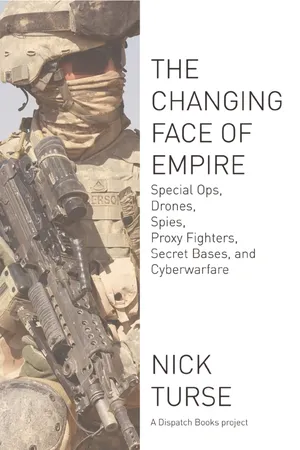
The Changing Face of Empire
Special Ops, Drones, Spies, Proxy Fighters, Secret Bases, and Cyberwarfare
- 107 pages
- English
- ePUB (mobile friendly)
- Available on iOS & Android
eBook - ePub
The Changing Face of Empire
Special Ops, Drones, Spies, Proxy Fighters, Secret Bases, and Cyberwarfare
About this book
Information
1.
The Changing Face of Empire
It looked like a scene out of a Hollywood movie. In the inky darkness, men in full combat gear, armed with automatic weapons and wearing night-vision goggles, grabbed hold of a thick, woven cable hanging from a MH-47 Chinook helicopter. Then, in a flash, each “fast-roped” down onto a ship below. Afterward, “Mike,” a Navy SEAL who would not give his last name, bragged to an Army public affairs sergeant that, when they were on their game, the SEALs could put 15 men on a ship this way in 30 seconds or less.
Once on the aft deck, the special ops troops broke into squads and methodically searched the ship as it bobbed in Jinhae Harbor, South Korea. Below deck and on the bridge, the commandos located several men and pointed their weapons at them, but nobody fired a shot. It was, after all, a training exercise.
All of those ship-searchers were SEALs, but not all of them were American. Some were from Naval Special Warfare Group 1 out of Coronado, California; others hailed from South Korea’s Naval Special Brigade. The drill was part of Foal Eagle 2012, a multinational, joint-service exercise. It was also a model for — and one small part of — a much publicized U.S. military “pivot” from the Greater Middle East to Asia, a move that includes sending an initial contingent of 250 Marines to Darwin, Australia, basing littoral combat ships in Singapore, strengthening military ties with Vietnam and India, staging war games in the Philippines, and shifting the majority of the Navy’s ships to the Pacific by the end of the decade.
That modest training exercise also reflected another kind of pivot. The face of American-style war-fighting is once again changing. Forget full-scale invasions and large-footprint occupations on the Eurasian mainland; instead, think: special operations forces working on their own but also training or fighting beside allied militaries (if not outright proxy armies) in hot spots around the world. And along with those special ops advisors, trainers, and commandos expect ever more funds and efforts to flow into the militarization of spying and intelligence, the use of ever more drone aircraft, the launching of cyber-attacks, and joint Pentagon operations with increasingly militarized “civilian” government agencies.
Much of this has been noted in the media, but how it all fits together into what could be called the new global face of empire has escaped attention. And yet this represents nothing short of a new Obama doctrine, a six-point program for twenty-first-century war, American-style, that the administration is now carefully developing and honing. Its global scope is already breathtaking, if little recognized, and like Donald Rumsfeld’s military lite and David Petraeus’s counterinsurgency operations, it is evidently going to have its day in the sun — and like them, it will undoubtedly disappoint in ways that will surprise its creators.
The Blur-ness
For many years, the U.S. military has been talking up and promoting the concept of “jointness.” An Army helicopter landing Navy SEALs on a Korean ship catches some of this ethos at the tactical level. But the future, it seems, has something else in store. Think of it as “blur-ness,” a kind of organizational version of war-fighting in which a dominant Pentagon fuses its forces with other government agencies — especially the CIA, the State Department, and the Drug Enforcement Administration — in complex, overlapping missions around the globe.
In 2001, Secretary of Defense Donald Rumsfeld began his “revolution in military affairs,” steering the Pentagon toward a military-lite model of high-tech, agile forces. The concept came to a grim end in Iraq’s embattled cities. A decade later, the last vestiges of its many failures continue to play out in a stalemated war in Afghanistan against a rag-tag minority insurgency that can’t be beaten. In the years since, two secretaries of defense and a new president have presided over another transformation — this one geared toward avoiding ruinous, large-scale land wars which the U.S. has consistently proven unable to win.
Under President Obama, the U.S. has expanded or launched numerous military campaigns — most of them utilizing a mix of the six elements of twenty-first-century American war. Take the American war in Pakistan — a poster-child for what might now be called the Obama formula, if not doctrine. Beginning as a highly-circumscribed drone assassination campaign backed by limited cross-border commando raids under the Bush administration, U.S. operations in Pakistan have expanded into something close to a full-scale robotic air war, complemented by cross-border helicopter attacks, CIA-funded “kill teams” of Afghan proxy forces, as well as boots-on-the-ground missions by elite special operations forces, including the SEAL raid that killed Osama bin Laden.
The CIA has conducted clandestine intelligence and surveillance missions in Pakistan, too, though its role may, in the future, be less important, thanks to Pentagon mission creep. In April 2012, in fact, Secretary of Defense Leon Panetta announced the creation of a new CIA-like espionage agency within the Pentagon called the Defense Clandestine Service. According to the Washington Post, its aim is to expand “the military’s espionage efforts beyond war zones.”
Over the last decade, the very notion of war zones has become remarkably muddled, mirroring the blurring of the missions and activities of the CIA and Pentagon. Analyzing the new agency and the “broader convergence trend” between Department of Defense and CIA missions, the Post noted that the “blurring is also evident in the organizations’ upper ranks. Panetta previously served as CIA director, and that post is currently held by retired four-star Army Gen. David H. Petraeus.”
Not to be outdone, the State Department, once the seat of diplomacy, continued on its long march to militarization (and marginalization) when it agreed to pool some of its resources with the Pentagon to create the Global Security Contingency Fund. That program will allow the Defense Department even greater say in how aid from Washington will flow to proxy forces in places like Yemen and the Horn of Africa.
One thing is certain: American war-making (along with its spies and its diplomats) is heading ever deeper into “the shadows.” Expect yet more clandestine operations in ever more places with, of course, ever more potential for blowback in the years ahead.
Shedding Light on “the Dark Continent”
One locale likely to see an influx of Pentagon spies in the coming years is Africa. Under President Obama, operations on the continent have accelerated far beyond the more limited interventions of the Bush years. 2011’s war in Libya; a regional drone campaign with missions run out of airports and bases in Djibouti, Ethiopia, and the Indian Ocean archipelago nation of Seychelles; a flotilla of 30 ships in that ocean supporting regional operations; a multi-pronged military and CIA campaign against militants in Somalia, including intelligence operations, training for Somali agents, a secret prison, helicopter attacks, and U.S. commando raids; a massive influx of cash for counterterrorism operations across East Africa; a possible old-fashioned air war, carried out on the sly in the region using manned aircraft; tens of millions of dollars in arms for allied mercenaries and African troops; and a special ops expeditionary force (bolstered by State Department experts) dispatched to help capture or kill Lord’s Resistance Army leader Joseph Kony and his senior commanders, operating in Uganda, South Sudan, the Democratic Republic of the Congo, and the Central African Republic (where U.S. Special Forces now have a new base) only begins to scratch the surface of Washington’s fast-expanding plans and activities in the region.
Even less well known are other U.S. military efforts designed to train African forces for operations now considered integral to American interests on the continent. These include, for example, a mission by elite Force Recon Marines from the Special Purpose Marine Air Ground Task Force 12 (SPMAGTF-12) to train soldiers from the Uganda People’s Defense Force, which supplies the majority of troops to the African Union Mission in Somalia.
The U.S. is also conducting counterterrorism training and equipping militaries in Algeria, Burkina Faso, Chad, Mauritania, Niger, and Tunisia. In addition, U.S. Africa Command (AFRICOM) has 14 major joint-training exercises planned for 2012, including operations in Morocco, Cameroon, Gabon, Botswana, South Africa, Lesotho, Senegal, and what may become the Pakistan of Africa, Nigeria.
Back in the Backyard
Since its founding, the United States has often meddled close to home, treating the Caribbean as its private lake and intervening at will throughout Latin America. During the Bush years, with some notable exceptions, Washington’s interest in America’s “backyard” took a backseat to wars farther from home. The Obama administration is now in the process of ramping up operations south of the border using its new formula. This has meant Pentagon drone missions deep inside Mexico to aid that country’s battle against the drug cartels, while CIA agents and civilian operatives from the Department of Defense were dispatched to Mexican military bases to take part in the country’s drug war.
In 2012, the Pentagon has also ramped up its anti-drug operations in Honduras. Working out of Forward Operating Base Mocoron and other remote camps there, the U.S. military is supporting Honduran operations by way of the methods it honed in Iraq and Afghanistan. In addition, Green Berets have been assisting Honduran Special Operations forces in anti-smuggling operations; and a Drug Enforcement Administration Foreign-deployed Advisory Support Team, originally created to disrupt the poppy trade in Afghanistan, has joined forces with Honduras’s Tactical Response Team, that country’s most elite counternarcotics unit. A glimpse of these operations made the news when DEA agents, flying in an American helicopter, were involved in an aerial attack on civilians that killed two men and two pregnant women in the remote Mosquito Coast region.
Less visible have been U.S. efforts in Guyana, where Special Operations Forces have been training local troops in heliborne air assault techniques. “This is the first time we have had this type of exercise involving Special Operations Forces of the United States on such a grand scale,” Colonel Bruce Lovell of the Guyana Defense Force told a U.S. public affairs official. “It gives us a chance to validate ourselves and see where we are, what are our shortcomings.”
Still in the Middle of the Middle East
Despite the end of the Iraq and Libyan wars, a coming drawdown of forces in Afghanistan, and copious public announcements about its national security pivot toward Asia, Washington is by no means withdrawing from the Greater Middle East. In addition to continuing operations in Afghanistan, the U.S. has consistently been at work training allied troops, building up military bases, and brokering weapons sales and arms transfers to despots in the region from Bahrain to Yemen.
In fact, Yemen, like its neighbor, Somalia, across the Gulf of Aden, has become a laboratory for Obama’s wars. There, the U.S. is carrying out its signature new brand of warfare with “black ops” troops like the SEALs and the Army’s Delta Force likely conducting kill/capture missions, while “white” forces like the Green Berets and Rangers are training indigenous troops, and robot planes hunt and kill members of al-Qaeda and its affiliates, possibly assisted by an even more secret contingent of manned aircraft.
The Middle East has also become the somewhat unlikely poster-region for another emerging facet of the Obama doctrine: cyberwar efforts. In a category-blurring speaking engagement, Secretary of State Hillary Clinton surfaced at the 2012 Special Operations Forces Industry Conference in Florida where she gave a speech talking up her department’s eagerness to join in the new American way of war. “We need Special Operations Forces who are as comfortable drinking tea with tribal leaders as raiding a terrorist compound,’’ she told the crowd. “We also need diplomats and development experts who are up to the job of being your partners.”
Clinton then took the opportunity to tout her agency’s online efforts, aimed at websites used by al-Qaeda’s affiliate in Yemen. When al-Qaeda recruitment messages appeared on the latter, she said, “our team plastered the same sites with altered versions… that showed the toll al-Qaeda attacks have taken on the Yemeni people.” She further noted that this information-warfare mission was carried out by experts at the State Department’s Center for Strategic Counterterrorism Communications with assistance, not surprisingly, from the military and the U.S. Intelligence Community.
These modest on-line efforts join more potent methods of cyberwar being employed by the Pentagon and the CIA, including “Olympic Games,” a program of sophisticated attacks on computers in Iran’s nuclear enrichment facilities engineered and unleashed by the National Security Agency (NSA) and Unit 8200, Israeli’s equivalent of the NSA. As with other facets of the new way of war, these efforts were begun under the Bush administration but significantly accelerated under President Obama, who became the first American commander-in-chief to order sustained cyberattacks designed to cripple another country’s infrastructure.
From Brushfires to Wildfires
Across the globe from Central and South America to Africa, the Middle East, and Asia, the Obama administration is working out its formula for a new American way of war. In its pursuit, the Pentagon and its increasingly militarized government partners are drawing on everything from classic precepts of colonial warfare to the latest technologies.
The United States is an imperial power chastened by more than 10 years of failed, heavy-footprint wars. It is hobbled by a hollowing-out economy, and inundated with hundreds of thousands of recent veterans — a staggering 45% of the troops who fought in Afghanistan and Iraq — suffering from service-related disabilities who will require ever more expensive care. No wonder the current combination of special ops, drones, spy games, civilian soldiers, cyberwarfare, and proxy fighters sounds like a safer, saner brand of war-fighting. At first blush, it may even look like a panacea for America’s national security ills. In reality, it may be anything but.
The new light-footprint Obama doctrine actually seems to be making war an ever more attractive and seemingly easy option — a point emphasized by former Chairman of the Joint Chiefs of Staff General Peter Pace. “I worry about speed making it too easy to employ force,” said Pace when asked about efforts to make it simpler to deploy Special Operations Forces abroad. “I worry about speed making it too easy to take the easy answer — let’s go whack them with special operations — as opposed to perhaps a more laborious answer for perhaps a better long-term solution.”
As a result, the new American way of war holds great potential for unforeseen entanglements and serial blowback. Starting or fanning brushfire wars on several continents could lead to raging wildfires that spread unpredictably and prove difficult, if not impossible, to quench.
By their very nature, small military engagements tend to get larger, and wars tend to spread beyond borders. By definition, military action tends to have unforeseen consequences. Those who doubt this need only look back to September 11, 2001, when three low-tech attacks on a single day set in motion a decade-plus of war that has spread across the globe. The response to that one day began with a war in Afghanistan, which spread to Pakistan, detoured to Iraq, popped up in Somalia and Yemen, and so on. Today, veterans of those Ur-interventions find themselves trying to replicate their dubious successes in places like Mexico and Honduras, the Central Africa Republic and the Congo.
History demonstrates that the U.S. is not very good at winning wars, having gone without victory in any major conflict since 1945. Smaller interventions have been a mixed bag with modest victories in places like Panama and Grenada and ignominious outcomes in Lebanon (in the 1980s) and Somalia (in the 1990s), to name a few.
The trouble is, it’s hard to tell what an intervention will grow up to be — until it’s too late. While they followed different paths, Vietnam, Afghanistan, and Iraq all began relatively sma...
Table of contents
- Cover
- Contents
- 1. The Changing Face of Empire
- 2. Uncovering the Military’s Secret Military
- 3. America’s Empire of Drone Bases
- 4. Arming Mideast Autocrats
- 5. The Pentagon’s Training Missions
- 6. Prisons, Drones, and Black Ops in Afghanis
- 7. Shadow Wars in Africa
- 8. Washington Puts Its Money on Proxy War
- 9. How the United States Creates Global Insta
- 10. What the U.S. Military Can’t Do
- A Note on the Text
- Special Thanks
- Acknowledgments
- About Nick Turse
- About Tom Engelhardt
- About TomDispatch
- About Dispatch Books
- About Haymarket Books
Trusted by 375,005 students
Access to over 1.5 million titles for a fair monthly price.
Study more efficiently using our study tools.
Frequently asked questions
Yes, you can cancel anytime from the Subscription tab in your account settings on the Perlego website. Your subscription will stay active until the end of your current billing period. Learn how to cancel your subscription
No, books cannot be downloaded as external files, such as PDFs, for use outside of Perlego. However, you can download books within the Perlego app for offline reading on mobile or tablet. Learn how to download books offline
Perlego offers two plans: Essential and Complete
- Essential is ideal for learners and professionals who enjoy exploring a wide range of subjects. Access the Essential Library with 800,000+ trusted titles and best-sellers across business, personal growth, and the humanities. Includes unlimited reading time and Standard Read Aloud voice.
- Complete: Perfect for advanced learners and researchers needing full, unrestricted access. Unlock 1.5M+ books across hundreds of subjects, including academic and specialized titles. The Complete Plan also includes advanced features like Premium Read Aloud and Research Assistant.
We are an online textbook subscription service, where you can get access to an entire online library for less than the price of a single book per month. With over 1.5 million books across 990+ topics, we’ve got you covered! Learn about our mission
Look out for the read-aloud symbol on your next book to see if you can listen to it. The read-aloud tool reads text aloud for you, highlighting the text as it is being read. You can pause it, speed it up and slow it down. Learn more about Read Aloud
Yes! You can use the Perlego app on both iOS and Android devices to read anytime, anywhere — even offline. Perfect for commutes or when you’re on the go.
Please note we cannot support devices running on iOS 13 and Android 7 or earlier. Learn more about using the app
Please note we cannot support devices running on iOS 13 and Android 7 or earlier. Learn more about using the app
Yes, you can access The Changing Face of Empire by Nick Turse in PDF and/or ePUB format, as well as other popular books in Politics & International Relations & African Politics. We have over 1.5 million books available in our catalogue for you to explore.