- From acclaimed best-selling author of Kill Anything That Moves
- With troops withdrawing from Iraq and Afghanistan the US shifts its attention to the resource rich continent of Africa. Those who wish to understand the next major military operation of the US will learn much from this book.
- It's Philip Gourevitch's We Wish to Inform You That Tomorrow We Will Be Killed with Our Families: Stories From Rwanda meets Dave Eggers' What Is the What; a searing work of reportage about life and loss in wartime. Readers interested in South Sudan, Africa in general, and modern war will no doubt be engrossed by this book, but Next Time They'll Come to Count the Dead will appeal to anyone interested in human drama, powerful emotion, and crisp writing.
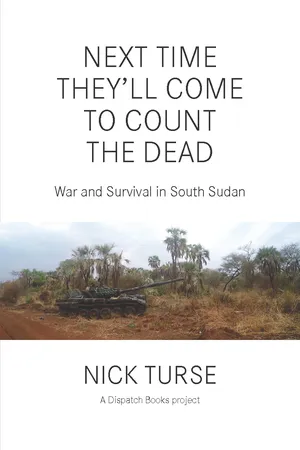
- For six weeks in the Spring of 2015, award-winning journalist Nick Turse traveled on foot as well as by car, SUV, and helicopter around war-torn South Sudan talking to military officers and child soldiers, United Nations officials and humanitarian workers, civil servants, civil society activists, and internally displaced persons -- people whose lives had been blown apart by a ceaseless conflict there.
- 220 pages
- English
- ePUB (mobile friendly)
- Available on iOS & Android
eBook - ePub
About this book
Information
Next Time They’ll Come to Count the Dead:
War and Survival in South Sudan
War and Survival in South Sudan
It’s dark and hot and he selects a quiet spot beyond the edge of the patio. Under the wispy branches of a mimosa tree in a desiccated dirtscape near the gated, guarded parking lot, we sit at a table for eight, just the two of us. The waiter is upon us immediately. I order a Tusker beer. My companion, water. With the dim golden glow of patio lights at our feet, I make small talk until the tall, young server is out of earshot. It wasn’t easy to schedule this meeting and we’re already an hour late, so I get down to it immediately.
Some nights, this is a sweaty expat scene packed with Americans, Canadians, and Europeans. Thursdays, it’s devoted to salsa dancing and late Sundays into early Mondays, it’s light on people but heavy on sound—the throbbing, thumping bass of African and American beats spun by the DJ at the club next door. Tonight, though, it’s sleepy, hushed, half-deserted—a scene befitting a bar named for a dead dog. Still, I automatically fall silent whenever a couple straggles by or our server checks my progress on the beer and my source’s plastic bottle of Aqua’na.
Maybe for my benefit, maybe to satisfy the hovering waiter, my table-mate orders a beer, too. As he does, the sheen on his skin—it was around 97 degrees at sunset and must still be in the low 90s—allows me to take note of his features even in the darkness. Rawboned with taut skin, his cheeks are slightly sunken, his face clean-shaven. His head is shaved too. A vein on its left side bulges. It’s hard not to look at it. His eyes are serious, but there’s a spark to them. They narrow whenever he’s making a point and he has many to make.
The waiter comes back with a Tusker Lite, seems satisfied, and finally leaves us be. It’s then that the grim subjects automatically come up. He speaks in a blur of words, racing through one nightmarish point after another. By the time I’ve deciphered one sentence, he’s leapfrogged two ahead. We talk about war, murder, and accountability, but there’s really only one question I want answered this night and it’s been on my mind for months.
My drinking companion is leaving the country tomorrow and the hour is getting late. With a final glance to my blindside and then the parking lot, I lean in and ask Edmund Yakani if he knows where the bodies are. All those people must be somewhere, I say. So where are the mass graves?1
§ § §
South Sudan is the youngest country in the world, tucked beneath its former parent nation with whom it shares half its name. It’s sandwiched between the Central African Republic, the Democratic Republic of Congo, Uganda, Kenya, and Ethiopia. When independence came in 2011, there was a lot of hope here. So much, in fact, that it seemed as if old wounds from 1989 and 1991 and 1993 and the rest of almost five decades of civil war might be swept away in a tide of ecstatic liberation—joy on the streets of Juba, the capital, forgiveness in towns from Bentiu to Bor, Wardak to Wau. But before long the old fissures, the old wounds, began to resurface—jagged memories that refused to stay buried, saw-toothed truths that tore at the fabric of the nation. “Blood will have blood,” wrote William Shakespeare and it didn’t take long before the words of the greatest playwright of southern Sudan’s former colonial overlord started to come true; the sins of the fathers became the terrors of the sons. But it was rarely the right sons—if there could ever be right sons. And all too often it was the daughters and their children, sometimes even babies.
In December 2013, months of tension between President Salva Kiir, a Dinka—that is, a member of the the largest tribe in the country—and Riek Machar, his vice president and a Nuer—a member of the second largest tribe—whom he had dismissed months before, reached a boiling point.2 On the night of the 15th, fighting broke out in the headquarters barracks of the army in the capital, Juba, between Dinka and Nuer members of the Presidential Guard, also known as the “Tiger Division.”3
Simon Wuor had a front-row seat as the violence unfolded and later told me his story. His home in Juba’s Khor William neighborhood was across the road from the sprawling military compound known as General Headquarters (GHQ) or Giyada. Around 10:15 p.m., he turned off the nightly news on SSTV, the national channel, and retired to his bedroom. It wasn’t long before he heard the pop, pop, pop. Three shots. Then more. Then, a continuous rattle of automatic weapons. He’d heard gunfire from headquarters before, many times in fact. But never like this.
Wuor, like most of his neighbors, assumed that whatever battle was going on among the soldiers of the Tiger Division would remain confined to the base. Strife and South Sudan go together. The country has been engulfed in violence for decades, since long before independence. Armed men did what armed men have long been wont to do. Wuor took it for granted that, whatever was going on, it would end quickly.
It didn’t.
Within minutes, news of the fighting was pinging from one cell phone to another in the capital and, before long, out in the countryside, too. A friend stationed at the GHQ across the street called to say that a firefight had broken out when Dinka soldiers tried to disarm their Nuer comrades so they could arrest senior officials from that tribe. He told Wuor to hunker down and stay indoors. The 27-year-old local supervisor for an international nongovernmental organization (NGO), his wife, and three children, ages six, three-and-a-half, and two, huddled under a bed, as bullets ripped through their corrugated metal home.
The gunfire was constant until about 1 a.m. when it softened, as Wuor recalls, before it broke back into a rattling roar. It kept up until dawn. Peeking outside, he saw soldiers swarming through the streets. So the family locked themselves in until the afternoon. By 3 p.m., the gunfire had quieted down and Wuor spoke with neighbors who were weighing a plan to make a run for Jebel Checkpoint, a neighborhood where there was said to be little fighting. It was on the way to “U.N. House”—the colloquial name for one of the two bases in Juba of the United Nations Mission in South Sudan (UNMISS)—a place of potential safety. A group of women and children were about to set off on the long trek there and, after brief consideration, Wuor decided to send his wife and children with them. He was planning to stay put to protect his home from looters. He could always run if things got worse.
They did.
At 4:30, Wuor’s phone rang again. You need to leave now, his friend told him. The Dinka Presidential Guard is on a killing spree, searching house to house. Take any route you think is safe. Just get away.
Simon Wuor isn’t a big man. The first time we spoke, he was wearing a plaid button-down shirt slightly too large for his modest frame, olive-drab pants, and red flip-flops. Wiry, with close-cropped hair, prominent cheekbones, and chin stubble that fades along the jaw line, there’s a nervous energy to him. He makes quick, staccato gestures, jabbing at the air or floor with his index finger to emphasize points. He’s a Nuer, and so the potential target, as his friend informed him, of the fury of the Dinka troops. He had, however, one thing in his favor. He does not sport the traditional tribal markings—ridge-like scars across the forehead, known as gaar—that identify men as Nuer and so, that December night, marked them for death.
Grabbing a black backpack and tossing in whatever crucial documents were at hand—his school diplomas as well as education certificates for secretarial skills and computer science—he began walking toward the University of Juba, in the vague hope that it might be safe.
As would happen again and again over the hours to come, Wuor was stopped by Dinka troops from the Sudan People’s Liberation Army (SPLA) who had set up impromptu checkpoints across the city. And here was where his other great advantage came into play.4 All over Juba, Dinka forces were employing words as weapons. Sometimes, they called out to people in the Nuer language. Respond in kind and you were shot.5 Other times, they used their own tongue to similar effect. “They greeted us in Dinka language,” a student recalled, “when we failed to answer they said that means you are Nuer and we are looking for Nuer.” The student managed to escape his residential compound, but four of his companions didn’t. He returned to find them all dead.6
Tipped off to the ethnic nature of the budding bloodbath, Wuor responded to questions in Arabic and English. Suspicious about his backpack, the soldiers would glance inside, see no weapons, and send him on his way. This happened again and again, and not once was he asked for the national ID in his pocket which identifies him as originally from Leer County in Unity State, a place that would instantly brand him a Nuer. From one roadblock to another he walked, sometimes at a brisk pace, without ever letting himself break into a run.
Then he saw them.
Up ahead, two of his cousins had been stopped at a checkpoint. Seated on the ground, they were being viciously beaten by Dinka soldiers. They were cringing and wincing as rifle butts slammed into their heads, their faces contorted in pain. Wuor’s eyes met theirs and a moment of recognition flashed between them. He quickly adjusted his gaze, looked away, and pretended not to know them. “It hurt me in my heart,” he says, his voice cracking as he recalls that moment. “It was so difficult.”
Leaving them to their fate, he threaded his way through the streets, falling in with a group of Ugandan nationals for a while.7 All of them were by then headed for the UNMISS compound known as Tomping, before he suddenly turned toward U.N. House on the other side of town, the direction he knew his wife and children had taken.
Wuor saw the bodies of soldiers and civilians in the streets everywhere he went. He had had to step over one just to leave his own front gate. And everywhere, he saw fellow Nuers being detained, but he swore to me that he wasn’t scared. I responded incredulously. How could that be possible? He didn’t have time for it, was his reply. He was fixated on getting somewhere, anywhere safe. All his thoughts, all his energies were focused on that goal as he ping-ponged through the capital. That only changed when he made it to Yei Road, the final leg of the journey to U.N. House.
Near a fork in that road known as Eye Radio junction, he came upon a scene that, even amid the carnage of that night, staggered him. There were bodies, blood-soaked and bullet-ridden, lining the sides of the dirt track. “They were civilians of every type. Men, women, and children,” he recalled. “That’s when the fear set in for me.” More corpses than he had seen all evening—and here on the road that he knew his wife and children had taken. “I was so frightened.” Wuor tells me that he couldn’t bring himself to look closely. He didn’t want to see his family murdered and left to rot at this desolate crossroads. He’s uncertain just how many bodies were there. “Many,” is all he can say.
Multiple witnesses recall seeing Dinka soldiers holding about 20 Nuer men, captured while attempting to flee to U.N. House, in a shelter not far from the crossroads. They watched as three of the Nuers were separated from the rest and shot dead. Another man detained near that road junction reported seeing the corpses of five men there.8 A Nuer man who asked that I refer to him only as Thudan, his first name, tells me that he also traveled down Yei Road sometime after Wuor. “There were a lot of bodies there. Not only men, but also women and children,” he says. “I regretted taking that route. If I had known what I’d see, I’d never have gone that way.”9
Witnesses also reported seeing very near U.N. House the bodies of three men who had been murdered. A woman told Human Rights Watch that her husband, a civilian, was killed at a military checkpoint near the U.N. base.10 Gatthuoy Gatkoi, a 31-year-old man whose tribal marks have left him with angry-looking, perpetually knitted brows, assures me that he saw many bodies on Yei Road between the junction and the UNMISS base, including two men he knew. “That’s when I became gripped with fear. That’s when I started running.”11
Head out to Yei Road on the outskirts of the capital today and you’ll find busted tarmac in some spots, gravel in others, everything gradually dissolving into cocoa-colored, heavily rutted, undulating earth. U.N. road crews are forever filling in runnels, rolling areas flat, trying to keep the road passable, but it’s a losing battle.
Keep on bumping along beyond the rusting, slightly ...
Table of contents
- Next Time They'll Come to Count the Dead
- A More Personal War
- Next Time They'll Come to Count the Dead: War and Survival in South Sudan
- Afterword
- Acknowledgments
- Notes
- About the Author
Trusted by 375,005 students
Access to over 1.5 million titles for a fair monthly price.
Study more efficiently using our study tools.
Frequently asked questions
Yes, you can cancel anytime from the Subscription tab in your account settings on the Perlego website. Your subscription will stay active until the end of your current billing period. Learn how to cancel your subscription
No, books cannot be downloaded as external files, such as PDFs, for use outside of Perlego. However, you can download books within the Perlego app for offline reading on mobile or tablet. Learn how to download books offline
We are an online textbook subscription service, where you can get access to an entire online library for less than the price of a single book per month. With over 1.5 million books across 990+ topics, we’ve got you covered! Learn about our mission
Look out for the read-aloud symbol on your next book to see if you can listen to it. The read-aloud tool reads text aloud for you, highlighting the text as it is being read. You can pause it, speed it up and slow it down. Learn more about Read Aloud
Yes! You can use the Perlego app on both iOS and Android devices to read anytime, anywhere — even offline. Perfect for commutes or when you’re on the go.
Please note we cannot support devices running on iOS 13 and Android 7 or earlier. Learn more about using the app
Please note we cannot support devices running on iOS 13 and Android 7 or earlier. Learn more about using the app
Yes, you can access Next Time They'll Come to Count the Dead by Nick Turse in PDF and/or ePUB format, as well as other popular books in Politics & International Relations & African Politics. We have over 1.5 million books available in our catalogue for you to explore.