Throughout the 2000s Latin America transformed itself into the leading edge of anti-neoliberal resistance in the world. What is left of the Pink Tide today? What is their relationship to the explosive social movements that propelled them to power? As China's demand slackens for Latin American commodities, will governments continue to rely on natural resource extraction? In an accessible and penetrating volume, Jeffery Webber examines the most important questions facing the Latin American left today.
eBook - ePub
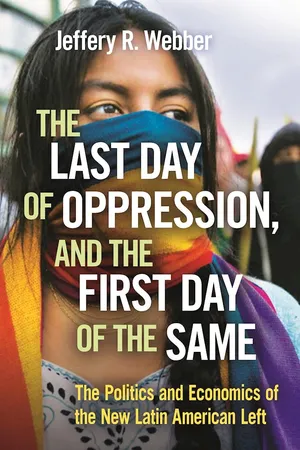
The Last Day of Oppression, and the First Day of the Same
The Politics and Economics of the New Latin American Left
- 336 pages
- English
- ePUB (mobile friendly)
- Available on iOS & Android
eBook - ePub
The Last Day of Oppression, and the First Day of the Same
The Politics and Economics of the New Latin American Left
About this book
Information
seven
The Long March East: Evo Morales and the Consolidation of Agrarian Capitalism in Bolivia559
With the support of more than 60 percent of the popular vote, the symbolic weight of Evo Morales’s third inauguration was heavy. The ceremonial images in Tiwanaku, and later in the National Congress, conveyed the pride of place occupied, at least symbolically, by indigenous peoples, peasants, miners, and workers in the MAS government. According to Bolivian sociologist Fernanda Wanderley, in recent years the predominance of symbolism has often cast a shadow over any coherent evaluation of the fit between the government’s practice and its ostensible ideals and political commitments: “This is the symbolic and political force of this government. The question of whether it is actually committed to these ideals constitutes another register of analysis. And while the sensation of an economic bonanza and macroeconomic stability are maintained, this question will remain secondary.”560
The establishment of a plural economy driven by state intervention, and indigenous liberation through territorial and political recognition, are said to have ushered in a democratic and cultural revolution, displacing the corruption and injustice of the preceding orthodox neoliberal order with a government of social movements.
With an average growth rate of 5 percent since 2006, impressive drops in levels of poverty and extreme poverty, massive infrastructural projects like the new gondola linking the sprawling shantytown of El Alto with the capital city of La Paz and the Tupac Katari satellite, and social achievements in areas such as illiteracy reduction, it is not difficult to see why Morales is popular. But in what sense does the new political economy introduced by Morales since 2006 offer a radical alternative to neoliberalism, much less a revolutionary transformation of Bolivian society, economy, and state?
This chapter explores this question in relation to Bolivia’s evolving agrarian class structure over the Morales era of contested neodevelopmentalism (2006–2016), in historical comparison with the eras of nationalist import-substitution industrialization (1952–1985), and orthodox neoliberalism (1985–2005). According to the Bolivian government, there has been a dramatic and egalitarian transformation of land tenure between the country’s two long periods of agrarian reform, 1953–1992 and 1996–2014, with the post-2006 governments of Morales achieving the bulk of reform carried out in the latter period. At the close of the 1953–1992 period, 39.24 million hectares, or 68 percent of land, was in the hands of large and medium property owners, this narrative suggests. Their share dropped to 9 percent by 2014, with only 6.3 million hectares under their control. Meanwhile, the latter period saw a dramatic expansion of state property (24.5 million hectares, or 34 percent), indigenous Tierras Comunitarias de Origen (Communitarian Lands of Origin, TCOs) (23.7 million hectares, or 33 percent), and peasants and interculturals (Andean indigenous-peasant migrants from the highlands to the lowlands) (17.8 million hectares, or 24 percent).561 By 2010, the Ministry of Rural Development and Land claimed that the distribution of rural properties undertaken to that point had already achieved a “communitarian renewal of agrarian reform” and in a short while would achieve “an equitable and inclusive structure for all economic actors,” which would result in “practically two thirds of the national territory being in the hands of the country’s majority, with the state having control of a half of the remaining third part of the national territory, and the sector of individual property owners linked to agro-industrial activity having access to the other half of the last third.”562 For the Morales government, this trajectory represents a radical rupture with the inherited agrarian class structure in Bolivia, which was characterized by a fundamental dualism of concentrated large capitalist properties on one side, and a majority rural population of land-poor or landless indigenous peasant...
Table of contents
- The Last Day of Oppression, and the First Day of the Same
- One: Latin America’s Second Independence
- Two: Global Crisis and Latin American Tendencies: The Political Economy of the New Latin American Left
- Three: Contemporary Latin American Inequality: Class Struggle, Decolonization, and the Limits of Liberal Citizenship
- Four: The Indigenous Community as “Living Organism”: José Carlos Mariátegui, Romantic Marxism, and Extractive Capitalism in the Andes
- Five: Chile’s New Left: More Than a Student Movement
- Six: Evo Morales and the Political Economy of Passive Revolution in Bolivia, 2006–2016
- Seven: The Long March East: Evo Morales and the Consolidation of Agrarian Capitalism in Bolivia
- Eight: Dual Powers, Class Compositions, and the Venezuelan People: Reflections on We Created Chávez
- Nine: Conclusion: From Hegemony to Impasse
- Acknowledgments
- About the Author
Trusted by 375,005 students
Access to over 1.5 million titles for a fair monthly price.
Study more efficiently using our study tools.
Frequently asked questions
Yes, you can cancel anytime from the Subscription tab in your account settings on the Perlego website. Your subscription will stay active until the end of your current billing period. Learn how to cancel your subscription
No, books cannot be downloaded as external files, such as PDFs, for use outside of Perlego. However, you can download books within the Perlego app for offline reading on mobile or tablet. Learn how to download books offline
Perlego offers two plans: Essential and Complete
- Essential is ideal for learners and professionals who enjoy exploring a wide range of subjects. Access the Essential Library with 800,000+ trusted titles and best-sellers across business, personal growth, and the humanities. Includes unlimited reading time and Standard Read Aloud voice.
- Complete: Perfect for advanced learners and researchers needing full, unrestricted access. Unlock 1.5M+ books across hundreds of subjects, including academic and specialized titles. The Complete Plan also includes advanced features like Premium Read Aloud and Research Assistant.
We are an online textbook subscription service, where you can get access to an entire online library for less than the price of a single book per month. With over 1.5 million books across 990+ topics, we’ve got you covered! Learn about our mission
Look out for the read-aloud symbol on your next book to see if you can listen to it. The read-aloud tool reads text aloud for you, highlighting the text as it is being read. You can pause it, speed it up and slow it down. Learn more about Read Aloud
Yes! You can use the Perlego app on both iOS and Android devices to read anytime, anywhere — even offline. Perfect for commutes or when you’re on the go.
Please note we cannot support devices running on iOS 13 and Android 7 or earlier. Learn more about using the app
Please note we cannot support devices running on iOS 13 and Android 7 or earlier. Learn more about using the app
Yes, you can access The Last Day of Oppression, and the First Day of the Same by Jeffery R. Webber in PDF and/or ePUB format, as well as other popular books in Politics & International Relations & Political Economy. We have over 1.5 million books available in our catalogue for you to explore.