![]()
1
Detroit
DETROIT WAS ACTUALLY the last stop I made on my big round-the-country journey looking for some answers — or at least some insightful questions and interesting stories — on what it’s going to take to change the law of the land so that a sustainable life is even potentially legal, much less standard practice. But the more I thought about the place, the more iconic it seemed as a prime example of where we went wrong, and also as a Petri dish of what could change for the better. So it makes sense to start with this most intriguing of metropolises.
Detroit is dying; Detroit is pulsating with life. Both are true, and the place is, at least on a few levels, undergoing a metamorphosis from a corporate car town to a thriving hub of grassroots artistic and regenerative experimentation. While broad avenues built for massive car traffic now lay barely used with plastic bags caught in dead weeds growing through cracks in the pavement, the residents of the city are reinventing themselves by growing their own food on abandoned land, running vegan restaurants out of their foreclosed homes and elaborately decorating nearby abandoned buildings to preserve them and scare away the crackheads.
Detroit is corrupt, almost utterly so. While I was there, the specter of ex-mayor Kwame Kilpatrick’s felony charges for paying nine million dollars of public funds to police officers to try and cover up an extramarital affair hung over the city, as did a multitude of other scandals including bribery and the embezzlement of educational funds involving a police chief and several former city council members. Over its two-hundred-year existence, the city has a long history of piling up laws on top of laws, many passed with special interests in mind rather than the welfare of the public. It seemed like whoever I spoke with said that what they were doing was illegal for some reason or another, in violation of some relic of a statute that was somewhat contradicted by another statute under a different department.
Laws can have two different purposes. They can protect the welfare of the less powerful by holding those with more power accountable. Or they can reinforce the privilege, Latin for “private law,” of the elite and keep the little guy from achieving any independence. Often it is the case that laws that start out with the purpose of, or at least the pretense of, promoting the former end up over time turning into the latter. Power, it seems, is the most addictive thing on earth. No amount of it is satisfying. The people I met in this dynamic city, and all across the country, were mostly violating laws that started out as reasonable but ended up being used as a source of privilege and corruption. The motivations of the amazingly diverse group of folks I met who were challenging laws across the land were remarkably consistent, a mix of a longing for more personal independence and a desire to bring their lives and communities back into the cycle of life. It was a great inspiration to see how consistently these two goals were achieved by the same actions.
Part of what makes Detroit so interesting as a jumping off point is how unsustainably it grew after 1900, especially as the advent of the automobile industry transformed the town into the Motor City. Detroit was one of the first cities to embrace the automobile on a large scale, with Henry Ford’s five-dollars-a-day wage given much of the credit for developing a manufacturing middle class capable of affording this luxury. All technology is a double-edged sword, and whatever conveniences it provides come at the cost of more dependencies. The car culture that swallowed Detroit’s city planning is an excellent example of this. The rampant suburbanization that didn’t severely affect many cities until after World War II was already evident in 1920’s Detroit. Many main thoroughfares are four or five lanes wide, even in the older parts of town. Trying to cross these mammoth and decaying boulevards on foot feels foolhardy, and the fear of the light changing before you’re anywhere near the other side is constant. Getting around without a car, unlike in neighboring midwestern cities like Milwaukee and Chicago, is unimaginable to a newcomer like myself.
Detroit continued its road-building binge after World War II, steamrolling older neighborhoods to make way for a bevy of interstates to ferry fearful whites out to the burbs from downtown. It worked. And then these urban refugees decided they would simply build their businesses out where they lived, especially after the Twelfth Street riot raged for five days in the summer of 1967 leaving 43 dead. Next, the oil spikes of the 1970s came and put massive dents in the auto industry. By the turn of the millennium, large swaths of the city had been abandoned and burned to the ground. Finding a grocery store became close to impossible for many urban residents.
All of this puts Detroit at the forefront of dealing with issues that are likely to plague the rest of the nation, and potentially the world, this century. Dwindling fossil fuel supplies will likely make much of the suburbs in their current form uninhabitable. Importing food long distances is likewise suspect. Archaic and poorly applied laws, relics of the days of cheap fossil fuels and ignorance of global climate disruption, hinder and exasperate attempts to retrofit existing infrastructure for sustainability. Every city faces the prospect of lower populations, so the paradigm of paying for existing infrastructure with revenue from new growth is suspect everywhere. Most fundamentally, relying on a culture that attempts to derive its satisfaction from ever-increasing–quantities of material goods rather than a deep connection with nature, community and personal spirituality is no longer possible for most folks in Detroit. The material economy has been decreasing for decades.
While responding with fear and dread to these disturbing phenomena is understandable, many Detroiters have also come to understand that relying on a fix from the powers that be is foolhardy at best. Mistrust of the law’s benevolence has combined with an ingrained DIY ethic to get folks out from in front of their TVs and computers and trying to do stuff to improve their lives and communities, regardless of the law or the outdated mores of their neighbors.
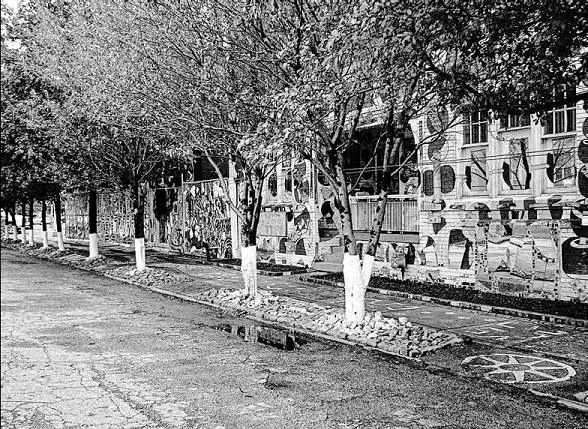
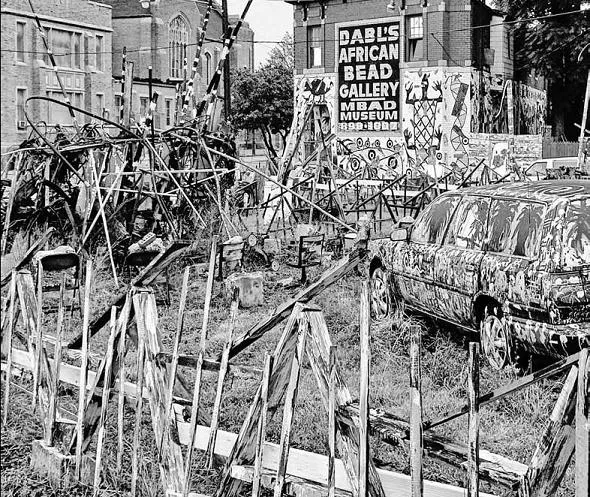
To understand whether changing any particular law will allow for a more profound flourishing of sustainability, it helps to start off with at least a cursory examination of the foundations of our culture and to test the bedrock upon which it rests. I found a great forum for exploring these deeper questions when I showed up at Dabl’s and Perette’s African Bead Museum, on the corner of Grand River and Grand Boulevard near downtown Detroit. I parked on a block that dead-ended into a freeway, with a staid church on my right and the vibrantly patterned African Bead Museum on my left. The brick walls of the two-story building were painted in a frenzied red, yellow and black, with shards of broken mirrors interwoven into bold geometric designs. The sidewalk was filled with a multitude of unrecognizable scripts (at least to me), all underneath an orderly procession of juvenile maple trees. Beyond this main building lay an intriguing arrangement of artwork in an open field, a mix of painted cars, stones sitting in chairs, and piled up paint cans in some kind of fort. All of this artwork was arranged in front of what had initially caught my eye, a two-story multi-family boarded-up house decorated with vivid geometric patterns and the ubiquitous shards of mirror.
The entrance to Dabl’s and Perette’s African Bead Museum in Detroit. The chevron beads painted on the wall represent a nonverbal form of cultural transmission sorely lacking today.
Once inside, I found Dabl presiding over a glass countertop with rows upon rows of hanging beads surrounding him on all walls. He is a large stout man, especially compared with my own skinny self, with close-cropped hair and an introspective air that gives a thoughtful and measured cadence to his deep voice. Over the next few hours I would receive not just a detailed history of the African bead, but also a multitude of ideas about how art, language and writing can either keep cultures enslaved on the path to destruction, or be used as tools of wisdom to help us integrate ourselves with the natural world. Finally, I would learn the motives behind his unsanctioned decorating of the two-story boarded-up home, and how this was an amazing example of bringing “art” (Dabl despised this word) back to its original purpose of preserving history and conveying cultural stories in an unwritten format.
Beads have a long history in all pre-European African societies, especially with the semi-nomadic pastoralists of sub-Saharan Africa, and their origin was considered mystical. Originally made of wood, bone, shells and stone, their diversity of color and meaning flourished after the introduction of glass beads from the Middle East in 200– 300 ad, and became crucially important for pastoralists. These glass beads were often further enhanced by local tribes, and some parts of Africa began manufacturing their own glass beads by the Middle Ages. Beads were used to convey position and marital status and represent ancestors, but especially, along with patterned textiles, to tell the stories of the tribe. More sedentary clans in the wetter parts of Africa also used beads, but supplemented them with artifacts such as carvings, masks and other totems. All these things assisted in keeping alive the oral traditions and stories that shaped and directed these cultures. While Dabl was an expert in the bead and its role in Africa specifically, I found myself generalizing much of what he said to indigenous cultures around the world. Ultimately, he was asking me a profound question: Is art or even literature sustainable? Or does it result in patterns of thought that ultimately separate us and our culture from the natural world? According to Dabl, as an African-American he is part of a population that has been marginalized and whose history and culture have been co-opted. There was not much to disagree with there. But he then argued that forsaking an oral tradition based on handcrafted artifacts in favor of art and the written word, and later the televised image, took a form of story transmission out of the natural world and the community, and isolated it in the mind and the individual. Likewise, the idea of the lone artist working in isolation to create works of “genius” separated from tradition and any cultural story forced the audience for this art to think in terms of these objects being inaccessible and without historical meaning. Such objects are not to be touched and their interpretation is ambiguous and often incomprehensible. They are not a part of day-to-day life and their utility is dispensable.
More traditional methods of cultural transfer like beads and other physical creations, the kind of stuff we would describe as being created by artisans, have been denigrated and eradicated to great effect and, according to Dabl, replaced with stories and religions that are anthropocentric and no longer in the control of the people that need them. Although I’ve heard similar arguments before, it was great to hear it explained from a minority perspective and put in terms of our relationship with creative expression.
One book that had a profound effect upon me in this regard is Chellis Glendinning’s My Name is Chellis and I’m in Recovery From Western Civilization. Chellis does a wonderful job laying out how our move from a nomadic lifestyle to agricultural domestication ten thousand years ago started a spiral of disconnection from the natural world that we had evolved with over tens of thousand of generations. This disconnection can be regarded as a massive ongoing trauma that has disrupted and almost destroyed our sense of safety and well-being on the Earth. We then react to this trauma with compulsive and addictive behavior that further disassociates us from ourselves, and leads to destructive actions that further traumatize ourselves and our descendents. Books like this have led to a field called eco-psychology that examines our disconnection from the natural world and tries to help us create a deeper understanding of our loss and the resulting compulsive behaviors, like non-stop technological addictions and trying to replace the hole in our hearts with more material goods, that seem to provide short-term fixes but exacerbate our original trauma of disconnection.
Although persuasive as all get out, arguments like these are ultimately frustrating in the vague solutions they offer and their pining away for a lost world it is no longer possible to recreate. Somehow we have to figure out a way to apply those primal connections to our current existence to restore the damage done to our individual and collective psyches and to the Earth itself. There has to be a way to cultivate an enduring compromise between our domesticated and wild selves, and to show that this is a more fulfilling life that others caught up in destructive behavior will want to emulate.
So as Dabl continued his explanation, I kept thinking to myself, what are we going to do about it? If artistic expression originally had the purpose of keeping alive the history of a culture and integrating a given people with their surrounding ecology, but has now been lost or co-opted to keep us isolated and anxiety-ridden, are we simply doomed to be blown in the wind like a decaying plastic bag? We can’t go back to being pastoralists on the plains of Africa.
Seeming to understand my frustration on this issue, Dabl got up from his perch behind the counters full of ancient beads and took me on a tour of the property. His magnum opus lay sprawled out in the field behind the shop, the paint cans and chairs and stones sitting in chairs. The piece is titled Iron Teaching Rocks How to Rust. It involved about a dozen different staging areas and was assembled with discarded urban detritus and painted with vivid reds, yellows and greens. Dabl is working to create living artwork that transfers a cultural story of meaning and history to its viewers. This story centers around the interwoven existence of iron, stone and wood, the foundations for humanity’s physical culture, and is based on his interpretation of a synthesis of African tradition. Dabl spun a long tale, not all of which I followed, to be honest, even though I’ve watched my video of him explaining it many times since. It involves a long saga of iron being freed from stone, iron engaging in a civil war, and stones escaping during the tumult. Other parts were more immediately comprehensible. A piece involving four timbers set out in a cross with stones on each point and in the middle represented the four stages of life. A big part of Dabl’s complaint about what he considered “outside” religions (he was referring to non-animist religions like Islam and Christianity introduced into Africa) is the concept of having to be judged once you die. He argued persuasively that belief in religions that judge you when you die not only goes a long way towards creating a fear of death, but also impedes the processing and passing on of cultural knowledge during the final quarter of life. Rather than creating an expectation of becoming an ancestor who advises their progeny after death, making the accumulation of knowledge and wisdom in later life attractive, Western religions create a horrendous stress in the elderly by pushing them up against a time when they might burn in hell forever. Regardless, knowledge is obliterated when the living can no longer turn to their ancestors for advice.
Part of Iron Teaching Rocks How to Rust. To the left of the car, chunks of concrete sit in chairs to learn from the tangle of metal wire before them.
Part of Iron Teaching Rocks How to Rust was a large iconic figure, which Dabl referred to as an mkissi, an iconic figure that is empowered with the help of iron. The mkissi played a central role in achieving two things. First, it kept vandals away. And secondly, it made all of the public artwork, including the heavily painted two-story abandoned building next door, invisible to the city officials. This is very important, because that building did not belong to Dabl or the African Bead Museum, and its decoration could potentially bring about two unwanted consequences. Either it could hasten the building’s demolition because of its “unsightliness.” Or the city could try to force the Bead Museum to take possession of the building because they are “using” it and thus charge them property tax.
Prior to its decoration and protection by the mkissi, the building was simply abandoned and had become a haven for prostitution and drug use. Dabl had continued his physical storytelling onto this abandoned home. The most conspicuous decorations were three giant blue, red and white chevron beads painted across the front on the first story. This style of glass bead was commonly made in Venice in the Middle Ages and exported to West Africa, where it became incorporated into the existing bead culture and traditional storytelling. There were also many jagged pieces of mirror worked into the design. Mirrors are important, according to Dabl, as a means of communicating with ancestors. They also reflect the sun, and the fact that it is possible to catch the fire of the sun by using correctly placed mirrors makes them an extension of the sun. There was one additional benefit of mirrors. They have the power to make potential wrongdoers become self-aware. Destructive behavior like crack cocaine use and vandalism are things people like to do in the dark where they keep their wrongdoing shielded from their own consciou...