![]()
CHAPTER 1
INTRODUCTION TO SMALL-SCALE WIND ENERGY
Humans have harvested energy from the wind for centuries. Harnessed by the Europeans as early as 900 years ago, wind was used to grind grain and manufacture goods. Wind powered ships that helped open up new territories, spurring international trade. In North America, wind energy has been used since the late 1800s. Over the years, tens of thousands of farms in the Great Plains relied on wind pump water for livestock and domestic uses — some still do.
Windmills began to emerge in the 1860s in rural America. By 1890, there were over 100 manufacturers of water-pumping windmills (Figure 1.1). All told over 8 million were installed in this country. Many of these water-pumping windmills have been restored and are still operating today with minimal maintenance.
Windmill vs. Wind Turbine
A windmill is a machine that converts the energy of the wind into other, more useful forms like mechanical energy. Early windmills were designed to grind grain and pump water. Later on, windmills were designed to generate electricity. Electricity-generating windmills are commonly referred to as wind turbines or wind generators. Water-pumping windmills are generally referred to as such or simply as windmills.
Wind energy was also extremely important to railroads in the West. Windmills were often used to fill water tanks along tracks to supply the steam engines of locomotives.
In the 1920s through the early 1950s, many Plains farmers also installed wind turbines to generate electricity. The turbines powered lights and all their appliances, many of which were ordered from the Sears catalog — including electric toasters, washing machines and radios. Radios were particularly important, as they allowed farmers and their families to keep in touch with the world.
Unfortunately, the use of water-pumping and small wind-powered electric generators began to decline in the United States in the late 1930s. Their demise was due in large part to America’s ambitious Rural Electrification Program. This program, which began in 1937, was designed to provide electricity to rural America. As electric service became available, wind-electric generators were mothballed.
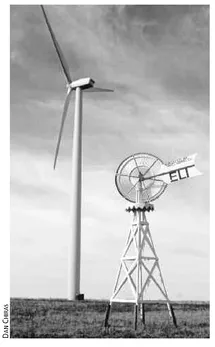
Fig. 1.1: The Old and the New. Water-pumping windmills like the one in the foreground were once common in the West and Midwest. The technology hasn’t changed in 100 years. In the distance is a modern commercial wind turbine that generates electricity to power cities and towns.
dp n="16" folio="3" ?In fact, local power companies required farmers to dismantle their wind generators as a condition for providing service via the ever-growing electrical grid. The electrical grid, or simply the grid, is the extensive network of high-voltage electrical transmission lines that crisscross nations, delivering electricity generated at centralized power plants to cities, towns and rural customers. A key advantage of the grid was its ability to provide virtually unlimited amounts of electricity to customers.
Unfortunately, rural electrification drove virtually all of the manufacturers of windmills and wind-electric generators out of business by the early 1950s. However, in the mid-1970s, wind energy made a resurgence as a result of intense interest in energy self-sufficiency in the United States, stimulated principally by back-to-back oil crises in the 1970s that resulted in skyrocketing oil prices and a period of crippling inflation. Generous federal incentives for small wind turbines, incentives from state governments, and changes in US law that required utilities to buy excess electricity from small renewable energy generators helped stimulate the comeback.
Soon thereafter, however, wind energy took a nosedive. Conservation and energy efficiency measures in the United States and new, more reliable sources of oil drove the price of oil and gasoline down. Federal and state renewable energy tax incentives disappeared as a result of a precipitous decline in America’s concern for energy independence. As a result, all but a handful of the small wind turbine manufacturers went out of business.
In the 1990s, commercial and residential wind energy staged another comeback as a result of many factors, among them rising oil prices, global awareness of the decline in world oil production, an increase in the cost of natural gas, and growing concern for global climate change and its impacts.
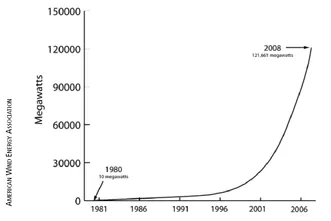
Because of these factors, many believe that this time around, wind energy is here to stay. Much to the delight of renewable energy advocates, large commercial wind farms have begun to appear in numerous countries, most notably the United States, Germany, Spain and Denmark. These facilities produce huge amounts of electricity and are changing the way the world meets its energy needs. Today, wind-generated electricity is the fastest growing source of energy in the world (Figure 1.2).
Fig. 1.2: Global Wind Energy Capacity. This graph shows the installed global capacity (in megawatts) of commercial wind turbines.
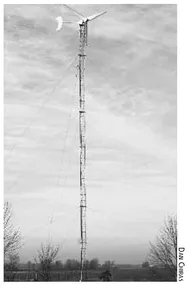
Although commercial wind farms are responsible for most of the growth in the wind industry, smaller residential-scale wind machines are also emerging in rural areas, supplying electricity to homes, small businesses, farms, ranches and schools (Figure 1.3). Most of the small-scale wind turbines “feed” the excess electricity they produce back onto the electrical grid.
World Wind Energy Resources
Wind energy is clearly on the rise and could become a major source of electricity in years to come because wind is widely available and often abundant in many parts of the world. Significant resources are found on every continent. Tapping into the world’s windiest locations could theoretically provide 13 times more electricity than is currently produced worldwide, according to the Worldwatch Institute, a Washington, DC-based nonprofit organization.
dp n="18" folio="5" ? Fig. 1.3: Small Wind Turbine on Tower. This ARE442 wind turbine installed at Mick’s house is mounted on a guyed lattice tower. Maintenance is performed by climbing the tower.
Rated Power in Watts or Kilowatts
Wind turbines are commonly described in terms of rated power, also known as rated output or rated capacity. Rated power is the instantaneous output of the turbine (measured in watts) at a certain wind speed (called the rated speed) at a standard temperature and altitude. The rated power of small wind turbines falls in the range of 1,000 to 100,000 watts. One thousand watts is one kilowatt (kW). Large wind turbines include all of those turbines over 100 kilowatts. Most larger turbines, however, are rated at one megawatt or higher. A megawatt is a million watts or 1,000 kilowatts. It is important to note that wind turbines do not produce their rated power all of the time, only when they’re running at their rated wind speed. As noted in Chapter 5, while rated power is commonly used when describing wind turbines, it is one of the least useful and most misleading of all parameters by which to judge a wind generator.
In North America, wind is abundant much of the year in the Great Plains and in many northern states. It is also a year-round source of energy along the Pacific and Atlantic coasts and the shores of the Great Lakes. Tapping into the windiest locations in the United States, for example, in North and South Dakota could produce enough electricity to supply all of the nation’s electrical needs. Proponents of wind energy estimate that wind could eventually provide at least 20 to 30 percent of the electricity consumed in the United States and other countries.
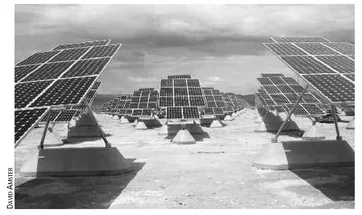
Proponents of renewable energy envision a future powered by wind and a host of other clean, affordable renewable energy resources, among them solar energy, biomass, geothermal energy, tidal energy, wave energy and ocean currents (Figure 1.4).
The Pros and Cons of Wind Energy
Wind is a seemingly ideal fuel source that could ease many of the world’s most pressing problems. Like all energy sources, small wind power has its advantages and disadvantages. Let’s look at the downsides of small wind systems first.
Fig. 1.4: Solar Array. In a renewable energy future, large solar electric installations like this one will supplement electricity produced by other renewable resources, including wind, hydropower and biomass.
dp n="20" folio="7" ? Disadvantages of Wind Energy
Small wind’s disadvantages are few and often grossly exaggerated or only perceived problems. They include wind’s variability, bird mortality, aesthetics, property values and unwanted sound. Some people are concerned about wind being more site specific than solar electricity. There’s even concern about ice falling from turbines after ice storms and interference with radio and televisions signals.
Variability and Reliability of the Wind
Perhaps the most significant “problem” with small wind is that the wind does not blow 100 percent of the time in most locations. Wind is a variable resource, to be sure. It’s not available 24 hours a day like coal or oil. In fact, a wind turbine may operate for four days in a row, producing a significant amount of electricity, then sit idle for two days — or a week.
Wind resources vary seasonally, too. In most locations, winds are typically strongest in the fall, winter and early spring, but decline during the summer. Wind even varies during the course of a day. Winds may blow in the morning, die down for a few hours, then pick up later in the afternoon and blow throughout the night.
Even though wind is a variable resource, it is not unreliable. Just like solar energy, you can count on a certain amount of wind at a given location during the year. With smart planning and careful design, you can design a wind system to meet your electrical needs.
Wind’s variable nature can be managed to our benefit by installing batteries to store surplus electricity in off-grid systems. The stored electricity can power a home or office when the winds fail to blow.
Surplus electricity can also be stored on the electrical grid in many systems. Thus, when a wind-electric system is producing more power than a home or business is using, the excess is fed onto the grid. In times of shortfall, electricity is drawn from the grid.
Wind’s variable nature can also be offset by coupling small wind systems with other renewable energy sources, for example, solar-electric systems. Such systems are referred to as hybrid systems. Solar-electric systems (or photovoltaic [PV] systems) generate electricity when sunlight strikes solar cells in solar modules. Hybrid systems can be sized to provide a steady year-round supply of electricity. Residential wind-generated electricity can also be supplemented by small gas or diesel generators.
Bird Mortality
One perceived problem with wind power is bird mortality. Unfortunately, this issue has been blown way out of proportion. Although a bird may occasionally perish in the spinning blades of a residential wind machine, this is an extremely rare occurrence. Ian is aware of only one instance of a bird kill, when a hawk flew into a small wind turbine.“Because of their relatively smaller blades and short tower heights, home-sized wind machines are considered too small and too dispersed to present a threat to birds,” notes Mick Sagrillo in his article, “Wind Turbines and Birds,” published by Focus on Energy, Wisconsin’s renewable energy program.
The only documented bird mortality of any significance occurs at large commercial-scale wind turbines — but even then, the number of deaths is relatively small. Commercial wind turbines kill an estimated 50,000 birds per year. While this may sound like a lot, this number pales in comparison to other lethal forces, among them domestic cats, automobiles, windows in buildings, and communication towers. All in all, cats are probably the most lethal “force” that birds encounter. Scientists estimate that our beloved cats kill about 270 million birds a year nationwide — though the number is very likely much higher.
Aesthetics
Although many people view small wind turbines as things of great beauty, others contend that they detract from natural beauty. Ironically, those who find wind turbines to be unsightly often ignore the great many forms of visual blight in the landscape, among them cell phone towers, water towers, electric transmission lines, radio towers and billboards. To be fair, there are differences between a wind tower and common sources of visual pollution. For one, a wind turbine’s spinning blades call attention to these machines. Another is that we’ve grown used to the ubiquitous electric lines and radio towers. As a result, people often fail to see them anymore. Given the opportunity to oppose a structure in their “viewshed” (for example, at a public hearing that may be required for permission to install a residential wind system) neighbors will often speak up in opposition. If you need to apply for permission to install a turbine on a tall tower, you may encounter this problem. We’ll talk about ways to address this in the last chapter.
Proximity to Homes and Property Values
Critics raise legitimate concerns when it comes to the placement of wind machines near their property. Although most of the issues over proximity have been raised by individuals and groups that oppose large commercial wind farms, residential systems can also cause a stir among neighbors. Some may be concerned about aesthetics. Others may worry about safety.
To avoid probl...