![]()
CHAPTER 1
The Sustainability Challenge Is a Leadership Challenge
dp n="17" folio="2" ?
The Urgent Need for a Practical Guidebook
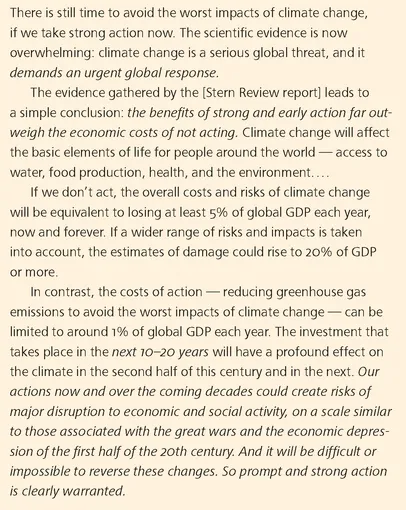
I am concerned that we are running out of time. Leading economists who study the economics of climate change, people like Nicholas Stern, say that we have 10 to 20 years before we reach an irreversible tipping point (Figure 1.0). Parts of the world are losing access to food and water and experiencing other severe resource, climate, population, and health problems. In isolation, each crisis is not good; combined, they are a troubling mix. Rather than improving, things seem to be worsening. So, in short, we need to crank up the urgency, stop the talking and hand-wringing, and get on with making our world more sustainable. As the most influential actors on the planet, companies must lead by example by adopting sustainable economic, environmental, and social practices. Quickly.
A few companies (3 to 5 percent) are already taking the lead. However, we need more enterprises to join the movement so that we have a critical mass (20 percent) of enlightened enterprises on board. We will only achieve unstoppable momentum if sustainability champions become more effective leaders.
Sustainability champions/leaders are looking for help, and they are understandably impatient. They seek a prescriptive distillation of lessons learned from others — an abridged field guide of tips for transforming organizational culture from unsustainability to sustainability, without all the supporting anecdotes and case studies. That is what this guidebook provides.
Despite the urgent need for corporate transformations, the change leadership style advocated throughout this book is decentralized and non-directive. It is courageously soft. That is why it works and enables companies to rapidly develop winning sustainability strategies, breakthrough products, and innovative services.
dp n="18" folio="3" ?FIGURE 1.0
Stern Review: The Climate Change Situation Is Urgent
Source: Nicholas Stern, The Economics of Climate Change, Cambridge University Press, 2006, pp. vi–ix (italics added).
Leadership Practices for Sustainability Champions
Sustainability champions are found throughout corporate hierarchies. They have a passion about sustainability and they aspire to persuade their companies to become model sustainable enterprises. They want their companies to be a more positive force in the world. Often they hold junior or middle management positions in their organizations and lack the authority to effect the necessary changes. Understanding that leadership is a role, not a position, they cleverly exert their influence and convince the right people to help make it happen.
Sustainability champions promote the dialogue that creates the culture change and governance transformations necessary for a company to be truly sustainable. They are change makers. They use strategies and tactics from the arsenal of effective organizational development practitioners, social marketers, team builders, and learning organization leaders. They transform their companies into more sustainable corpo - rate citizens with better products, more responsible services, and more inclusive governance approaches.
Another appropriate label for these leaders is “sustainability intrapreneurs.” Intrapreneurs apply entrepreneurial approaches within existing large organizations.1 Sustainability intrapreneurs integrate environmental and social values and behaviors deeply into their companies. I will use the labels “sustainability champion” and “sustainability intrapreneur” interchangeably.
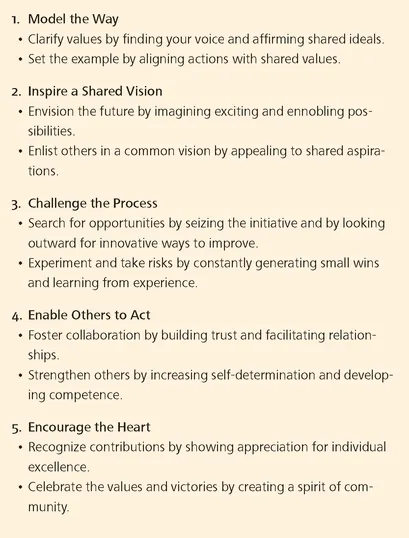
The sustainability challenge is a leadership challenge. Sustainability champions/intrapreneurs apply The Five Practices of Exemplary Leadership®, outlined in Figure 1.1, to sustainability challenges in their organizations. This guidebook elaborates on how to do that, echoing the five leadership practices in its suggested steps, practices, paradoxes, and advice on how to avoid derailers.
dp n="20" folio="5" ?FIGURE 1.1
Kouzes and Posner: The Five Practices of Exemplary Leadership®
Source: James M. Kouzes and Barry Z. Posner, The Leadership Challenge, Jossey-Bass, p. 26. Copyright © 2007. Reproduced by permission of John Wiley and Sons, Inc. The Five Practices of Exemplary Leadership® is a registered trademark of James M. Kouzes and Barry Z. Posner.
An Unsustainable Company
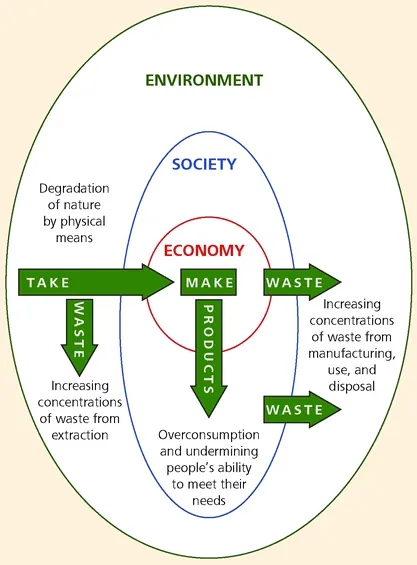
How would you know an unsustainable enterprise if you saw one? Unfortunately, it would look like today’s take-make-waste norm, as portrayed in Figure 1.2. That model is not working. That is, it violates all four of the Natural Step’s systems conditions for a sustainable society.2
1. It contributes directly or indirectly to the systematic increase in the concentrations of waste from substances extracted from the earth’s crust, such as heavy metals, fossil fuels, and byproducts from their use.
2. It contributes directly or indirectly to systematic increases in concentrations of hazardous and non-hazardous waste from substances produced by society, such as over 70,000 chemicals, dioxins, and PCBs.
3. It contributes directly or indirectly to systematic overextraction and degradation of nature by physical means, such as deforestation, overharvesting of fisheries, and depletion of farm lands.
4. It contributes directly or indirectly to abuses of political or economic power in society so that human needs are not met for such things as clean air, potable water, nutritious food, adequate shelter, and quality of life.
The indirect contributions referenced above occur in the company’s supply chain and its distribution system to end users. They include the company’s ecological footprint from its indirect consumption of water, energy, and raw materials throughout its value chain. Corporate accountability for supply chain impacts is a recent sustainability demand from important stakeholders.
Unsustainable capitalism is a fun game for some, but it causes too much collateral damage in the environmental and social spheres. We need a more responsible game plan.
dp n="22" folio="7" ?FIGURE 1.2
Unsustainable, Linear, Take-Make-Waste Model
Source: Based on ideas in Bob Doppelt, The Power of Sustainable Thinking, Earthscan, 2008, p. 18; Peter M. Senge et al., The Necessary Revolution, Doubleday, 2008, pp. 27 and 102 (Copyright © 2008 by Peter M. Senge and Bryan Smith, Nina Kruschwitz, Joe Laur and Sara Schley. Used by permission of Doubleday, a division of Random House Inc.); Ray Anderson, Mid-Course Correction , Peregrinzilla Press, 1998, p. 107; and the Natural Step’s four systems conditions, NaturalStep.org/en/the-system-conditions.
A Sustainable Company
A sustainable corporate model differs significantly from today’s model. Figure 1.3 shows how it honors Natural Capitalism’s four strategies for an authentically sustainable society.3
1. Radical resource productivity: Companies stretch natural resources by increasing productivity for a given amount of a resource by factors of 5, 10, or 100. This addresses issues of overharvesting and depletion.
2. Ecological redesign: Companies use closed-loop production systems so that any waste from production and end-of-life disposal is treated as a resource and reused. Companies acknowledge they can’t throw things away because there is no “away.”
3. Service and flow economy: Companies replace their goods with services. They lease products and their solutions instead of selling them. When the product becomes obsolete or is unable to produce its service, the company takes it back and recycles or remanufactures the returned product.
4. Investment in natural capital: Companies restore, maintain, and expand ecosystems to sustain society’s needs and avoid social upheaval and costly regulations.
The new borrow-use-return business model is more responsible.4 A sustainable enterprise aspires to a sus...