![]()
PART I
Green Buildings Today
![]()
CHAPTER 1
Green Buildings in a Global Context
Green buildings are part of a global response to increasing awareness of the role of human activity in causing global climate change. Buildings account for more than 40% of all global carbon dioxide emissions, one of the main culprits implicated in the phenomenon of global warming. While the US and Western Europe, Canada and Japan contribute the majority of greenhouse gas emissions at the present time, this situation is going to change dramatically in the near future. The projected rapid growth of carbon dioxide emissions from China, India, the rest of Asia, Brazil and Russia make it imperative that the entire world participate in reducing the “carbon footprint” (the impact on the environment in terms of the amount of greenhouse gases produced, measured in units of carbon dioxide) of urban civilization over the next 30 years. Global temperature increases are inevitable, with significant consequences for all of us.
Many observers predict that half the new building over the next three decades will occur in China alone, some 220 billion square feet of new space for residential, commercial and industrial uses. Without a focus on energy-efficient and green buildings, we have no chance for tackling global climate change. The US and other developed countries need to set a leadership example in tackling their own contributions to carbon dioxide emissions. There is every reason to believe that this is not only the socially responsible thing to do, but that it will be good business as well, for the entire world soon will be buying all manner of “carbon reduction” technologies. As the most inventive nation in the world, the US is poised to reap enormous economic advantage from addressing climate change issues in buildings with new technologies, processes and systems. By doing so, we will not only grow our own economy but will also make a major contribution to the global problem.
There are other practical reasons for innovating with green buildings. Consider for a moment the major scarcities of clean potable water around the world, as well as worsening long-term drought conditions in the American Southwest and in places such as Australia. New water conservation, wastewater treatment and water reuse technologies promise to cut building water use in half, perhaps leading to a 5% to 10% reduction in total water use. Learning how to cut energy use in buildings will also cut water use from thermal power plants (coal and nuclear), estimated to use half the water supply in the western US, directly or indirectly.
In many parts of the world, conflicts over energy and water resources are becoming common. Global warming threatens the water supplies of much of the world dependent on summer runoff from glaciers and high-mountain snow packs for summer irrigation. Some predict that as the Himalayas become more rainy and less snowy, and as water from their snow pack runs o faster in the spring, the entirety of Southeast Asia dependent on the Mekong River, for example, will begin to experience worsening drought conditions, along with the need to make vast infrastructure investments in water desalination, water storage and water conservation systems. Saving water in urban uses such as buildings is critical for many urbanizing areas. Water may very well assume the economic and strategic importance in the coming several decades that oil has had for nearly 100 years.
Energy shortages are already a way of life in much of the world, but more acutely so in the rapidly developing mega-cities around the globe. In fact, most of the 40 largest cities in the world are not in the currently developed world; they are places such as Rio de Janeiro and Sao Paulo, Brazil; Mumbai, Chennai, Pune, Bangalore, Delhi and Kolkata, India; Karachi and Lahore, Pakistan; Hong Kong, Beijing, Chonqing, Wuhan, Tianjin, Shenyang, Guangzhou and Shanghai, China. Of the top 40 cities by population, there are only two in the US: NewYork and Los Angeles. In Japan, only one: Tokyo; in Russia, only two: St. Petersburg and Moscow; in Western Europe, only London; in developed East Asia, only Seoul and Singapore.1 Clearly, we must introduce green buildings on a massive worldwide scale to halt the growth of carbon dioxide emissions and avoid the potential for major climate changes and severe economic and health disruptions over the next 30 to 50 years.
Green buildings also present a way to attack the inequity of global resource distribution by providing affordable housing for the poor that is healthier, more resource efficient and cheaper to own and operate. Already many architects, engineers and planners have responded to the disaster of Hurricane Katrina in 2005 by developing innovative housing designs that allow poor and lower middle-class people to have a healthy, attractive home, with lower utility costs and more flood-proofing than conventional housing. Renewable energy systems using the ubiquitous solar and wind energy of the planet are powering many poor villages in the developing world, helping to provide education and health care in resource-poor environments.
Finally, green buildings are good for the environment. Features such as green roofs emphasize sensitivity to urban habitat preservation. Innovative onsite stormwater management and the use of sustainably harvested wood and recycled-content materials help reduce the environmental and infrastructure effects of our current building methods. The essence of good design is having one action carry multiple benefits.
In 2005 an innovative competition to design conventional housing with zero or positive resource and environmental impacts drew more than 600 entries from around the world. The winning team, a group of young designers from Mithun Architects and Planners in Seattle, Washington, designed a house that operates totally on renewable energy, but with a few twists, as the design team explains their concept.
(The core of the house) extends vertically, clad with a super-conductive photosynthetic plasma-cell skin that is able to generate 200% more electrical voltage per area than contemporary photo-voltaics. Building on current research involving extracted spinach protein, this living skin is photosynthetic and phototropic; it grows and follows the path of the sun, generating electricity in excess of single family needs. Excess power is distributed to neighboring homes and street lighting infrastructure.
This is an example of the type of out-of-the-box thinking that green buildings are eliciting. The design also addresses water reuse, materials selection, ventilation needs and community connectedness.2
New green building materials are showing how we can reduce the impact on people and ecosystems from chemicals that contain persistent bio accumulative and toxic compounds. By applying the “precautionary principle”— in essence, putting the burden of proof on industry to test everything and know its effects fully before releasing new chemicals into the human and natural ecosystems — green building product selections can help reduce the “chemical soup” that causes acute chemical sensitivities in many people. At the larger ecosystem level, the precautionary principle is an application of the Hippocratic Oath that doctors abide by: “First, do no harm.”3 There are strong reasons to suspect that human ingenuity is not infallible and that natural systems that have evolved over millions of years without having to deal with industrial chemicals are far more fragile than we assume.
Some 40 years ago, the Whole Earth Catalog, a bible of sorts to many Baby Boomers, coined the slogan “We are as gods and better get good at it.” The essence of that message is that if human beings are remaking the Earth in their own image—a process well underway —we’d better start drawing lessons from nature about achieving long-term sustainability on a very finite planet. Green buildings are a major priority for achieving sustainable development without sacrificing quality of life for all Earth’s inhabitants, human and otherwise. The Hannover Principles, first enunciated in 1992 by American architect William McDonough and German chemist Dr. Michael Braungart, give clear guidance for sustainable design. The first principle reads simply: “Insist on the rights of humanity and nature to coexist in a healthy, supportive, diverse and sustainable condition.”4 Green buildings are an organized approach to conforming to this attitude.
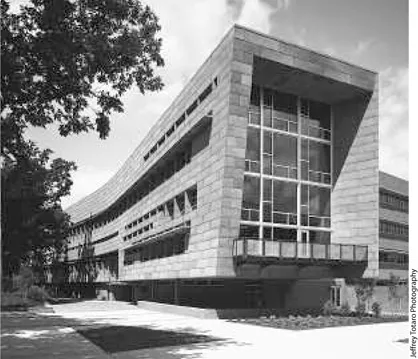
A LEED® Gold-certified Building at Penn State University, designed by Overland Partners with WTW Architects, reduces energy use by 40% .
Resource Depletion and Carbon Dioxide Emissions
According to the US Green Building Council, the annual direct impacts of all US residential and commercial buildings include 39% of total energy use, 68% of electricity consumption and 30% of greenhouse gas emissions. Add in the embodied energy in making building materials, getting them to the job site, installing and servicing them, and total energy use is closer to 48% . Buildings make a major impact on just about every aspect of the world we live in; building design and construction can account for up to 30% of raw materials use, 40% of non-industrial landfill waste (including 31% of the mercury in municipal waste); 12% of potable water use, according to the US Green Building Council and the US Environmental Protection Agency.5 Taking firm actions to reduce the environmental impacts of buildings can have a number of beneficial effects:
• Reduce ocean and river pollution from stormwater runoff.
• Extend the life of municipal infrastructure by using less water and contributing less stormwater, thereby allowing growth without infrastruc...