![]()
PART I
TECHNIQUES
Planning
Planting
Sustainable Crop Protection
Soil and Crop Quality
Harvest and Beyond
![]()
Planning
Chapter 1
Year-Round Production
Food production requires planning, and the stages of a good planning process are cyclical, with information from each stage suggesting changes for other stages. Before the cycle even starts, it is important to be clear about the goals of your farming. Here at Twin Oaks Community, the goal of our garden crew is to increase our self-sufficiency and reduce dependence on the cash economy. We aim to provide a diverse, year-round supply of tasty, fresh, organic vegetables and small fruit for our intentional community of a hundred people, and also to grow enough to process for out-of-season use.
The increasing interest in buying local food and eating organic is creating a need for a dependable supply of local, sustainably grown winter vegetables as well as summer ones. Before you wail with exhaustion at the thought of more work and no rest, let me emphasize that all farmers need time to rest, and this needs to be incorporated into the farm’s schedule. It might take the form of a complete shutdown of the farm’s interaction with the public, or a slowdown that allows all the workers to take turns vacationing. Give careful consideration to what you can do to extend the season without overworking yourself, your crew, or your soil. If you decide to provide produce during the winter, you’ll find that the pace is naturally slower: few weeds germinate and established crops need less attention. It’s not a second hectic summer.
We’ve identified 16 factors that help us to keep good food on the table year round:
1. Planning: During the winter we spend a few hours each week working on some aspect of planning the coming year’s work. This helps us make best use of our land, money, people, climate and crops. We also do some mid-year planning for the second half of the year, for the hoophouse and for the intensive raised bed area where we grow many different crops in quick rotation. We recognize that a plan is just a plan of what we intend to do: if the situation changes we can always change the plan. Having a map and a schedule helps us make the best use of the growing season and minimizes the need for last-minute, middle-of-the-field, brain-frying calculations in August. I create a field manual, with all the most important maps, schedules and crop specifications inside plastic sheet protectors. See the next chapter for all the details on this.
2. Caring for the soil: Compost, cover crops and organic mulches such as spoiled hay or old sawdust all improve the soil. Getting an annual or biennial soil test and amending with any needed lime, gypsum or other minerals will help increase yields. A good multi-year rotation schedule for the main crops will also help get the most from your soil, by varying what is drawn from it each year.
3. Gearing up: Having appropriate, functioning machinery and tools, as well as an ample irrigation system, ensures that productivity is not limited by your equipment. Implements need to fit the scale of the farming and the number of people available to do the work. We’re growing on 3.5 acres (1.5 hectares). What we have is workable, although not ideal. We use a John Deere tractor for disking, compost spreading and bush-hogging, an 11-hp BCS “walking tractor” (rototiller), many scuffle hoes, an Earthway manual seeder, some drip irrigation, seven overhead rotary sprinklers (Rainbirds), seven wheelbarrows, six Garden Way carts and many stacks of plastic five-gallon buckets. We also have lots of helpers.
4. Research and information: One of the most important farm implements is the brain! Gathering (and retaining) information helps avoid silly mistakes in the field. Books, websites, seed catalogs, conferences and field trips to other farms can feed the farmer’s mind and spirit and lead to better crops. A good filing system, in both paper and electronic formats, keeps the information accessible.
5. Choice of crops and varieties: Every year we try to introduce a new crop or two, on a small scale, to see if we can add it to our “portfolio.” Sometimes we can successfully grow a crop that is said not to thrive in our climate. Rhubarb works, but brussels sprouts really don’t. We like to find the varieties of each crop that do best for our conditions. We read catalog descriptions carefully and try varieties that offer the flavor, productivity and disease resistance we need. Later we check how the new varieties do compared with our old varieties. We use heirloom varieties if they do well, hybrids if they are what works best for us. We don’t use treated seeds or GMOs, because of the wide damage we believe they do.
6. Maximizing plant health: Keeping plants growing well, by preventing and controlling pests, diseases and weeds, will lead to a longer productive crop life and a longer-running food supply.
7. Overwintering crops: Kale, collards, spinach, leeks and parsnips can all survive outdoors without rowcover in our climate (USDA Winter Hardiness Zone 7). We can harvest small amounts throughout the winter, and when spring arrives, the plants perk up and give us big harvests sooner than the new spring-sown crops. Arugula, mache (corn salad) and some other small greens are very winter-hardy too.
8. Season extension: The supply of a crop can often be extended at both ends of its normal growing season. Usually an extension of two or three weeks takes only a little extra vigilance and a modest investment in rowcover or shadecloth. Naturally, the further you try to extend the season of a crop beyond what is normal for your climate, the more energy it takes and the less financially worthwhile it becomes. We have recently discovered the wonders of biodegradable plastic mulch, such as Eco-One and Biotelo Mater-Bi. These mulches warm the spring soil and bring melons to maturity three or four weeks earlier.
9. Indoor growing: A hoophouse is a very good investment for winter crops, as the rate of growth of cold-weather crops is much faster inside, and the quality of the crops, especially leafy greens, is superb. Even though we had expected good results from a hoophouse, we were amazed at just how incredibly productive it was. Also, working in winter inside a hoophouse is much more pleasant than dealing with frozen rowcovers and hoops outdoors. Greenhouses and coldframes also offer opportunities for cold-weather cropping.
10. Transplants: Using transplants often makes multiple croppings possible in a bed in one season, because it reduces the length of time each crop needs to be in the bed. It also extends the season in the spring by allowing plants started inside in milder conditions to be set out as soon as the weather is mild enough, giving them a head start over direct-sown crops. And it means over-wintered cover crops can be left to grow longer (for example, until clovers, vetches or peas begin to flower), for improved soil nutrients.
11. Succession cropping: We plant outdoor crops here in central Virginia every month. Admittedly, in December and January the only things we plant are multiplier onions (potato onions). We grow nine plantings of carrots, six or seven plantings of sweet corn, five or six of cucumbers, squash, zucchini, edamame and bush beans. We do almost fifty plantings of lettuce! Cowpeas and limas get two plantings. This means as one planting is passing its peak, a younger one starts to be productive. Some crops grow here in spring and again in the fall, so we make the most of both seasons. Examples include broccoli, cabbage, spinach, kale, collards, turnips, beets, potatoes and many Asian greens. I recommend recording dates of sowing, first harvest and last harvest for each planting. You can use this information to determine the best sequence of planting dates for keeping up a continuous supply.
12. Interplanting and undersowing: Sowing or transplanting one crop (or cover crop) while another is still growing is a way of increasing the productivity of the land. Sometimes it enables a cover crop to get established in a timely way that would not be possible if we waited for the food crop to be finished first. We undersow our last sweet corn planting with oats and soybeans, which then become the winter cover. We interplant peas in the center of spinach beds in March, and plant lettuce either side of peanuts in April. We also undersow our fall brassicas with clovers in August, to form a green fallow crop for the following year.
13. Storage: We store potatoes in a root cellar; sweet potatoes, winter squash, pumpkins, garlic and onions in a basement; carrots, beets, turnips, rutabagas, celeriac and kohlrabi in a walk-in cooler; and peanuts in the pantry. Meeting the different storage requirements of various crops helps maximize their season of availability.
14. Food processing: We have a food processing crew who pickle, can, freeze and dry whatever produce we don’t need to eat right away. They also make sauerkraut and jams. We make use of a solar food dryer and a small electric dehydrator. Processed (or “value-added”) foods effectively lengthen the season, without requiring out-of-season growing.
15. Crop review: During the main growing season, we don’t do a lot of paperwork. We record planting dates, and for our succession crops we note the harvest start and finish dates. We label each crop in the field with a row tag. When the crop is finished we pull up the labels and consign them to one of two plastic jars in the shed: “Successes” or “Dismal Failures.” On a rainy day in fall, I transfer the information to the notes column on our Planting Schedule. At the beginning of the winter, we take time to discuss and write up what worked and what didn’t, so that we learn from the experience and can do better next year. This is an example of those triangular cycles recommended in personal growth literature and management workshops, which rotate through three stages: “Plan–Execute–Review” or “Learn–Do–Reflect.”
16. Lots of help: Last but by no means least, we arrange our work so that unskilled visitors and new community members can join in and be useful.
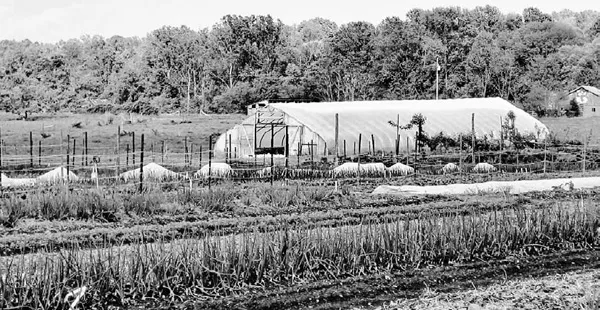
Protecting plants with a hoophouse or rowcover can extend the season. Credit: Kathryn Simmons.
![]()
Planning
Chapter 2
Create Your Own Field Manual
No one has the same farm you do! This chapter will give an overview of our winter annual planning process, and help you create a handy, customized reference file you can consult when anything seems unclear during the hot days of the busy season.
My dedication to winter planning came from the time I found myself standing in the full sun in the middle of the field with a tape measure, notebook and pencil, trying to figure out how many rows of sweet corn I could fit in, and how long to make them. My brain wasn’t functioning at its best, and I was under pressure to get seeds in the ground. There had to be a saner way — ah, winter planning!
Once we have completed one step in our winter planning process, we print out a copy of the final spreadsheet, map or list and decorate it with a whimsical sticker. This lets us easily tell one sheet from another, and the final corrected versions from earlier drafts. The order in which we do these steps means that the information we need is gradually transferred along the chain, and we don’t need to keep going back to consult the many different notes made during the previous year. At the top of the sheet we list which other charts, spreadsheets or maps are needed to compile the new one for that stage. At the bottom we list places to post or file copies, and which subsequent planning stages to pass that information on to.
Plannin...