EAT UP
eBook - ePub
Available until 23 Dec |Learn more

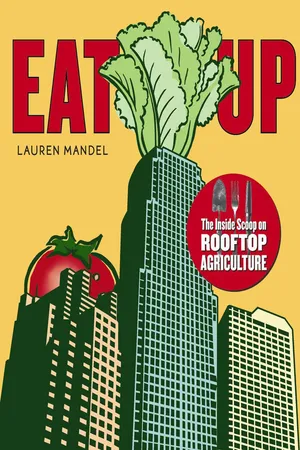
EAT UP

The Inside Scoop on Rooftop Agriculture

  1. 280 pages
  2. English
  3. ePUB (mobile friendly)
  4. Available on iOS & Android
eBook - ePub
Available until 23 Dec |Learn more

EAT UP

The Inside Scoop on Rooftop Agriculture

About this book

From roof to table – urban food has reached new heights.

Soaring prices and concerns about chemical-laden fruits and vegetables increasingly drive us to grow our own healthy food close to home. In cities, however, vanishing ground space and contaminated soils spur farmers, activists, and restaurateurs to look to the skyline for a solution. The hunger for local food has reached new heights, and rooftops can provide the space that cities need to bring fresh, organic produce to tables across North America.

The first full-length book to focus entirely on rooftop agriculture, Eat Up views this growing movement through a practitioner's lens, explaining:

  • Structural, access, and infrastructural considerations
  • Zoning and building codes
  • Proven growing techniques
  • Business and marketing strategies

This graphically rich guide provides inspiration and advice to aspiring growers through photographs of successful rooftop farms and gardens and interviews with industry professionals. Easy-to-use checklists and a decision tree are included to help gauge the viability of each unique rooftop opportunity. Essential reading for home gardeners, entrepreneurs, restaurateurs, policy makers, academics, and designers, Eat Up takes urban agriculture to a whole new level, proving that rooftop farming is not just pie in the sky—it is the future of urban food.

Lauren Mandel holds a master's degree in landscape architecture from the University of Pennsylvania and a bachelor of arts degree in environmental science. She is a project manager and rooftop agriculture specialist at Roofmeadow, where she designs green roofs and oversees green roof and rooftop agriculture projects around the country.

Frequently asked questions

Yes, you can cancel anytime from the Subscription tab in your account settings on the Perlego website. Your subscription will stay active until the end of your current billing period. Learn how to cancel your subscription.
No, books cannot be downloaded as external files, such as PDFs, for use outside of Perlego. However, you can download books within the Perlego app for offline reading on mobile or tablet. Learn more here.
Perlego offers two plans: Essential and Complete
  • Essential is ideal for learners and professionals who enjoy exploring a wide range of subjects. Access the Essential Library with 800,000+ trusted titles and best-sellers across business, personal growth, and the humanities. Includes unlimited reading time and Standard Read Aloud voice.
  • Complete: Perfect for advanced learners and researchers needing full, unrestricted access. Unlock 1.4M+ books across hundreds of subjects, including academic and specialized titles. The Complete Plan also includes advanced features like Premium Read Aloud and Research Assistant.
Both plans are available with monthly, semester, or annual billing cycles.
We are an online textbook subscription service, where you can get access to an entire online library for less than the price of a single book per month. With over 1 million books across 1000+ topics, we’ve got you covered! Learn more here.
Look out for the read-aloud symbol on your next book to see if you can listen to it. The read-aloud tool reads text aloud for you, highlighting the text as it is being read. You can pause it, speed it up and slow it down. Learn more here.
Yes! You can use the Perlego app on both iOS or Android devices to read anytime, anywhere — even offline. Perfect for commutes or when you’re on the go.
Please note we cannot support devices running on iOS 13 and Android 7 or earlier. Learn more about using the app.
Yes, you can access EAT UP by Lauren Mandel in PDF and/or ePUB format, as well as other popular books in Technology & Engineering & Sustainable Agriculture. We have over one million books available in our catalogue for you to explore.

1 | The Backdrop

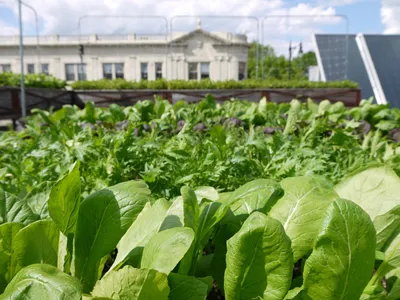
Rooftop greens basking in the sun, Uncommon Ground, IL
Rooftop greens basking in the sun,
Uncommon Ground, IL

what is rooftop agriculture?

Soaring food prices and obesity rates increasingly prompt North Americans to grow their own fruits and vegetables close to home. In cities, forgotten parcels such as vacant lots, sidewalk strips, and park fragments historically served as prime poaching grounds for urban farmers and gardeners to plant their seeds. During recent years, however, land insecurity and contaminated soils demand creative solutions that allow urban agriculture to creep up walls and balconies, and onto rooftops. Broadly speaking, rooftop agriculture is the cultivation of plants, animals and fungi on rooftops for the purpose of human use and consumption. This includes foodstuffs, fibers, animal products and medicinal plants. The hunger for local food has reached new heights, and you truly can’t get more local than your own roof!
The hunger for local food has reached new heights.

urban agricultural niche

Rooftop agriculture is one cog in the greater urban food system. The practice should not be viewed as a cure-all for hunger, nor should the assumption be reached that it will dominate food production in all cities. Rooftop agriculture works in concert with community gardens, farmers’ markets, grocery stores and, of course, rural agriculture to feed hungry cities. A key principle of ecology states that diversity in any system breeds resilience. If one strand of the web fails, the others will hold the web together. Food systems are no different. Rooftop agriculture is powerful in its ability to enhance the diversity, and therefore resilience, of the greater urban food system. Farmers and gardeners pursuing all types of urban agriculture, from planting sunflowers along abandoned railways to raising fish in basements, have the potential to learn from one another. Rooftop agriculture similarly absorbs lessons from other forms of urban production, and in turn contributes to the collective knowledge. There’s always more to learn.
Rooftop agriculture is powerful in its ability to enhance the diversity and resilience of the greater urban food system.

gardening vs. farming

The boundary between gardening and farming is a blurry one. Practitioners, academics and even policy makers qualify the distinction in varying ways, and no one can seem to agree upon a universal definition. One common and relatively compelling opinion describes gardening as the production of agricultural products for self-consumption, charity or gifting. Farming is often defined as the production of these same goods in exchange for money. EAT UP embraces this distinction and highlights inspirational gardens and farms on rooftops around North America. The book also explores the rooftop agricultural industry, as this scale of production encompasses both gardening and farming which involves rooftop farms and gardens with multiple locations.

who’s doing it?

As rooftop farms and vegetable gardens sprout up in cities across North America, restaurant patrons, community groups, individuals and families get to savor the bounty. But who’s actually up on the roof growing all this food? Lots of people — that’s who! People of all different ages and ethnicities, with varied skill sets, and dozens of reasons for growing food.
In North America, rooftop farmers tend to be between the ages of 22 and 55, with men and women equally engaged. Most skyline farmers migrate to rooftops from ground-level farms, some in urban areas, others in more traditional rural settings. Farmers who land these highly prized rooftop positions are generally very knowledgeable about their agrarian genre — whether it be row farming, beekeeping, hydroponics or some other form of production. It’s rare that a newbie finds herself in charge of much on the skyline, as these farms can require large initial investments, which leaves little room for error with day-to-day operations. Less experienced apprentices, interns and volunteers often assist rooftop farmers, as do teams of directors, volunteer coordinators, marketing personnel, publicity coordinators and technical specialists. Other professionals that are critical during the rooftop farm’s design and construction may include a landscape architect, green roof consultant, structural engineer, mechanical/electrical/plumbing (MEP) engineer, architect, waterproofing membrane provider, greenhouse designer, hydroponic system designer and construction contractors from various trades. It takes a village.
Rooftop gardening, on the other hand, attracts enthusiasts with all levels of experience. Novice gardeners may enjoy planting rooftop containers with herbs, while a master gardener may forge an entire community garden by himself. Kids play an important role in rooftop gardening as well. From school and after-school gardens, to family plots, to community gardens, kids spark enthusiasm and soak up knowledge about rooftop gardening. They even teach their friends and parents! Other parties that may be involved during the inception and construction of a rooftop garden include a structural engineer, architect, carpenter, plumber, and possibly an electrician.
Whether well-seasoned or completely green, urbanites from all backgrounds increasingly seek out rooftop farming and gardening opportunities. As the trend continues, more and more individuals, communities and entrepreneurs will look toward the roof for a food solution.
This book highlights North American rooftop agriculture professionals and enthusiasts from Canada, Lebanon, India, France, Sweden, Australia and all corners of the US.
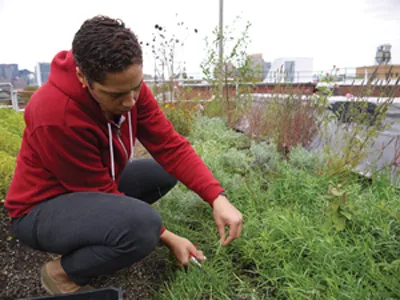
Volunteer harvesting herbs, Eagle Street Rooftop Farm, NY
Volunteer harvesting herbs,
Eagle Street Rooftop Farm, NY

a brief history

urban agriculture

The earliest record of food production within cities dates back to 3100 BCE, when home vegetable gardens were commonplace in China.1 Some historians believe that in addition to providing food, ...

Table of contents

  1. Cover
  2. Title Page
  3. Copyright
  4. Dedication
  5. Contents
  6. Acknowledgments
  7. Intent
  8. Chapter 1 | The Backdrop
  9. Chapter 2 | What’s in It for Me?
  10. Chapter 3 | Seed to Plate
  11. Chapter 4 | Rooftop Gardens (SMALL-SCALE)
  12. Chapter 5 | Rooftop Farms (MEDIUM-SCALE)
  13. Chapter 6 | Rooftop Agriculture Industry (LARGE-SCALE)
  14. Chapter 7 | Potential Hotspots
  15. Chapter 8 | The Path to Market
  16. Glossary
  17. Endnotes
  18. Bibliography
  19. Index
  20. About the Author