![]()
part 1
the call for creative community
![]()
1
The Creative Imperative
A few years ago, we attended a spoken word show featuring young performers from Hip Hop Hope, a program led by Power of Hope, the teen arts organization we founded in 1996. One 17-year-old in particular mesmerized us with his powerful presence and eloquent words. As we watched him stride back and forth across the makeshift stage, we assumed he was a pro who had been performing for years. Exactly how long he had been performing? “Three months,” he told us, “just since going to Hip Hop Hope.” He confessed he’d been too shy to stand up in front of an audience before. “Now I’m performing all over Seattle,” he beamed.
Popular belief tells us that this kind of transformation would be a slow incremental process, but in over 18 years of working with youth and adults in our creativity-based programs, we have almost come to expect such rapid change. In just one week of living in an arts-rich supportive community, we see people’s empathy and self-confidence bloom, not to mention their desire to make a contribution to the world. It’s as if a light comes on.
Again and again, young people defy the media stereotypes of the disaffected, uncaring, hard-to-reach generation. If you have fallen prey to the commonly held view, think again. Through poetry, creative writing, theater, dance and visual art they express the depth of their caring and concern. They step out of their cliques to befriend people from cultures and backgrounds different from their own. A recent Muslim immigrant in our Young Women Empowered program in Seattle told us, “Before this program, I only ever talked to people who look just like me. Now I can relate to anyone.” They gain the confidence to bring their ideas and thoughts into the world. “I used to be silent in school,” said another young woman. “Now my teachers can’t keep me quiet!” Furthermore, they recognize that taking creative risks and becoming engaged citizens makes them happy. “I now have more fun taking big scary creative risks than I used to have doing things that were bad for me,” enthused a young man from an urban neighborhood.
Adults in these intergenerational programs are similarly affected. As they push their creative edges, they discover parts of themselves long dormant, and many connect with this vibrant younger generation for the first time. “This camp reminds me of what it feels like to be fully alive,” said a health care worker at a program in Uganda. And similar results have been borne out in the slums of Bangalore, the back country of Brazil and the war-torn north of Uganda as well as in inner cities of England, the US, Canada, South Africa and Italy.
The Turning of the Tide — To the Right Brain In the US, over three million students drop out of high school each year, with attrition rates in minority communities double and triple those of white students.2 Of the youth who do stay in school, two-thirds say they are bored every day and 17 percent say they are bored in every class. Of those, nearly 40 percent say they are bored because the material isn’t relevant to their lives.3 It’s as if there is no room in too many of our schools for the emerging souls of our young people.
David Whyte, a poet known for his work bringing poetry into the corporate world, speaks of a similar conundrum for adults. He suggests that people leave big parts of their souls in the parking lot when they go into their workplace. How many of us leave ourselves behind when we go to work, whether in a large or small company, a for-profit business, NGO, school or service organization?
Change is afoot, however. A growing number of neuroscientists and leading-edge thinkers in multiple disciplines concur that right-brain thinking — artistic, holistic, pattern-oriented — is the mode of thinking most needed in the 21st century. In his best-selling book, A Whole New Mind, social commentator Daniel Pink tells us that education that pays attention to the right brain is exactly what young people need in order to thrive in this new century. He writes,
The keys to the kingdom are changing. The future belongs to a very different kind of person with a different kind of mind: creators and empathizers, pattern recognizers and meaning makers. These people — artists, inventors, designers, storytellers, caregivers, consolers, big picture thinkers — will now reap society’s richest rewards and share its greatest joys.4
Pink identifies six attributes of right-brain thinking as essential to success in the 21st century: design, story, synthesis, empathy, play and a sense of meaning.
We believe that young people intuitively know this. They are voting with their feet as they contribute to the massive dropout rates in secondary schools that are run on the outmoded factory model of education. Today’s learning needs to include a right-brained approach that engages young people and prepares them to be creative contributors to a world in flux. In our high-technology world, young people need first-hand — unplugged — experiences of themselves, others and the natural world. Expressing their own thoughts and feelings helps them make meaning of their lives; putting their voice out into the world promotes a sense of agency and personal power. And the research is now clear: social and emotional intelligence — right-brain intelligence — is a more reliable indicator of academic and life success than IQ ever was. Science is confirming what we’ve known for a long time. As far back as AD 100, Greek historian Plutarch claimed, “A young person is not a vessel to be filled but a fire to be lit.” Education that activates the right brain is needed in order for young people to thrive.
Developmental scientist Peter Benson, in his book Sparks: How Parents Can Help Ignite the Hidden Strengths of Teenagers has this to say: “Thriving begins with the human spark — that which gives us aliveness, hope, direction and purpose.”5 Research conducted by the Search Institute, where Benson was director, confirms the effectiveness of creative expression and a multi-arts approach in helping young people find their spark. In a recent national study in the US, a substantial majority of youth reported that they feel most alive when they are expressing themselves creatively.6 Using the arts is the best way we know of to activate the powers of the right brain.
Through our work with adults in training programs and organizations, we find that they are looking for the same thing as youth — a deeper connection with themselves and each other and greater access to their creative power. When we sing together, make art, write and read to one another, dance and drum, or play theater games, the two sides of our brain come into balance and the walls that separate us tumble. It’s as if everyone in the room releases a collective sigh of relief and remembers what it means to be human.
“Creative expression is most often accompanied by a feeling of shimmering joy.” — Rollo May
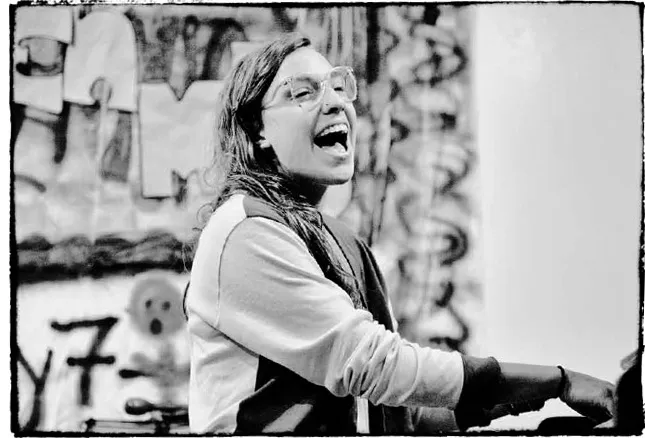
Credit: Sara Dent, Power of Hope Canada
One participant in an arts and leadership workshop we led at a major organizational development conference wrote, “If you would have described what we were going to do I might not have attended, thinking it might be too light weight for me. Well, I was wrong. You showed us beyond a doubt that the arts can be used to bring people together, to bond almost instantly and to overcome barriers of race, age and walk of life. I would not have believed it!”
Creative Expression Is the Secret Sauce The arts provide powerful tools for transforming lives and communities. In the not-too-distant past — and in some cultures still today — creative expression was seamlessly woven into everyday life. Cross-cultural anthropologist Angeles Arrien tells us that in land-based cultures, when sick people went to the local healer, they were essentially asked four questions. She calls these the healing salves:
• When did you stop singing?
• When did you stop dancing?
• When did you stop telling your story?
• When did you stop sitting in silence?7
We Are All Creative
Creativity is one of our greatest sources of energy, and creative expression is what makes it operational in our lives. Unfortunately, too many people are cut off from this powerful force. “When I ask people in my classes who thinks they are creative, it’s shocking to see how few hands go up,” said Rebekka Goldsmith, a singer and vocal coach who leads vocal empowerment trainings in Seattle. We have this same experience again and again, particularly when working with adult groups.
We attribute this to the overidentification of creativity with art-making — and particularly professional art-making. If you can make great art, you’re creative. If you can’t, you’re one of the great mass of uncreative people. Actually, we are all creative. Our creativity is simply our ability to think things up and make them happen. Cooking breakfast, planting a garden and coming up with a budget for an organization are all acts of creativity. Most of us express our creativity in small ways throughout the day.
Creativity, of course, also has to do with artistic expression, and studies show that we thrive when we express ourselves through the arts — especially when we are not under the pressure to be good. In a recent UCLA study of 25,000 youth over 12 years of age, James Caterall found that when young people are engaged in creating art at an early age, they outperform their peers in every category, including academics as well as life skills.8
Studies of US schools that integrate the arts into learning also paint a powerful picture. Schools, teachers and communities that use arts-based learning methods have consistently positive outcomes. The social and emotional climate in schools and classrooms improves, and students bec...