![]()
![]()
Chapter 4
The Workshop Experience
CREDIT: PAULA BAKER-LAPORTE
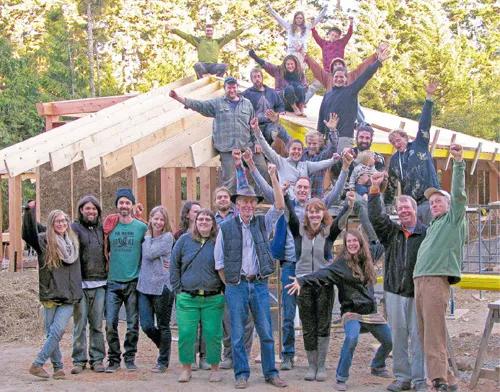
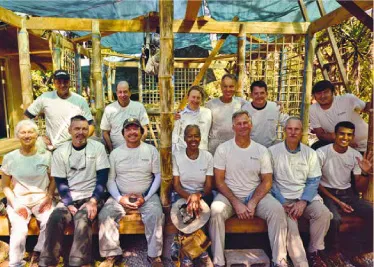
At EcoNest, we hold four Natural Building Workshop sessions each year. Students are invited to hone the innate builder within. Whether the entry point is “screw gun 101″ or refining complex wooden joinery skills, the environment is created and the tone is set for enrichment, but not just of building skills. There is something significant that happens on a soul level when we come together to build with common vision—a vision of working in balance with nature.
Paula relates her experience at a recent workshop.
CREDIT: KEVIN ROWELL
EcoNest Workshop, Costa Rica
Last winter I had the rare opportunity to be a full workshop participant in Costa Rica. I “unplugged” from my office, where the design and administration keeps us busy, and I experienced a profound reminder of why we choose to do this work. Here are some of the memories I took away with me:
I am seated on a bag of rice husks across from Kat, whom I will come to know well over the next few days. Today, we are making mud patties destined to become the walls of our building. Sooney joins us in the work and teaches us a song of gratitude for food. As we learn, Kat chimes in with beautiful harmony. I find my own voice, underused, rusty, in and out of tune, but appreciated none the less. This is not the only time this week that I will step outside my comfort zone. Our patty work takes on the rhythm of the song. We decide to sing this song at dinner for Jorleni and Flori, the two village women who have been consistently churning out incredible meals for our group of 15. Even though they won’t understand the words, we feel certain they will feel our appreciation, so we practice in earnest. The work never stops. As we sing together, our pile of patties grows to an impressive mountain. This camaraderie creates an afternoon of light-hearted pleasure I am never afforded sitting alone with my computer, my usual portal of communication and creative expression. I feel alive. My body is working. I am outdoors and in the heart of nature with butterflies, strange birds, and even a daily inspection from the village deer named Bambi. This time, in this place, the walls are of wattle and daub and bamboo. Back home in Ashland, the workshop experience repeats itself in an equally beautiful bio-region with a more substantial clay/fiber and timber frame fit for the vicissitudes of that climate.
At the end of the week, a new building stands in this little village. It models a sustainable way of building an elegant structure with the materials at hand. It models working in community, building skills, and building bridges inward and outward.
We sang our song, and the kitchen ladies smiled shyly, a little teary-eyed. Not too bad at all!
Modern-day Precedents for Building-Craft Revival
We believe that crafting a home that will serve for centuries is a noble pursuit, worthy of our deepest respect. In contrast, standard conventional home construction involves the assembly of pre-manufactured components into homes with brief warranties. Most construction work is seen as a “blue-collar affair,” not a real profession. Is there a place for the true artisan in our fast-paced consumer culture?
We have seen a growing interest and acceptance of our work because there is a growing segment of the population that chooses quality over quantity, and simplicity over life in the fast lane. These are people who have an abiding desire to steward the environment, and they realize that meaningful change begins at home.
This small but growing segment of our population is the support system for the rebirth of the American artisan and a culture based in respect for nature.
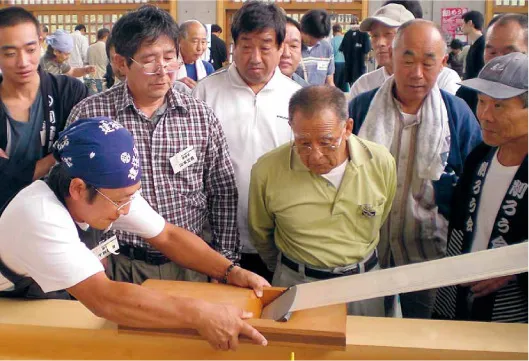
We have been deeply inspired by the precedent set by our European and Asian contemporaries who have kept the ancient building traditions of their cultures alive. Through the Timber Framers Guild, we have been exposed to master craftsmen from around the world. In Japan, we witnessed the Kezurou-Kai hand-planing event. In India, we observed Shilpis carving stone temples and statues in granite with the perfection of their ancestors.
CREDIT: ROBERT LAPORTE
A crowd of carpenters watch with admiration as master carpenter Senga-san produces a silk-like shaving at Kezurou-Kai planing competition in Japan.
The Way of the Craftsman
At our workshops, we have the opportunity to introduce students to “the way of the craftsman.” For many, it is the very first time that they learn to hold a tool with reverence and to approach a piece of wood with humility. For some, this experience is the first step on the road to a passionate career. Dale Brotherton is an accomplished artisan in Japanese woodworking, and we have the great privilege of having him as one of our instructors. The following article written by Dale illuminates our sentiments.
CREDIT: ROBERT LAPORTE
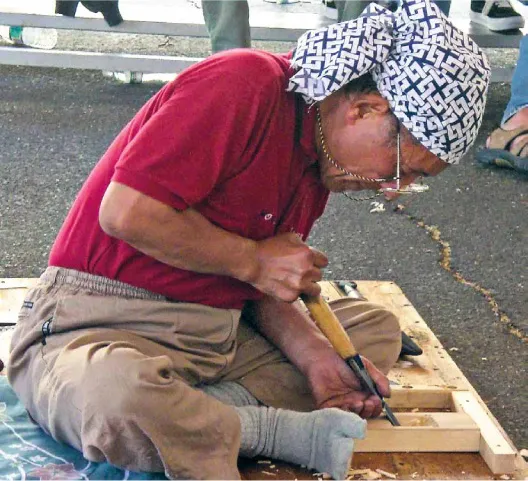
A master plane carpenter in traditional posture using all limbs to create a plane block.
CREDIT: ROBERT LAPORTE
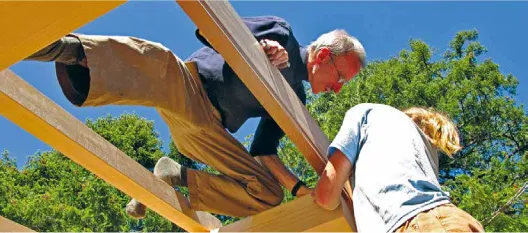
Dale Brotherton in action, assembling a porch roof with a student at an EcoNest workshop.
The Way of the Craftsman
by Dale Brotherton Takumi Company, Japanese Traditional Carpentry
For most of us, it’s easy to forget that our modern approach to learning is very different from that taken by the majority of humans throughout history. Even when pursuing a traditional craft like woodworking or carpentry, the tendency is to study as much as possible, then, relying heavily on the perfect tool, carefully attempt to produce the “perfect” finish from day one. Such an approach inevitably results in only shallow and fleeting satisfaction.
On the other hand, those who have trained in the old ways or have ...