![]()
STRAW BALE BUILDING has made remarkable inroads since the resurgence of this American pioneer building method in the 1990s. From just a handful of enthusiastic builders in the southwestern United States, the use of straw bale walls to make healthy, energy-efficient and low-impact homes and commercial buildings has grown exponentially in only 20 years, and is now recognized in Appendix S of the 2015 International Residential Code (IRC) in the United States. Professional builders, guilds and organizations around the world are actively building and developing methodologies for meeting code requirements while honoring the environmental impetus that inspired the straw bale pioneers.
A Grassroots Development
In a building industry in which innovation and code change are predominantly driven by patents and corporate financial interests, the fact that straw bale building has grown so quickly and widely within a code-driven context speaks volumes about the inherent applicability of this style of construction to a wide range of climates and building contexts. Those pushing straw bale building forward have done so with only grassroots means at hand; there have been no well-connected lobbyists or industry reps involved, no reliable sources of funding, only individual designers and builders with a passion for the advantages this building style can offer individuals and society at large.
The labor equation
The major hurdle that straw bale building faces in its move toward widespread adoption is the higher labor inputs that site-built straw bale walls require. On a construction-cost basis, it has been adequately demonstrated that a well-trained straw bale building crew can complete homes at a price point that is entirely competitive with conventional approaches, as lower material costs can be leveraged to offset higher labor costs. But the conventional construction industry prioritizes the reduction of on-site labor inputs, even when the cost advantages of labor-saving materials and systems are negligible — or even more expensive. The ability to shorten the build cycle and minimize the time construction crews need to be on site motivates the industry. And if the additional labor time involved in straw bale building and the attendant increase in the length of time that crews are on site are not deterrent enough for mainstream contractors, then the need to train crews to work with a new material, using new techniques and methodologies, are certainly barriers to bale walls becoming part of the mainstream palette of options.
An innovation is born, accidentally
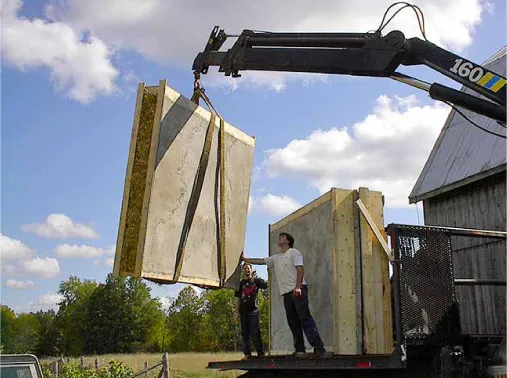
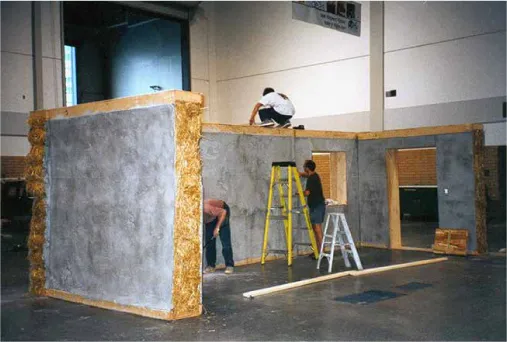
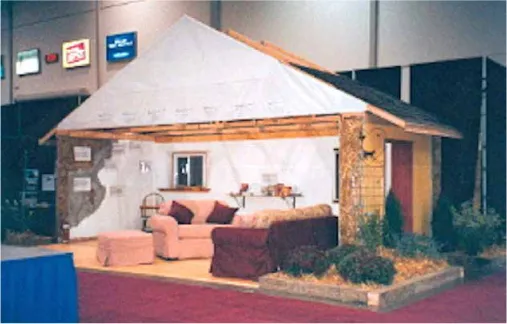
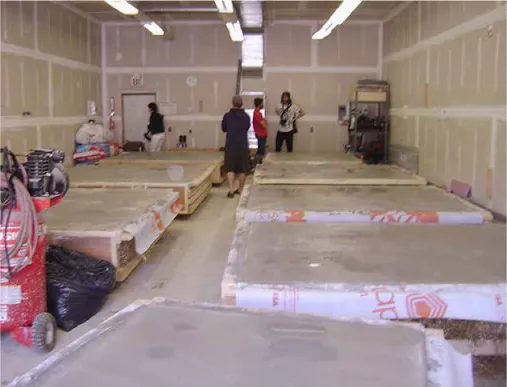
Many straw bale builders have recognized this “deficiency” and have put their minds to exploring ways to get past this hurdle. My own foray into prefabricating straw bale walls began in 2000, when I was invited to create a display for the Toronto Home Show. Realizing it would be impossible to site-build a model straw bale home within the window of time allowed by the show, my partners and I decided to build and plaster the walls in my barn, and deliver the finished panels to the show floor for assembly. We had no idea if it would work, but went ahead and gave it a try. The panels arrived at their destination in perfect condition — no plaster cracks or other transportation issues, and one panel even survived a forklift mishap that saw it fall to the floor but sustain almost no damage. The demo building was assembled very quickly, and I can still feel the “high” that came along with watching this crazy idea prove itself to be extremely feasible.
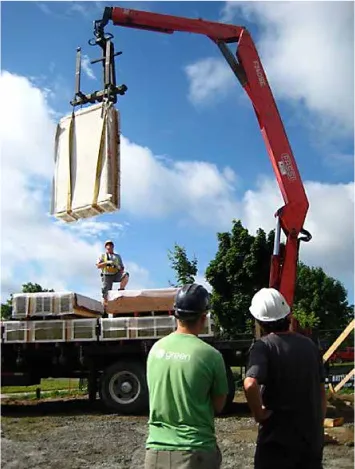
In the following 15 years, I’ve been fortunate to have had the opportunity to build a large number of buildings using prefabricated straw bale panels. Each outing has involved changes to the construction, the lifting and assembling process and the final finishing of the panels. While I cannot say that the process is perfected, I can definitely say that every option we’ve used has been viable and a vast improvement on the labor input and construction timeline of site-built straw bale walls.
An international phenomenon
At the same time that I began experimenting with prefab bale walls, the idea surfaced in no fewer than three countries on three different continents, without any direct contact between those trying out the system. Within a few years, there would be early adopters in at least half a dozen more countries. Today, there are several commercial ventures producing panels and a number of builders who use the technique on a regular basis.
A long list of advantages
The benefits of prefabricating straw bale walls are many, and include significant reduction of labor input (especially plastering labor); removal of weather restraints during construction; better curing conditions for plaster; more consistent wall construction and plaster thickness; greatly shortened installation time; and a straighter, squarer and more conventional aesthetic. All of these help to position this type of straw bale building as a real alternative for conventional contractors. A contractor can order walls and have them installed without needing to engage with new supply chains or teach crews new skills. There are no truckloads of bales to be brought to construction sites and stored, no messy on-site plastering. The walls arrive and go up, and within a day or two the wall phase of the building is done and the crew can move on to roof framing, with the structure, insulation, air sealing and sometimes even the final finish of the walls completed in a single step.
Prefab doesn’t preclude site building
Some straw bale builders see the use of panelized systems as being antithetical to the grassroots nature of straw bale construction. But there is no inherent either/or choice to be made. Those who have a passion for building with bales on site and hand plastering the walls in situ have many excellent reasons to continue to do so. Panelized systems don’t preclude site building; they just extend the option to use low-impact, highly insulating bale walls to a range of builders and owners who otherwise would not consider the idea. And panelized systems can also be helpful to owner-builders who do not have access to a large labor pool: panels can be built on site by one or two people and tipped up in place, providing an option for those who can only build part time by breaking the process down into manageable sections that are protected from the weather as soon as they are stood up in place.
Small-scale production facilities
To me, one of the most exciting aspects of prefabricating straw bale walls is that the process favors the use of regional “micro-factories” rather than large, centralized production facilities. The investment required to start a panel-building facility is remarkably small — only requiring basic tools and equipment — and locally acquired straw bales, lumber and plaster materials are the most cost-effective options. Short transportation distances between production facility and building site also make economic and environmental sense. Prefabricated straw bale wall micro-factories are viable local business opportunities in communities anywhere in the world where there is a source of straw bales. Rural communities could benefit from the value-added production and supply of walls to nearby urban centers.
Practicality and idealism combined
As a designer and a builder, I’m a pragmatist as well as a strident environmentalist. Prefabricated straw bale wall panels — or S-SIPs (Strawbale Structural Insulated Panels), as they will be called in this book — are among a very small number of approaches to building that satisfy both of these perspectives. In marrying all of the real and measurable ecological advantages inherent in straw bale building with the very practical need to make buildings that are affordable and simple to construct, this approach is one that is ready and waiting to help redirect the building industry in a much more environmentally responsible direction. Whether you are an owner-builder looking to build a single home or a developer looking for a way to green your next subdivision, I hope that this book inspires you in a meaningful way. There is ample evidence that straw bale walls work and work very well; now there is a way to bring those advantages to the modern construction marketplace.
![]()
Why Straw Bales?
WHILE IT MAY NOT INITIALLY STRIKE one as possessing ideal qualities for construction, there are many compelling reasons for using straw bales as a building material.
Great thermal performance
Though some enthusiasts seem to imbue straw with almost-magical insulating qualities, the truth is that typical straw bales do not have remarkable thermal properties. Most testing has shown R-values ranging from 1.5–2.3 per inch,1 lower than many commercially produced insulation products. However, straw bale walls are widely attributed a whole-wall R-value of 30, which exceeds all current requirements in the International Residential Code (US) and the National Building Code (Canad...