After decades of missed opportunities, the door to a sustainable future has closed, and the future we face now is one in which today’s industrial civilization unravels in the face of uncontrolled climate change and resource depletion. The questions we need to ask now focus on what comes next. This book provides a hard but hopeful look at the answer
eBook - ePub
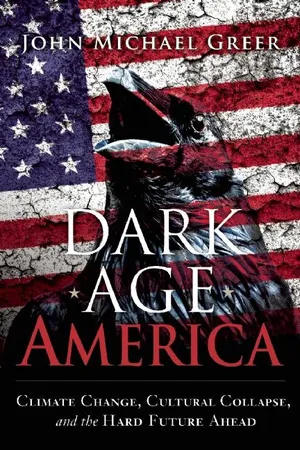
Dark Age America
Climate Change, Cultural Collapse, and the Hard Future Ahead
- 256 pages
- English
- ePUB (mobile friendly)
- Available on iOS & Android
eBook - ePub
About this book
Information
1
THE WAKE OF INDUSTRIAL CIVILIZATION
IT HAS BEEN MORE THAN FOUR DECADES SINCE SCIENTISTS began warning of the inevitable consequences of trying to pursue limitless economic growth on a finite planet.1 Since that time, as the limits to growth have become more and more clearly visible on the horizon of our future, a remarkable paradox has unfolded. The closer we get to those limits, the more they impact our daily lives, and the more clearly our current trajectory points toward the brick wall of a difficult future, the less most people in the industrial world seem to be able to imagine any alternative to driving the existing order of things ever onward until the wheels fall off.
This is as true in many corners of the activist community as it is in the most unregenerate of corporate boardrooms. For too many of today’s environmentalists, renewable energy isn’t something that they ought to produce for themselves, unless they happen to be wealthy enough to afford the rooftop PV systems that have become the latest status symbol in suburban neighborhoods on either coast. It’s certainly not something that they ought to conserve. Rather, it’s something that utilities and the government are supposed to produce as fast as possible, so that Americans can keep on using three times as much energy per capita as the average European and twenty times as much as the average Chinese.
Such enthusiasm for change that does appear in the activist community by and large focuses on world-changing events of one kind or another. As it happens, though, we have a serious shortage of world-changing events just now. There are good reasons for that, just as there are equally strong, if not equally good, reasons why so many people are pinning all their hopes on a world-changing event of one kind or another. Therapists like to point out that if you always do what you’ve always done, you’ll always get what you’ve always gotten, and of late it’s become a truism (though it’s also a truth) that doing the same thing and expecting to get different results is a good working definition of insanity.
The attempt to find some way around that harsh but inescapable logic is the force that drove the prophetic hysteria about 2012 and drives end-of-the-world delusions more generally: if the prospect of changing the way you live terrifies you, but the thought of facing the consequences of the way you live terrifies you just as much, daydreaming that some outside force will come along and change everything for you can be a convenient way to avoid having to think about the future you’re making for yourself.2 Unfortunately, that sort of daydream has become far more common than the sort of constructive action that might actually make a difference.
That hard fact pretty much guarantees a future that is considerably worse than the present, by almost any imaginable definition. The difficulty here is that faith in the prospect of a better future has been so deeply ingrained in all of us that trying to argue against it is a bit like trying to tell a medieval peasant that heaven with all its saints and angels isn’t there any more. The hope that tomorrow will be, or can be, or at the very least ought to be, better than today is hardwired into the collective imagination of the modern world. Behind that faith lies the immense inertia of three hundred years of industrial expansion, which cashed in the cheaply accessible fraction of the Earth’s fossil fuel reserves for a brief interval of abundance so extreme that garbage collectors in today’s America have access to things that emperors could not get before the Industrial Revolution dawned.
That age of extravagance has profoundly reshaped—in terms of the realities of human life before and after our age, a better word might be “distorted”—the way people nowadays think about nearly anything you care to name. In particular, it has blinded us to the ecological realities that provide the fundamental context to our lives. It’s made nearly all of us think, for example, that unlimited exponential growth is possible, normal, and good, and so even as the disastrous consequences of unlimited exponential growth slam into our society one after another like waves hitting a sand castle, the vast majority of people nowadays still build their visions of the future on the fantasy that problems caused by growth can be solved by still more growth.
The distorted thinking we have inherited from three centuries of unsustainable growth crops up in full force even among many of those who think they’re reacting against it. Activists at every point on the political spectrum have waxed rhetorical for generations about the horrors the future has in store, to be sure, but they always offer a way out—the adoption of whatever agenda they happen to be promoting—and it leads straight to a bright new tomorrow in which the hard limits of the present somehow no longer seem to apply. (Take away the shopworn trope of “the only way to rescue a better future from the jaws of imminent disaster” from today’s activist rhetoric, for that matter, and in most cases there’s very little left.)
Still, the bright new tomorrow we’ve all been promised is not going to arrive. This is the bad news brought to us by the unfolding collision between industrial society and the unyielding limits of the planetary biosphere. Peak oil, global warming, and all the other crises gathering around the world are all manifestations of a single root cause: the impossibility of infinite growth on a finite planet. They are warning signals telling us that we have gone into full-blown overshoot—the state, familiar to ecologists, in which a species outruns the resource base that supports it3—and they tell us also that growth is not merely going to stop; it’s going to reverse, and that reversal will continue until our population, resource use, and waste production drop to levels that can be sustained over the long term by a damaged planetary ecosystem.
That bitter outcome might have been prevented if we had collectively taken decisive action before we went into overshoot. We didn’t, and at this point the window of opportunity is firmly shut. Nearly all the proposals currently being floated to deal with the symptoms of our planetary overshoot assume, tacitly or otherwise, that this is not the case and that we still have as much time as we need. Such proposals are wasted breath, and if any of them are enacted—and some of them very likely will be enacted, once today’s complacency gives way to tomorrow’s stark panic—the resources poured into them will be wasted as well.
Thus I think it’s time to pursue a different and more challenging project. We could have had a better future if we’d done the right things when there was still enough time to matter, but we didn’t. That being the case, what kind of future can we expect to get?
There is a standard term in historical studies for that kind of future. That term is “dark age.”

That label actually dates from before the period most often assigned it these days. Marcus Terentius Varro, who was considered the most erudite Roman scholar of his time, divided up the history known to him into three ages: an age of history, for which there were written records; before that, an age of fable, from which oral traditions survived; and before that, a dark age, about which no one knew anything at all.4 It’s a simple division but a surprisingly useful one. Even in those dark ages where literacy survived as a living tradition, records tend to be extremely sparse and unhelpful, and when records pick up again, they tend to be thickly frosted with fable and legend for a good long while thereafter. In a dark age, the thread of collective memory and cultural continuity snaps, the ends are lost, and a new thread must be spun from whatever raw materials happen to be on hand.
Dark ages of this kind are a recurrent phenomenon in human history, and the processes by which they come about have a remarkable degree of similarity even when the civilizations that precede them differ in every imaginable way. The historian Arnold Toynbee, whose massive twelve-volume work A Study of History remains the most comprehensive study of historical cycles ever penned, has explored this curious parallelism in detail.5 On the way up, he noted, each civilization tends to diverge not merely from its neighbors but from all other civilizations throughout history. Its political and religious institutions, its arts and architecture, and all the other details of its daily life take on distinctive forms, so that as it nears maturity, even the briefest glance at one of its creations is often enough to identify its source.
Once the peak is past and the long road down begins, though, that pattern of divergence shifts into reverse, slowly at first, and then with increasing speed. A curious sort of homogenization takes place: distinctive features are lost, and common patterns emerge in their place. That doesn’t happen all at once, and different cultural forms lose their distinctive outlines at different rates, but the further down the trajectory of decline and fall a civilization proceeds, the more it resembles every other civilization in decline. By the time that trajectory bottoms out, the resemblance is all but total; compare one post-collapse society to another—the societies of post-Roman Europe, let’s say, with those of post-Mycenean Greece—and it can be hard to believe that dark age societies so similar could have emerged out of the wreckage of civilizations so different.
It’s interesting to speculate about why this reversion to the mean should be so regular a theme in the twilight and aftermath of so many civilizations. Still, the recurring patterns of decline and fall have another implication—or, if you will, another application. Modern industrial society, especially but not only here in North America, is showing all the usual symptoms of a civilization on its way toward history’s compost bin. If, as the evidence suggests, we’ve started along the familiar track of decline and fall, it should be possible to map the standard features of the way down onto the details of our current situation, and come up with a fairly accurate sense of the shape of the future ahead of us.
Mind you, the part of history that can be guessed in advance is a matter of broad trends and overall patterns, not the sort of specific incidents that make up so much of history as it happens. Exactly how the pressures bearing down on late industrial America will work out in the day-by-day realities of politics, economics, and society will be determined by the usual interplay of individual choices and pure dumb luck. That said, the broad trends and overall patterns are worth tracking in their own right, and some things that look as though they ought to belong to the realm of the unpredictable—for example, the political and military dynamics of border regions, or the relations among the imperial society’s political class, its increasingly disenfranchised lower classes, and the peoples outside its borders—follow predictable patterns in case after case in history, and show every sign of doing the same thing this time around too.
What I’m suggesting, in fact, is that in a very real sense, it’s possible to map out the outlines of the history of North America over the next five centuries or so in advance. That’s a sweeping claim, and I’m well aware that the immediate response of at least some of my readers will be to reject the possibility out of hand. I’d like to encourage those who have this reaction to try to keep an open mind.
This claim presupposes that the lessons of the past actually have some relevance to our future. That’s a controversial proposal these days, but to my mind the controversy says more about the popular idiocies of our time than it does about the facts on the ground. People in today’s America have taken to using thought-stoppers such as “But it’s different this time!” to protect themselves from learning anything from history—a habit that no doubt does wonders for their peace of mind today, though it pretty much guarantees them a face-first collision with a brick wall of misery and failure not much further down time’s road.
Among the resources I plan on using to trace out the history of the next five centuries is the current state of the art in the environmental sciences, and that includes the very substantial body of evidence and research on anthropogenic climate change. I’m aware that some people consider that controversial, and, of course, some very rich corporate interests have invested a lot of money into convincing people that it’s controversial, but I’ve read extensively on all sides of the subject, and the arguments against taking anthropogenic climate change seriously strike me as specious. I don’t propose to debate the matter here either—there are plenty of forums for that. While I propose to leaven current model-based estimates on climate change and sea-level rise with the evidence from paleoclimatology, those who insist that there’s nothing at all the matter with treating the atmosphere as an aerial sewer for greenhouse gases are not going to be happy with everything I have to say.
I also propose to discuss industrial civilization’s decline and fall without trying to sugarcoat the harsher dimensions of that process, and that’s going to ruffle yet another set of feathers. Those who follow the news will doubtless already have noticed the desperate attempts to insist that it won’t be that bad, really it won’t, that are starting to show up these days whenever straight talk about the future slips through the fog of collective mythology that our society uses to blind itself to the consequences of its own actions. Those who dare to use words such as “decline” or “dark age” can count on being taken to task by critics who insist earnestly that such language is too negative, that of course we’re facing a shift to a different kind of society but it shouldn’t be described in such disempowering terms, and so on through the whole vocabulary of the obligatory optimism that’s so fashionable among the privileged these days.
That sort of talk may be comforting, but it’s not useful. The fall of a civilization is not a pleasant prospect—and that’s what we’re talking about, of course: the decline and fall of industrial civilization, the long passage through a dark age, and the first stirrings of the successor societies that will build on our ruins. That’s how the life cycle of a civilization ends, and it’s the way that ours is ending right now.
What that means in practice is that most of the familiar assumptions people in the industrial world like to make about the future will be stood on their heads in the decades and centuries ahead. Most of the rhetoric being splashed about these days in support of this or that or the other Great Turning that will save us from the consequences of our own actions assumes, as a matter of course, that a majority of people in the United States—or, heaven help us, in the whole industrial world—can and will come together around some broadly accepted set of values and some agreed-upon plan of action to rescue industrial civilization from the rising spiral of crises that surrounds it. My readers may have noticed that things seem to be moving in the opposite direction, and history suggests that they’re quite correct.
Among the standard phenomena of decline and fall, in fact, is the shattering of the collective consensus that gives a growing society the capacity to act together to accomplish much of anything at all. The schism between the political class and the rest of the population—you can certainly call these “the one percent” and “the ninety-nine percent” if you wish—is simply the most visible of the fissures that spread through every declining civilization, breaking it into a crazy quilt of dissident fragments pursuing competing ideals and agendas. That process has a predictable endpoint, too: as the increasingly grotesque misbehavior of the political class loses whatever respect and loyalty it once received from the rest of society and the masses abandon their trust in the political institutions of their society, charismatic leaders from outside the political class fill the vacuum, violence becomes the normal arbiter of power, and the rule of law becomes a polite fiction when it isn’t simply abandoned altogether.
The economic sphere of a society in decline undergoes a parallel fragmentation for different reasons. In ages of economic expansion, the labor of the working classes yields enough profit to cover the costs of a more or less complex superstructure, whether that superstructure consists of the pharaohs and priesthoods of ancient Egypt or the bureaucrats and investment bankers of late industrial America. As expansion gives way to contraction, the production of goods and services no longer yields the profit it once did, but the members of the political class, whose power and wealth depend on the superstructure, are predictably unwilling to lose their privileged status, and they have the power to keep themselves fed at everyone else’s expense. The reliable result is a squeeze on productive economic activity that drives a declining civilization into one convulsive financial crisis after another and ends by shredding its capacity to ...
Table of contents
- Cover
- Title Page
- Copyright Page
- Contents
- 1. The Wake of Industrial Civilization
- 2. The Ecological Aftermath
- 3. The Demographic Consequences
- 4. The Political Unraveling
- 5. The Economic Collapse
- 6. The Suicide of Science
- 7. The Twilight of Technology
- 8. The Dissolution of Culture
- 9. The Road to a Renaissance
- Endnotes
- Bibliography
- Index
- About the Author
- A Note About the Publisher
Trusted by 375,005 students
Access to over 1.5 million titles for a fair monthly price.
Study more efficiently using our study tools.
Frequently asked questions
Yes, you can cancel anytime from the Subscription tab in your account settings on the Perlego website. Your subscription will stay active until the end of your current billing period. Learn how to cancel your subscription
No, books cannot be downloaded as external files, such as PDFs, for use outside of Perlego. However, you can download books within the Perlego app for offline reading on mobile or tablet. Learn how to download books offline
Perlego offers two plans: Essential and Complete
- Essential is ideal for learners and professionals who enjoy exploring a wide range of subjects. Access the Essential Library with 800,000+ trusted titles and best-sellers across business, personal growth, and the humanities. Includes unlimited reading time and Standard Read Aloud voice.
- Complete: Perfect for advanced learners and researchers needing full, unrestricted access. Unlock 1.5M+ books across hundreds of subjects, including academic and specialized titles. The Complete Plan also includes advanced features like Premium Read Aloud and Research Assistant.
We are an online textbook subscription service, where you can get access to an entire online library for less than the price of a single book per month. With over 1.5 million books across 990+ topics, we’ve got you covered! Learn about our mission
Look out for the read-aloud symbol on your next book to see if you can listen to it. The read-aloud tool reads text aloud for you, highlighting the text as it is being read. You can pause it, speed it up and slow it down. Learn more about Read Aloud
Yes! You can use the Perlego app on both iOS and Android devices to read anytime, anywhere — even offline. Perfect for commutes or when you’re on the go.
Please note we cannot support devices running on iOS 13 and Android 7 or earlier. Learn more about using the app
Please note we cannot support devices running on iOS 13 and Android 7 or earlier. Learn more about using the app
Yes, you can access Dark Age America by John Michael Greer in PDF and/or ePUB format, as well as other popular books in Social Sciences & Environment & Energy Policy. We have over 1.5 million books available in our catalogue for you to explore.