Essential Building Science
Understanding Energy and Moisture in High Performance House Design
- 160 pages
- English
- ePUB (mobile friendly)
- Available on iOS & Android
Essential Building Science
Understanding Energy and Moisture in High Performance House Design
About this book
Down and dirty – a complete step-by-step guide to making, installing and living with beautiful, all-natural earthen floors
Poor heat and moisture management are the enemies of durable, comfortable, and efficient housing, and good building design and construction starts with a solid understanding of good building science.
Essential Building Science provides a highly visual and accessible introduction to the fundamentals of building science for residential construction.
Part one covers the rationale behind high-performance design and the fundamentals of building physics, including thermal dynamics, moisture transfer, and hygro-thermal dynamics such as vapor drive and condensation.
Part two teaches the vital critical thinking skills needed to consider buildings as whole systems and to develop thermal and moisture control strategies regardless of the specifics of the design. Case studies and examples from across North American climatic zones illuminate real-life problems and offer builders, designers, and DIYers the insights and tools required for creating better new buildings and dramatically improving old ones.
Good science plus critical thinking equals high performance buildings.
Frequently asked questions
- Essential is ideal for learners and professionals who enjoy exploring a wide range of subjects. Access the Essential Library with 800,000+ trusted titles and best-sellers across business, personal growth, and the humanities. Includes unlimited reading time and Standard Read Aloud voice.
- Complete: Perfect for advanced learners and researchers needing full, unrestricted access. Unlock 1.4M+ books across hundreds of subjects, including academic and specialized titles. The Complete Plan also includes advanced features like Premium Read Aloud and Research Assistant.
Please note we cannot support devices running on iOS 13 and Android 7 or earlier. Learn more about using the app.
Information

Chapter 1
Establishing Goals
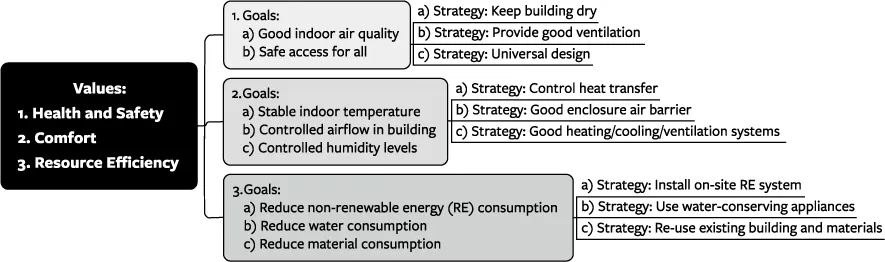
Value: Health and Safety | |
Goal: Good indoor air quality | |
Strategies | Actions |
Keep building dry (avoid mold) | Follow moisture control strategies to create a well-detailed enclosure that avoids leaks, condensation, and groundwater intrusion. |
Good ventilation | Install a well-sized and appropriately designed ventilation system for the home, and ensure it runs correctly. |
Reduce pollutants | Avoid products with off-gassing chemicals such as the solvents and glues common in paints, floor covering, and furnishings. |
Combustion safety | Avoid the use of combustion appliances and/or use sealed combustion appliances when necessary. |
Goal: Safe Use for All | |
Universal Design (UD) | Follow established UD guidelines to ensure access to those needing assistance moving about in the home. |
Value: Comfort | |
Goal: Stable indoor temperature | |
Strategies | Actions |
Control heat transfer | Follow thermal control strategies for a well-detailed, airtight and well-insulated enclosure, and include thermal mass inside the building. |
Provide appropriate heating and cooling | Install a well-sized and appropriately designed heating/AC system for the home, and ensure it runs correctly and is serviceable. |
Keep surface temperatures warm | Insulate slabs, walls, and ceilings. Install thermally efficient windows. |
Goal: Controlled air flow (no drafts when cold, circulation when warm) | |
Install quality air barrier | Ensure air barrier detailing in design, and perform quality control in the field with a blower-door test. |
Good ventilation | Install a well-sized and appropriately designed ventilation system for the home, and ensure it runs correctly. |
Goal: Controlled humidity levels | |
Same as for other goals addressing comfort | Keep building dry, keep surfaces warm, install an appropriate ventilation system. |
Table of contents
- Cover
- Title Page
- Copyright Page
- ACKNOWLEDGMENTS
- INTRODUCTION
- Part I: Rationale
- Part II: Fundamentals of Building Physics
- Part III: Developing Strategies
- ENDNOTES
- RESOURCES
- INDEX
- ABOUT THE AUTHOR
- A NOTE ABOUT THE PUBLISHER