More and more managerial challenges require leaders to be accountable-to take initiative without having full authority for the process or the outcomes. Accountability goes beyond responsibility. Whereas responsibility is generally delegated by the boss, the organization, or by virtue of position, accountability is having an intrinsic sense of ownership of the task and the willingness to face the consequences that come with success or failure. Through this guidebook you will learn how your organization and its leaders can create a culture that fosters accountability by focusing on five areas: support, freedom, information, resources, and goal and role clarity.
- 30 pages
- English
- ePUB (mobile friendly)
- Available on iOS & Android
eBook - ePub
Accountability: Taking Ownership of Your Responsibility
About this book
Information
Focus Areas

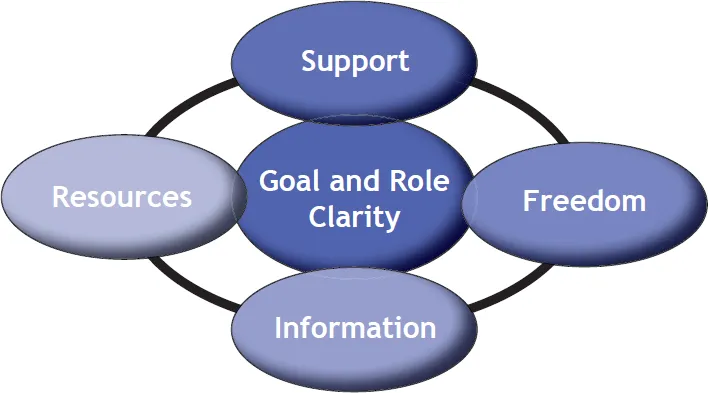
CCL’s research has yielded a simple model that is designed to build a culture of accountability (see Figure 1, page 13). The five focus areas are
• support—organizational, supervisory, and work team support
• freedom—the freedom to direct important aspects of the work
• information—access to relevant information needed to do the work
• resources—access to enough resources to do the work
• goal and role clarity—clarity of the goal, responsibility, and consequences of action or inaction
Accountability Scorecard
Rate how well you think your organization and its leaders employ these practices of accountability. The scale ranges from 1 (not very descriptive of us) to 5 (very descriptive of us).
— | 1. We are specific and clear about roles, team leadership, and individual ownership in a way that eases confusion. |
— | 2. People have a sense of ownership for the results of their team. |
— | 3. We face squarely what went right and what did not, and why. |
— | 4. When things don’t go right, we don’t hear denial, blaming, excuses, and scapegoating. |
— | 5. The team leader is held accountable for the results of the team, even when results fall short of rising expectations. |
— | 6. The accounting aims at improvement, not punishment. |
— | 7. People expect that their actions, decisions, and behaviors will be evaluated. |
— | 8. Leaders take the initiative to claim and create what they need to succeed. |
— | 9. People are held accountable if they don’t do what they say they will do. |
— | 10. When facing competing priorities (for example, cutting costs versus improving customer service), people feel that they have the freedom, support, and control to decide how to navigate the conflict. |
— | 11. People feel and can see a strong link between what they do and overall team performance. |
If your total score is less than 33, your organization and its leaders probably need to take a look at how they can better create a culture that encourages accountability.
Of the above eleven items, which two have improved most in the past eighteen months?
Which two might you be overdoing?
Which two would benefit you most to improve in the next eighteen months?
In addition, leaders have to balance between two competing considerations: process and results. Indicate below how well your leaders balance these two considerations, with 1 indicating that they put too much weight on the process, 3 indicating that the balance is just right, and 5 indicating that they put too much weight on results.
— | a. Leaders are held accountable for the standards and procedures they use to make decisions. |
— | b. Leaders are held accountable for the outcomes of their decisions. |
Figure 1. The Five Components of Building Accountability
Support
In complex organizations, support for major projects can be both broad and deep. In general terms, there are three types of support that are most crucial for fostering accountability. The first is an organizational level of support. The second centers around the role of the supervisor or boss. The third is the human resources assigned to the task—the manager’s team.
Support for accountability has a structural aspect as well as a cultural aspect.
The structural component comprises systems that provide goal and role clarity, that grant authority and official power, that supply information from internal and market sources, and that furnish resources for operational implementation. Following are some questions you can ask to determine the degree of structural support for accountability at each of the three levels.
• Organizational level
– Does the organization publicly acknowledge the importance of the work and the people doing it?
– Do our strategy and tactics align with the work’s mission and vision?
– Are there clear processes to ...
Table of contents
- Cover
- Copyright
- Title Page
- Table of Contents
- Being Accountable
- Levels of Commitment
- Focus Areas
- Managing Polarities
- Team Accountability
- The Fear Factor
- Last Words
- Suggested Readings
- Background
- Key Point Summary
Trusted by 375,005 students
Access to over 1.5 million titles for a fair monthly price.
Study more efficiently using our study tools.
Frequently asked questions
Yes, you can cancel anytime from the Subscription tab in your account settings on the Perlego website. Your subscription will stay active until the end of your current billing period. Learn how to cancel your subscription
No, books cannot be downloaded as external files, such as PDFs, for use outside of Perlego. However, you can download books within the Perlego app for offline reading on mobile or tablet. Learn how to download books offline
Perlego offers two plans: Essential and Complete
- Essential is ideal for learners and professionals who enjoy exploring a wide range of subjects. Access the Essential Library with 800,000+ trusted titles and best-sellers across business, personal growth, and the humanities. Includes unlimited reading time and Standard Read Aloud voice.
- Complete: Perfect for advanced learners and researchers needing full, unrestricted access. Unlock 1.5M+ books across hundreds of subjects, including academic and specialized titles. The Complete Plan also includes advanced features like Premium Read Aloud and Research Assistant.
We are an online textbook subscription service, where you can get access to an entire online library for less than the price of a single book per month. With over 1.5 million books across 990+ topics, we’ve got you covered! Learn about our mission
Look out for the read-aloud symbol on your next book to see if you can listen to it. The read-aloud tool reads text aloud for you, highlighting the text as it is being read. You can pause it, speed it up and slow it down. Learn more about Read Aloud
Yes! You can use the Perlego app on both iOS and Android devices to read anytime, anywhere — even offline. Perfect for commutes or when you’re on the go.
Please note we cannot support devices running on iOS 13 and Android 7 or earlier. Learn more about using the app
Please note we cannot support devices running on iOS 13 and Android 7 or earlier. Learn more about using the app
Yes, you can access Accountability: Taking Ownership of Your Responsibility by Browning in PDF and/or ePUB format, as well as other popular books in Business & Leadership. We have over 1.5 million books available in our catalogue for you to explore.