It is sometimes hard to accept change - particularly when it is delivered as a hardship, disappointment, or rejection. But by developing resiliency managers can not only accept change, but learn, grow, and thrive in it. This guidebook defines resiliency, explains why it's important, and describes how you can develop your own store of resiliency. It focuses on nine developmental components that, taken together, create a sense of resiliency and increase your ability to handle the unknown and to view change - whether from disappointment or success - as an opportunity for development.
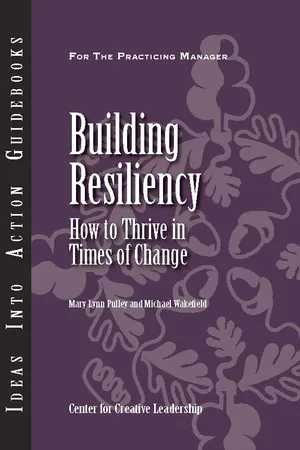
- 26 pages
- English
- ePUB (mobile friendly)
- Available on iOS & Android
eBook - ePub
About this book
Information
Becoming Resilient

Beginning early in life you have developed behaviors and perspectives that have enhanced or hindered your ability to be resilient and adaptable as an adult. Yet resiliency can be developed. It’s possible to change your views, habits, and responses by modifying your thoughts and actions in nine areas: acceptance of change, continuous learning, self empowerment, sense of purpose, personal identity, personal and professional networks, reflection, skill shifting, and your relationship to money.
These nine areas aren’t separate facets of resilience but intertwined and interrelated themes. Each builds on the others, influences the others, and in concert with the others can bolster your resiliency and your skill in handling change. By improving in all of these areas you broaden your outlook and become less narrowly focused – more able to adapt to change.
Acceptance of Change
Change is constant and inevitable, and to some managers it brings an overwhelming discomfort. The roots of that discomfort can sometimes be traced to such feelings as fear (How can I continue to succeed when the rules have changed?) or a need to exert control (If I don’t do it my way, the way I have always done it, then it won’t be done right). Other managers try to deny change by focusing on the skills that have brought them past success and ignoring gaps in their leadership competencies. But sooner or later a change for which they are not prepared results in a mistake with serious consequences – a missed promotion, negative appraisal, demotion, or termination.
“He couldn’t change. He had a rigid and outdated management style. He was inflexible and people got tired of it.”
Successful managers accept change and adapt to it. If you find yourself uncomfortable with the idea of change, you can increase your resiliency in this area by creating an accurate portrait of yourself and an accurate picture of your environment. Here are three actions you can take to build up your resiliency by becoming more accepting of and adaptable to change.
1. Pay attention to the people and the work around you. Don’t bury yourself in a narrow channel of work or you risk being blindsided. Seek out new challenges that stretch your skills or that minimize your weaknesses.
2. Pay attention to your physical and mental well-being. If you feel discomfort, which is natural when changes occur, take that as a signal to further explore your feelings and thoughts about the change. Use the Resiliency Worksheet on pages 22 and 23 as a guide to exploring your reaction to change.
3. Examine change on its own terms. Decide which changes you can control and which changes you can’t control. For example, if your organization gives your team a new performance mandate, you manage that change through your team leadership. But if your organization undergoes a downsizing or reacts dramatically to a market shift, that kind of change is beyond what you can control. In that case it’s better to move your energies away from the anxiety spawned by the change and toward developing new skills and bolstering current strengths.
Accepting Change Is Crucial
According to research from the Center for Creative Leadership (CCL), the number one reason managers derail – fall off the “track of success” – is their inability to change or adapt during a transition. North American managers said 55 percent of the most successful managers they knew displayed the ability to adapt (European managers put the number even higher at 67 percent). That ability to adapt, that resiliency, was the most frequently mentioned success factor in CCL’s most recent study of executive derailment.
Continuous Learning
The nature of resiliency asks that you acquire new skills and understanding and be able to apply them during times of change. Many managers resist learning new ways, holding on to old behaviors and skills even when changes make it obvious that they don’t work anymore. If you find yourself in that description, think about your resistance. It may be that you think your old ways are important to who you are and that changing might somehow affect your identity. Your old skills and behaviors might be deeply connected to your self-w...
Table of contents
- Cover
- Copyright
- Title Page
- Table of Contents
- What Is Resiliency?
- Why Is Resiliency Important?
- Becoming Resilient
- Resiliency Worksheet
- Suggested Readings
- Background
- Key Point Summary
Trusted by 375,005 students
Access to over 1.5 million titles for a fair monthly price.
Study more efficiently using our study tools.
Frequently asked questions
Yes, you can cancel anytime from the Subscription tab in your account settings on the Perlego website. Your subscription will stay active until the end of your current billing period. Learn how to cancel your subscription
No, books cannot be downloaded as external files, such as PDFs, for use outside of Perlego. However, you can download books within the Perlego app for offline reading on mobile or tablet. Learn how to download books offline
Perlego offers two plans: Essential and Complete
- Essential is ideal for learners and professionals who enjoy exploring a wide range of subjects. Access the Essential Library with 800,000+ trusted titles and best-sellers across business, personal growth, and the humanities. Includes unlimited reading time and Standard Read Aloud voice.
- Complete: Perfect for advanced learners and researchers needing full, unrestricted access. Unlock 1.5M+ books across hundreds of subjects, including academic and specialized titles. The Complete Plan also includes advanced features like Premium Read Aloud and Research Assistant.
We are an online textbook subscription service, where you can get access to an entire online library for less than the price of a single book per month. With over 1.5 million books across 990+ topics, we’ve got you covered! Learn about our mission
Look out for the read-aloud symbol on your next book to see if you can listen to it. The read-aloud tool reads text aloud for you, highlighting the text as it is being read. You can pause it, speed it up and slow it down. Learn more about Read Aloud
Yes! You can use the Perlego app on both iOS and Android devices to read anytime, anywhere — even offline. Perfect for commutes or when you’re on the go.
Please note we cannot support devices running on iOS 13 and Android 7 or earlier. Learn more about using the app
Please note we cannot support devices running on iOS 13 and Android 7 or earlier. Learn more about using the app
Yes, you can access Building Resiliency: How to Thrive in Times of Change by Pulley, Wakefield in PDF and/or ePUB format, as well as other popular books in Business & Leadership. We have over 1.5 million books available in our catalogue for you to explore.