Leaders often have to make decisions without complete information, and those decisions need to be both right and timely. Using reflective techniques can help you learn to depend on your intuition for help in making good decisions quickly. Reflective practices may seem time-consuming at first, but the time you put in on the front end will pay you back both in time and in the quality of the decisions you make.
- 28 pages
- English
- ePUB (mobile friendly)
- Available on iOS & Android
eBook - ePub
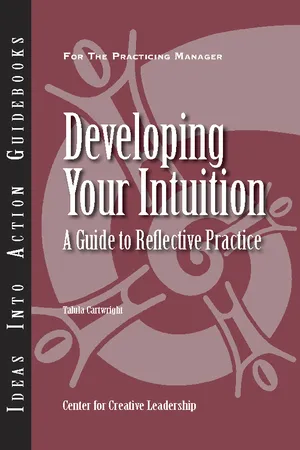
Developing Your Intuition: A Guide to Reflective Practice
About this book
Information
Tools for Reflective Practice

When your brain is working on an intuitive level, it sorts through all kinds of information: emotions, events, data, logic, images, facts, assurances, goals, plans, to-do lists, and anything else that’s available to it. This kind of mental processing is fascinating because your brain goes through these gyrations while you’re not even aware of it. Think about how often a new idea has surprised you while you were taking a shower, digging in the garden, or driving to work. Suddenly you have an answer to a problem you’ve been struggling with or the name of someone you’ve been trying to remember. These flashes result from your brain’s constant working. You can think of intuition as the result of all this processing. You may say you don’t know how you know you are right. You may say it’s only a hunch. But actually it’s a result of your brain at work, and reflective practice is a deliberate way to fuel that process.
The Journal
Many of us forget most of the new things we are exposed to every day. Even in learning situations where we are deliberately trying to remember information, we forget about half of it.
Keeping a journal greatly improves the chances of our remembering the experiences that are important to us, and it also gives us a place to reflect on them. The more we can reflect on how an experience or feeling connects with our values, our other experiences, and our priorities, for example, the more lessons we can draw from it. Reflection connects our experience and feelings to our intuitive senses so that those lessons are available to us when we have to make decisions without full information.
In choosing a journal for your reflective practice, it’s useful to select one with unlined pages so that you can write and draw. Don’t worry if you don’t think of yourself as an artist. Most people don’t. Drawing taps into those modes of thinking that are intuitive and visual, which are what you want to strengthen and learn to trust as a way to develop your intuition. You can also paste in photos and other visual images.
Think of a challenge you are facing right now. It can be personal or professional. It can be a small challenge or a big one. It can be a fresh one or one you’ve been struggling with for some time. Take some time first just to reflect about the challenge. Drawing about it may be useful at this point. What parts of it do you notice? What kind of a challenge is it? What have you already done about it?
Drawing has another benefit: it forces you to slow down and pay attention. Try taking your new journal and drawing the objects and people around you. Don’t worry about your skill as an artist. Just draw what you see. Look closely. As you draw, you may see that you haven’t represented certain measurements correctly or that depth and detail are missing. As you correct and refine your drawing, you strengthen your ability to perceive things as they are. The longer you draw an object, the more information and qualities you will notice about it and the more you will come to understand it. Strengthening your skills of perception will prove useful in solving problems because it’s important that you look at the whole problem objectively and completely. Before you make an important decision, you need to feel confident that you haven’t taken shortcuts to get to your solution or misled yourself about the nature of the problem. Drawing exercises all of the basic perceptual skills, which are the same skills we need in problem solving and decision making. Drawing slows down the process of perception, which is an excellent way to increase the information we are getting from the environment, because we aren’t taking so many shortcuts. We notice the boundaries, the blank spaces, the shadows, the proportions, and the gestalt. All of this trains not only our eyes but also our thinking, and we become better problem solvers. We call this paying close attention, and it is a competency that we all had as children but may have neglected as we have gotten older.
Make writing in...
Table of contents
- Cover
- Copyright
- Title Page
- Table of Contents
- Intuition and Reflection
- Bringing It All Together
- Tools for Reflective Practice
- From Reflection to Action
- Suggested Readings
- Background
- Key Point Summary
Trusted by 375,005 students
Access to over 1.5 million titles for a fair monthly price.
Study more efficiently using our study tools.
Frequently asked questions
Yes, you can cancel anytime from the Subscription tab in your account settings on the Perlego website. Your subscription will stay active until the end of your current billing period. Learn how to cancel your subscription
No, books cannot be downloaded as external files, such as PDFs, for use outside of Perlego. However, you can download books within the Perlego app for offline reading on mobile or tablet. Learn how to download books offline
Perlego offers two plans: Essential and Complete
- Essential is ideal for learners and professionals who enjoy exploring a wide range of subjects. Access the Essential Library with 800,000+ trusted titles and best-sellers across business, personal growth, and the humanities. Includes unlimited reading time and Standard Read Aloud voice.
- Complete: Perfect for advanced learners and researchers needing full, unrestricted access. Unlock 1.5M+ books across hundreds of subjects, including academic and specialized titles. The Complete Plan also includes advanced features like Premium Read Aloud and Research Assistant.
We are an online textbook subscription service, where you can get access to an entire online library for less than the price of a single book per month. With over 1.5 million books across 990+ topics, we’ve got you covered! Learn about our mission
Look out for the read-aloud symbol on your next book to see if you can listen to it. The read-aloud tool reads text aloud for you, highlighting the text as it is being read. You can pause it, speed it up and slow it down. Learn more about Read Aloud
Yes! You can use the Perlego app on both iOS and Android devices to read anytime, anywhere — even offline. Perfect for commutes or when you’re on the go.
Please note we cannot support devices running on iOS 13 and Android 7 or earlier. Learn more about using the app
Please note we cannot support devices running on iOS 13 and Android 7 or earlier. Learn more about using the app
Yes, you can access Developing Your Intuition: A Guide to Reflective Practice by Cartwright in PDF and/or ePUB format, as well as other popular books in Business & Leadership. We have over 1.5 million books available in our catalogue for you to explore.