If your team isn't getting results, you may think the problem starts with a failure in leadership. While the person in charge may have issues, a leadership problem doesn't necessarily mean you have a "leader" problem. Leadership is not just about the people at the top, but is a social process, enabling individuals to work together as a cohesive group to produce collective results. This book will show you how to diagnose problems in your team by focusing on the three outcomes of effective leadership: direction, alignment, and commitment. By assessing where your group stands in each of these outcomes, you can plan and implement the changes necessary to get better results.
eBook - ePub
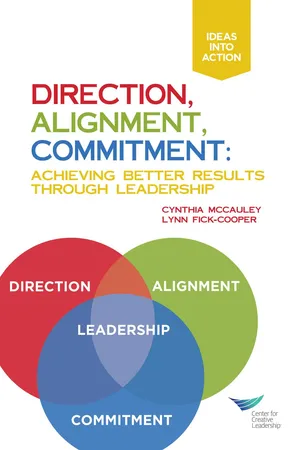
Direction, Alignment, Commitment: Achieving Better Results Through Leadership
- 34 pages
- English
- ePUB (mobile friendly)
- Available on iOS & Android
eBook - ePub
Direction, Alignment, Commitment: Achieving Better Results Through Leadership
About this book
Information
STEP 1:
ASSESS CURRENT LEVELS OF DIRECTION, ALIGNMENT, AND COMMITMENT IN THE GROUP
ASSESS CURRENT LEVELS OF DIRECTION, ALIGNMENT, AND COMMITMENT IN THE GROUP
Let’s start by examining three groups struggling with DAC outcomes.
The board of a state-focused foundation whose mission is to improve the health of its underprivileged citizens is creating a new five-year strategic plan. As the board evaluates the impact of the foundation’s grants over the last five years, several board members express concerns that the foundation might be headed in the wrong direction. While some of the individual programs the foundation funds have resulted in impressive successes, the board hasn’t seen enough improvement on overall health indicators for the underprivileged. Every board member supports the foundation’s mission, and while the board feels good about what the foundation has achieved across the state, they wonder why the results don’t reflect greater impact. Does the foundation’s overall direction need to change radically to get the results they hope for? Some members seem eager to embrace a new direction; others are feeling the need to be more cautious.
Gabriela is serving on a cross-functional team designing and implementing an onboarding process for all new employees. Team members know what they are trying to achieve; they worked together to craft a team charter that everyone supports. They’ve put in place a plan to accomplish the work and assigned specific tasks to each team member. However, the team is falling behind its timelines and Gabriela is worried. Sometimes the team seems unclear about who is responsible for what, and they have to revisit and clarify assignments. She also has noticed that the team gets bogged down when trying to reconcile different ideas about how best to design some aspects of the overall process. She doesn’t think the team has a direction problem, but are they struggling with aligning their work?
Deon is the project manager for a new product development team responsible for developing the next big innovation in the organization’s most important product line. The team has extensive market research into customer needs, representatives from critical organization departments, and a substantial budget for prototyping and testing. Unfortunately, the team is experiencing extensive quality issues with the first prototype they sent to market testing. At each of their last three team meetings, at least 1–2 members have been absent due to schedule conflicts or competing deadlines. Since none of the team members report directly to Deon, he struggles with how to get the group to commit the time and effort required to address the quality issues so that the team can achieve its goals.
When you find yourself in similar situations, concerned about whether individuals are pulling together in ways needed to succeed as a group, it is time to step back and assess the degree to which the group has the DAC it needs. Use the statements in the following “DAC Assessment” to complete a systematic assessment of DAC in the group. Better yet, have everyone in the group rate each of the statements and combine answers. Getting this broader input from group members is particularly important if you are the formal leader of the group. Your position in the group can skew your perspective! For instance, you may be less likely to sense a direction problem because you had a hand in setting the direction.
DAC ASSESSMENT
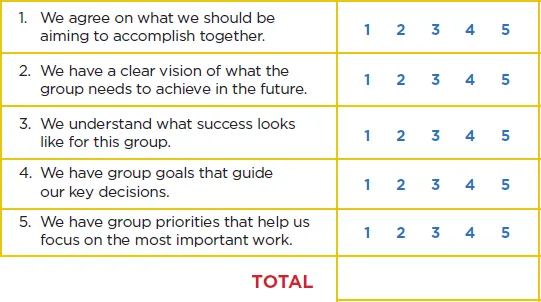
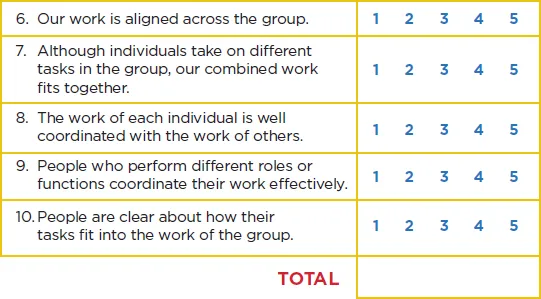
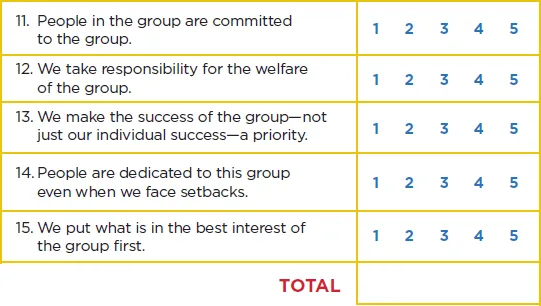
Instructions: On a scale of 1–5, indicate the extent to which each of the following statements describes the way things stand right now in the group. The terms we, our, everyone, and people in the statements refer to members of the group. Once you’ve rated the individual statements, add up your ratings in each section to yield total scores for direction, alignment, and commitment.
This assessment is also available at www.ccl.org/dac.

DIRECTION
ALIGNMENT
COMMITMENT
There are a number of ways to gather DAC assessment data from group members that keeps their identity anonymous (which encourages honest responses), and combines their data into a group-level summary for the entire group to review:
• Distribute paper copies of the assessment and have group members return it to a central person who tallies the data for the group.
• Create an online survey and send the link to group members. The survey package typically will produce a group summary of the data.
• Ask group members to complete the assessment and bring it to a group meeting. The assessment sheets can be gathered, shuffled, and randomly redistributed. Individuals can then transfer the data from the sheet they received to a wall chart that allows the group to see the whole group’s data.
Group members can complete the assessment at www.ccl.org/dac and bring the printed results to a group meeting.
Whichever process you use, the goal of this assessment step is to identify whether any or all of...
Table of contents
- Cover
- Title Page
- Copyright
- Contents
- Do You Have a Leadership Problem?
- DAC Leadership Framework
- Step 1: Assess Current Levels of Direction, Alignment, and Commitment in the Group
- Step 2: Look for Factors Contributing to Low Levels of Direction, Alignment, or Commitment.
- Step 3: Identify Changes That Could Improve Direction, Alignment, or Commitment.
- The Rest of the Story
- Background
- Suggested Resources
- Additional Resources
Trusted by 375,005 students
Access to over 1.5 million titles for a fair monthly price.
Study more efficiently using our study tools.
Frequently asked questions
Yes, you can cancel anytime from the Subscription tab in your account settings on the Perlego website. Your subscription will stay active until the end of your current billing period. Learn how to cancel your subscription
No, books cannot be downloaded as external files, such as PDFs, for use outside of Perlego. However, you can download books within the Perlego app for offline reading on mobile or tablet. Learn how to download books offline
Perlego offers two plans: Essential and Complete
- Essential is ideal for learners and professionals who enjoy exploring a wide range of subjects. Access the Essential Library with 800,000+ trusted titles and best-sellers across business, personal growth, and the humanities. Includes unlimited reading time and Standard Read Aloud voice.
- Complete: Perfect for advanced learners and researchers needing full, unrestricted access. Unlock 1.5M+ books across hundreds of subjects, including academic and specialized titles. The Complete Plan also includes advanced features like Premium Read Aloud and Research Assistant.
We are an online textbook subscription service, where you can get access to an entire online library for less than the price of a single book per month. With over 1.5 million books across 990+ topics, we’ve got you covered! Learn about our mission
Look out for the read-aloud symbol on your next book to see if you can listen to it. The read-aloud tool reads text aloud for you, highlighting the text as it is being read. You can pause it, speed it up and slow it down. Learn more about Read Aloud
Yes! You can use the Perlego app on both iOS and Android devices to read anytime, anywhere — even offline. Perfect for commutes or when you’re on the go.
Please note we cannot support devices running on iOS 13 and Android 7 or earlier. Learn more about using the app
Please note we cannot support devices running on iOS 13 and Android 7 or earlier. Learn more about using the app
Yes, you can access Direction, Alignment, Commitment: Achieving Better Results Through Leadership by Cynthia D McCauley, Cooper in PDF and/or ePUB format, as well as other popular books in Business & Leadership. We have over 1.5 million books available in our catalogue for you to explore.