In nonprofit organizations, staff development is increasingly crucial, but lack of resources leads many nonprofit leaders to believe that effective feedback systems are unattainable. However, nonprofits can implement effective feedback through their organizations by taking advantage of the Situation-Behavior-Impact (SBI) model. Using this system, you can give effective feedback that will help your nonprofit achieve its mission.
- 30 pages
- English
- ePUB (mobile friendly)
- Available on iOS & Android
eBook - ePub
Feedback that Works for Nonprofit Organizations
About this book
Information
Delivering Effective Feedback

CCL has developed a feedback technique called Situation-Behavior-Impact, or SBI. Using this technique, which CCL teaches to thousands of leaders every year, you can deliver feedback that replaces personal attacks, incorrect judgments, vague statements, and third-party slights with direct and objective comments on a person’s actions. Hearing this kind of feedback, the recipient can see what actions he or she can take to continue to improve performance or to change behavior that is ineffective or even an obstacle to performance.
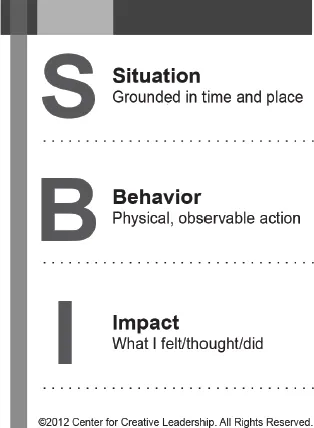
The SBI technique works because it is simple and direct. When giving feedback, you capture the situation, describe the behavior you observed, and then explain the impact that the behavior had on you. In the following pages, we will show you how to use each component of the SBI approach.
Capture the Situation
The first step in giving effective feedback is to capture and clarify the specific situation in which the behavior occurred. If you say, “On Tuesday, in the break room with Carol and Fred” rather than “A couple days ago at the office with everybody,” you avoid the kind of vague comments and exaggerations that derail many feedback opportunities. Describing the location and time of a behavior creates context for your feedback recipients, helping them clearly remember their thinking and behavior at the time.
Remember that capturing the situation is only the start of your feedback session. Here are a few examples of how you might successfully describe a situation when giving feedback:
• “Yesterday, when you presented our fund-raising strategy to the board …”
• “Last Monday, after lunch, while we were walking with Cindy to the meeting …”
• “Today, first thing this morning, when you and I were talking at the coffee machine …”
• “This past Tuesday afternoon, at the welcome reception for the new program manager, when Karl was explaining his new job description …”
Specificity is important when recalling a situation. The more specifics and details you can use in bringing the situation to mind, the clearer your message will be.
Describe the Behavior
Describing behavior is the second step in giving effective feedback. It’s also the most crucial step—and the one most often omitted—because behavior can be difficult to identify and describe. The most common mistake in giving feedback happens when judgments are communicated using adjectives that describe a person but not a person’s actions. This is ineffective because it does not give the receiver information about what behavior to begin, continue, or stop in order to improve performance. Consider the statements below:
• “He was rude during the meeting.”
• “She was engaged during the small-group discussion.”
• “She seemed bored at her team’s presentation.”
• “He seemed pleased with the report his employees presented.”
These statements describe an observer’s impression or interpretation of a behavior. Now look at the following list of actions an observer might witness that would lead to those impressions and interpretations.
• “He spoke at the same time another person was speaking.” (rude)
• “She leaned forward in her chair, wrote notes after other people spoke, and then shared her thoughts with the group, referring to some of the things that other people had said.” (engaged)
• “She yawned, rolled her eyes, and looked out the window.” (bored)
• “He smiled and nodded his head.” (pleased)
The statements in this list use verbs to describe a person’s actions. The focus is on the actual behavior, not on a judgment as to what the behavior might mean. If you remember to use verbs when describing behavior, you avoid the mistake of judging behavior. By focu...
Table of contents
- Cover
- Copyright
- Title Page
- Table of Contents
- Effective Feedback and Nonprofit Organizations
- Delivering Effective Feedback
- Putting It All Together
- The Importance of Feedback for Nonprofit Organizations
- Background
- Suggested Resources
Trusted by 375,005 students
Access to over 1.5 million titles for a fair monthly price.
Study more efficiently using our study tools.
Frequently asked questions
Yes, you can cancel anytime from the Subscription tab in your account settings on the Perlego website. Your subscription will stay active until the end of your current billing period. Learn how to cancel your subscription
No, books cannot be downloaded as external files, such as PDFs, for use outside of Perlego. However, you can download books within the Perlego app for offline reading on mobile or tablet. Learn how to download books offline
We are an online textbook subscription service, where you can get access to an entire online library for less than the price of a single book per month. With over 1.5 million books across 990+ topics, we’ve got you covered! Learn about our mission
Look out for the read-aloud symbol on your next book to see if you can listen to it. The read-aloud tool reads text aloud for you, highlighting the text as it is being read. You can pause it, speed it up and slow it down. Learn more about Read Aloud
Yes! You can use the Perlego app on both iOS and Android devices to read anytime, anywhere — even offline. Perfect for commutes or when you’re on the go.
Please note we cannot support devices running on iOS 13 and Android 7 or earlier. Learn more about using the app
Please note we cannot support devices running on iOS 13 and Android 7 or earlier. Learn more about using the app
Yes, you can access Feedback that Works for Nonprofit Organizations by Clark in PDF and/or ePUB format, as well as other popular books in Business & Leadership. We have over 1.5 million books available in our catalogue for you to explore.