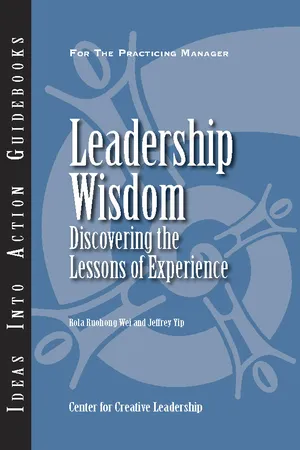
In a fast-paced global economy emphasizing innovation and productivity, leaders need to bring as much wisdom as possible to bear on their daily decisions. They often find themselves pulled between making decisions quickly and making them well. The processes described in this guidebook, inquiry and reflection, can help you develop your capacity to make wise choices. You will begin to see a broad range of possible responses and wisely choose the ones that will work best.
- 32 pages
- English
- ePUB (mobile friendly)
- Available on iOS & Android
eBook - ePub
About this book
Information
Developing Wisdom through Inquiry

This strategy enables you to learn from others, simply by asking questions of people you carefully select about lessons they have learned from their experience. With the swift changes the world is going through, including the developing global economy, leaders today often find themselves in problematic situations they have never encountered before. For example, doing business for the good of the larger society with a focus on sustainable development has not become a demand until recently. In addition, problems may evolve in an unpredictable manner and call for breakthrough thinking. Sometimes relying on past experience and old solutions does not help resolve current problems and uncertainties. Thus, you may need to consult others and open the door for dialogue and multiple perspectives in order to be wise in problem solving. Many people know the importance of asking others, but are unsure about how to do it. Three things must be considered: whom to ask, what to ask, and how to ask.
Whom to Ask
You should use care in selecting individuals to ask for input. Although common sense might lead you to consider older and more educated people, not all people in these groups are wise. In addition, individuals who are young or less educated could have exceptional understanding about handling difficult situations. The list below provides you with criteria to help you identify appropriate individuals.
Criteria for Choosing Individuals for Your Inquiry
Choose people who
• are mindful about their personal strengths and limitations
• understand others through dealing with a variety of people
• are able to make complex decisions
• are good listeners and open to all sides of the issues
• are comfortable not knowing everything
• are equipped with a wide knowledge base
• are keen observers
• think before speaking, acting, or making decisions
• are able to take the long view
• seek out information, especially details
• are reflective about their experience
• have the ability to interpret the environment
• are empathetic
What to Ask
After picking the right individuals to have conversations with, you need to know what to inquire about. Asking others about their experience and learning might be very challenging without appropriate tools. The quality and quantity of the information that you receive is dependent upon what and how you ask. You can use the following interview protocol for a general inquiry into a person’s lessons of experience.
When you think about your career and life, certain events or episodes probably stand out in your mind—things that had a lasting impact on who you are today. Could you pick a few of those key events and tell me what you learned from those experiences?
You can also ask about events related to a situation that is bothering you now. Doing so will give you a chance to find out how someone else has handled a similar situation. The list on page 15 provides examples.
The questions that will help you draw out your interviewee’s learning from the event are grouped into four categories:
What happened to your interviewee. These questions help you find out surface facts and understand the context of the experience of others. They focus on the who, what, when, and where of the event.
How your interviewee felt. These questions explore the interviewee’s emotions and personal connections to the situation.
What your interviewee learned and how the learning occurred. These questions make sense of the situation by exploring the major lessons that your interviewee took from the event and unveiling the process that facilitated his or her learning. The questions relate to the person’s values and assumptions, and to the significance and implications of the event for him or her.
Examples of Events for Your Inquiry
Ask about
• starting from scratch in setting up a function or branch for your organization
• managing a business turnaround
• moving from one function to another within your organization
• business mistakes
• dealing with subordinates’ performance problems
• changing from a technical to a supervisory role
• dealing with prejudice or discrimination
• managing conflicts with your peers
• managing conflicts with your boss
• dealing with downsizing and managing emotion...
Table of contents
- Cover
- Copyright
- Title Page
- Table of Contents
- Why Leadership Wisdom?
- Acquiring Leadership Wisdom
- Developing Wisdom through Inquiry
- Developing Wisdom through Reflection
- Wisdom as a Process
- Suggested Readings
- Background
- Key Point Summary
Trusted by 375,005 students
Access to over 1.5 million titles for a fair monthly price.
Study more efficiently using our study tools.
Frequently asked questions
Yes, you can cancel anytime from the Subscription tab in your account settings on the Perlego website. Your subscription will stay active until the end of your current billing period. Learn how to cancel your subscription
No, books cannot be downloaded as external files, such as PDFs, for use outside of Perlego. However, you can download books within the Perlego app for offline reading on mobile or tablet. Learn how to download books offline
Perlego offers two plans: Essential and Complete
- Essential is ideal for learners and professionals who enjoy exploring a wide range of subjects. Access the Essential Library with 800,000+ trusted titles and best-sellers across business, personal growth, and the humanities. Includes unlimited reading time and Standard Read Aloud voice.
- Complete: Perfect for advanced learners and researchers needing full, unrestricted access. Unlock 1.5M+ books across hundreds of subjects, including academic and specialized titles. The Complete Plan also includes advanced features like Premium Read Aloud and Research Assistant.
We are an online textbook subscription service, where you can get access to an entire online library for less than the price of a single book per month. With over 1.5 million books across 990+ topics, we’ve got you covered! Learn about our mission
Look out for the read-aloud symbol on your next book to see if you can listen to it. The read-aloud tool reads text aloud for you, highlighting the text as it is being read. You can pause it, speed it up and slow it down. Learn more about Read Aloud
Yes! You can use the Perlego app on both iOS and Android devices to read anytime, anywhere — even offline. Perfect for commutes or when you’re on the go.
Please note we cannot support devices running on iOS 13 and Android 7 or earlier. Learn more about using the app
Please note we cannot support devices running on iOS 13 and Android 7 or earlier. Learn more about using the app
Yes, you can access Leadership Wisdom: Discovering the Lessons of Experience by Wei,, Yip in PDF and/or ePUB format, as well as other popular books in Business & Leadership. We have over 1.5 million books available in our catalogue for you to explore.