Organizations today are awash in change. Managing change requires leaders to focus simultaneously on managing the business and providing effective leadership to the people. More often than not, it is the focus on the people side that loses out. This book offers a framework for understanding the issues and competencies that contribute to effective leadership during times of change. Its purpose is to help leaders determine how to choose and move among a variety of managerial approaches--to help them see what's working, what's not working, and what's missing. In this way, leaders can more clearly assess their impact and learn how to meet the demands of both managing the business and leading the people.
- 102 pages
- English
- ePUB (mobile friendly)
- Available on iOS & Android
eBook - ePub
About this book
Information
1
BUILDING TRUST IN EXTRAORDINARY TIMES
Consider three people:
Rachel is a vice president of sales and marketing for a Fortune 50 company. The company recruited her a year ago in large part because of her impressive track record with its top competitor. Her move was the result of years of hard work and patience, and from Rachel’s perspective it was a well-deserved reward. She had finally earned a senior-level job at a powerful company, had creative and talented management teams to lead, and was eager to enjoy all the perks of hitting the corporate big time.
But all is not well. Rachel is struggling to meet sales and revenue goals, a major initiative to reorganize the global sales force has run aground, the new advertising campaign has garnered lukewarm response, and employee turnover has accelerated in recent months. Rachel is angry, confused, and frustrated at what she perceives to be a lack of commitment from the people in her marketing department, who in her words “won’t get with the program,” and from salespeople who are resisting the changes she is implementing.
Antonio is the top administrator in a state office of health and human services. Trained in social work, he spent just two years as a caseworker before moving into an administrative role. Antonio has become a skilled manager and effective politician, able to maneuver effectively through local, state, and federal bureaucracies. He’s well liked, and he has considered running for public office. But his political ambitions are on hold because he currently faces the toughest challenge of his career. Because of budget shortfalls and pressure for smaller, leaner government operations, Antonio is orchestrating a massive reorganization of his agency that involves a major reduction of employees. As a savvy administrator, Antonio knows what needs to be done, and he’s working hard to figure out the best way to do it.
Even though he’s the architect of most of the change, Antonio is increasingly anxious about his ability to make it happen. He feels it’s important, as he puts it, to “put a good face on the change” and to demonstrate “100 percent commitment to the direction we’re headed.” Usually very social and engaging, Antonio has kept to himself lately. Uncharacteristically, he’s been lashing out when anyone questions his tactics. He feels burned out and is considering leaving public service after the reorganization.
Mitchell was the director of R & D for a small, highly successful biotech firm that was recently purchased by a major pharmaceutical company. A key driver behind the purchase was the perceived value of the smaller firm’s work. Mitchell and his colleagues were relieved to learn that they would remain as an intact unit in the larger organization and that no one would be laid off. Even so, the transition has not gone as well as expected. After a three-month honeymoon, company headquarters and the company’s main R & D unit started to make noises about how Mitchell’s group needs to change its focus.
Mitchell finds himself as the go-between, supporting and speaking for “his” people while negotiating the new environment. He and his R & D team sometimes miss the days when they could just “do the work and not worry about politics,” as he describes it. Mitchell is eager to make the transition successful. He’s willing to explore the implications and benefits of changing course, but he’s also comfortable pushing back and speaking openly to the powers that be in the parent company. He thinks the situation will get better when his colleagues stop comparing the present circumstances to the past. He also realizes that his team needs more time to find its legs so that it can stand up to outside influences and have a more powerful voice in the debate.
Leadership in Extraordinary Times
The leadership pressures that managers like Rachel, Antonio, and Mitchell face are characteristic of current organizational life. Certainly, a crisis or a difficult situation creates extraordinary pressure on organizations and their leaders. But those special circumstances are not required for the emotional pitch of a leadership situation to be shifted. Rachel’s new high-profile role, Antonio’s restructuring initiative, the acquisition of Mitchell’s company—these kinds of events take leaders out of their emotional comfort zone. Leaders face intense pressure to achieve results, putting new expectations and tough demands on themselves and their organizations. In addition, countless sources strain the overall working environment: the economy, unemployment, pressure to do more with less, new challenges of working globally, post-9/11 domestic and international concerns, rapid technological advances, and so on. The reality is that the nature of leadership today is, by and large, bound up in the lurch and sway of change and transition—what we call extraordinary times.
Paradoxically, the dynamic of extraordinary times in organizations is becoming commonplace. Most organizations are experiencing waves of change, one upon another upon another. And their people must make the transition from one organizational reality to the next, over and over again. Managers are so steeped in change as the norm that often when we ask them, “How are you handling the change?” they reply, “Which one? What change are you talking about? There are so many.” Rapid, repeated change and constant transition create an emotional dynamic in organizations. Individuals and organizations are running at a higher emotional pitch than they have in decades past.
So what is the impact of extraordinary times on leaders and leadership?
The primary impact is that leading is categorically different when people’s emotions are stretched and stressed. Extraordinary times make it both more critical and more difficult for executives to focus simultaneously on managing the business and providing effective leadership. More often than not, it is the focus on the people side of leadership that loses out.
Many managers have mastered the structural side of leading change: creating a vision, reorganizing, setting strategy, restructuring, and so on. They are educated, evaluated, and rewarded on the basis of their dealing with structural challenges and so have more experience with that aspect of organizational change. But they commonly overlook the human side of change—what people need to let go, to build hope, and to learn. That’s not to say that these managers are not aware of the human side of change, but too often they don’t lead their people in a way that reflects their understanding. Unlike structural changes, which can be handled in an abstract and detached way, the human side of change has to be addressed from the inside out. It is precisely because of the extraordinary changes, stresses, and pressures generated by structural or operational changes that people’s needs for leadership are greater. The real challenge to leaders in this position lies in managing the long-term aspects of recovery, revitalization, and recommitment.
Leaders often tell us they would like to pay greater attention to the emotional or human elements of leading change, but they see those as secondary when compared to the more tangible, bottom-line business practices and demands that also require their attention and leadership. But in fact, leaders who minimize or ignore the powerful emotional undercurrents that accompany change and transition risk the bottom line. Perfectly good strategies and change initiatives stall or fail when employees are not committed and engaged. Leaders who fail to gain sufficient buy-in from employees by connecting with their emotional dynamic slow and undermine their progress toward new goals. They may also destabilize the organizational culture by eroding the trust and values that establish and maintain employee dedication. Instead of a loyal, productive, and enthusiastic workforce, executives and managers must lead employees who are insecure, fearful, and skeptical. Their employees are compliant but not committed. And commitment is necessary to make a successful transition.
Valuing Authenticity
We’ve disappointed managers who have turned to us for a simple diagnosis and five-step program for effective leadership in extraordinary times. We’ve frustrated HR professionals seeking the big tool or the research-proven quick fix for organizational malaise. We’ve let down executive teams looking to jump-start a change initiative that has stalled. All of them and many others come to us looking for best practices, saying, “Just tell us what to do.” And we tell them that there is a better way to approach both the structural and people sides of an organization in transition. It’s potentially more powerful, more far-reaching, and more hopeful than any prepackaged kit of best practices. We also tell them that it is challenging, it is ongoing, and it begins with a focus on leadership not as a way of practice, but as a way of being authentic and straightforward amid the emotional sway of change. Authenticity in a leader generates trust from others. Trust is an elusive quality, but in its absence almost nothing is possible. From a position of trust, a leader can more effectively guide others through change and transition.
Building authenticity into your leadership requires that you see both yourself and others as the complex, whole people you are—emotions included. This perspective takes into account that, during times of change, you and everyone else in the organization are collectively steering a course through the events that surround you, but all of you are navigating individually and in the context of your own lives.
Who you are and what you bring to a situation make a big difference in how you deal with that situation. When different people are faced with the exact same set of circumstances, they are likely to respond in different ways. As a leader, your ability to appreciate that and to lead people with that in mind is an important part of leading effectively in extraordinary times.
Self-awareness and a focus on learning underlie authenticity. Certainly, managers and executives should recognize their strengths and weaknesses. But authenticity calls for a deeper recognition and a closer attention to your emotions, expectations, struggles, motivations, preferences, frustrations—even the contradictions they may hold. Leading with authenticity flows from this foundation of self-knowledge and embraces a commitment to learning. Those who lead with authenticity recognize that what they need to learn about themselves, their organizations, and others is continual, and they find ways to learn and grow through feedback, action, experience, and reflection. In times of change, people look for leaders who can appreciate their vulnerability and inspire them, understand them, support them, and guide them through the valley of chaos. Leaders can meet those needs by being genuine and vulnerable, traits that are themselves powerful learning triggers.
Change and Transition
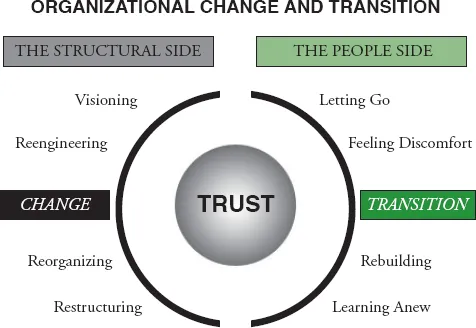
Change and transition are not the same thing. Transition represents the psychological and emotional adaptation to change. In our work situations, as well as other areas of our lives, adaptation is essentially a process of letting go of the old way and accepting the new way. Leaders need to recognize that when change initiatives are not going well, it is probably because people are stuck in some part of the transition. They may not be ready to let go because what they have to leave behind was comfortable and it worked. They may not be ready to accept because learning is never pain free—there is a drop in competency and comfort at the initial stage of the learning curve. People resist when they feel at risk. They are grieving because they are letting go of something they value and are trying to adapt to something that is unknown. When people feel this way, they aren’t able to fully appreciate and to actively commit to a change initiative. Trying to solve the problem by focusing only on the structural side of leadership—reiterating your plans and rationale, pushing the data or measurements—doesn’t help resolve the troubles that are connected to people’s difficulty with transition. Instead, your leadership task is to connect to the personal and the emotional fallout of change so that you can help individuals in the organization let go, deal with the discomfort, rebuild, and learn.
Leading Change
Here’s what frequently happens in an organization when a change initiative is put into play: Accustomed to the structural side of leadership—visioning, reengineering, reorganizing, and restructuring—senior leaders see problems and opportunities, and come up with ways for the organization to deal with them. Skilled managers look at direction, structure, operations, and other factors, and then develop a plan of action. Goals are set, processes are revamped, jobs are redesigned or eliminated, and new metrics are established—all under the umbrella of “change initiative.” All the while, leaders often mask their own emotional response to the change in an effort to maintain an image of strength.
Then, with some recognition of the importance of commitment and communication, the organization’s leaders roll out the new plan/process/structure/strategy. For a large-scale change, announcements, meetings, newsletters, and other communication channels become part of the process. When the situation involves more modest or narrowly focused changes, the organization’s leaders often make them with little or no notice and with little or no awareness of unintended consequences. When communication occurs, it is driven by or tuned to legal ramifications.
Having introduced the new way of work, the leaders who are responsible for the plan or for catalyzing the change are usually ready to move on—or they feel compelled to act as if they are ready to move on. They have a plan, they know what to measure, and they know how to proceed. Most managers are focused on leading the structural side of change, represented by the left side of the diagram on the preceding page. That’s how leadership has been defined for them, and what they’ve been rewarded for.
Unfortunately, the best-laid plans for organizational change are frequently diluted or damaged by a failure to exert strong leadership around the people issues. Sooner or later, leaders see that the change isn’t working according to plan. Individuals are not performing as needed and are even resistant. In response, leaders naturally turn to their strengths and habitual ways of behaving. They reiterate the logic of the change and push people harder. They try to motivate people by cheerleading, getting angry, threatening. They get impatient when employees won’t get with the program. Frustration grows as leaders wonder why employees can’t just do what needs to be done. Usually, the organization sheds the more resistant employees, which raises the pressure on and anxiety in the people who remain.
Over the years, we’ve observed this scenario repeat itself time and time again. Senior leaders from multinational corporations, government agencies, small and midsize businesses, and nonprofit organizations have come to us for help when they hit this point and did not realize the benefits they had expected to see. Our diagnosis of the symptoms is often the same: change initiatives break down because people stall somewhere during the transition.
Leading Transition
Organizational events—restructuring, mergers and acquisitions, and financial difficulty—as well as overall uncertainty trigger all kinds of behavioral and emotional reactions. Confronted by change, people go through a time of transition. This adaptive process occurs at a different pace and in various ways for each individual, depending upon the circumstances. In an organization undergoing change, the leader’s responsibility is to live through this process of transition with others in a genuine and authentic way, and to lead in a way that helps bring people through transition so that they can adapt and contribute in the long term.
Leaders who are best able to cope with transition are in touch with their personal reactions to change. They are comfortable sharing those emotions. But such leaders are not the norm. Most leaders have focused little attention on understanding and learning from their own emotional transitions and therefore are not well prepared to foster such efforts in others. When leaders have reservations, a sense of loss, fear, or some other ...
Table of contents
- Cover
- Title Page
- Copyright
- Contents
- Preface
- Introduction
- Chapter 1: Building Trust in Extraordinary Times
- Chapter 2: Catalyzing Change versus Coping with Transition
- Chapter 3: Sense of Urgency versus Realistic Patience
- Chapter 4: Being Tough versus Being Empathetic
- Chapter 5: Optimism versus Realism and Openness
- Chapter 6: Self-Reliance versus Trusting Others
- Chapter 7: Capitalizing on Strengths versus Going against the Grain
- Chapter 8: Plotting Your Tendencies
- Chapter 9: Complexities That Challenge Balance
- Appendix: And the Work Continues …
- Suggested Readings
Trusted by 375,005 students
Access to over 1.5 million titles for a fair monthly price.
Study more efficiently using our study tools.
Frequently asked questions
Yes, you can cancel anytime from the Subscription tab in your account settings on the Perlego website. Your subscription will stay active until the end of your current billing period. Learn how to cancel your subscription
No, books cannot be downloaded as external files, such as PDFs, for use outside of Perlego. However, you can download books within the Perlego app for offline reading on mobile or tablet. Learn how to download books offline
Perlego offers two plans: Essential and Complete
- Essential is ideal for learners and professionals who enjoy exploring a wide range of subjects. Access the Essential Library with 800,000+ trusted titles and best-sellers across business, personal growth, and the humanities. Includes unlimited reading time and Standard Read Aloud voice.
- Complete: Perfect for advanced learners and researchers needing full, unrestricted access. Unlock 1.5M+ books across hundreds of subjects, including academic and specialized titles. The Complete Plan also includes advanced features like Premium Read Aloud and Research Assistant.
We are an online textbook subscription service, where you can get access to an entire online library for less than the price of a single book per month. With over 1.5 million books across 990+ topics, we’ve got you covered! Learn about our mission
Look out for the read-aloud symbol on your next book to see if you can listen to it. The read-aloud tool reads text aloud for you, highlighting the text as it is being read. You can pause it, speed it up and slow it down. Learn more about Read Aloud
Yes! You can use the Perlego app on both iOS and Android devices to read anytime, anywhere — even offline. Perfect for commutes or when you’re on the go.
Please note we cannot support devices running on iOS 13 and Android 7 or earlier. Learn more about using the app
Please note we cannot support devices running on iOS 13 and Android 7 or earlier. Learn more about using the app
Yes, you can access Leading with Authenticity in Times of Transition by Bunker, Wakefield in PDF and/or ePUB format, as well as other popular books in Business & Leadership. We have over 1.5 million books available in our catalogue for you to explore.