Creative solutions can be challenged and defended in the pursuit of profitability. But first, creativity must be demystified. A process that targets innovation provides leaders with just such a problem-solving approach. The goal is to produce high-quality ideas that are appropriate to the task - which means groups and organizations can implement them with less risk. Work with the targeted innovation process consists of activities in five areas: stating the problem in a way that encourages creative problem solving, learning and understanding different problem-solving styles, learning and understanding creative pathways and their relationship to problem solving, generating ideas, and evaluating those ideas. Targeted innovation reconciles creativity with management. Managers can use it to solve problems that meet their organization's call for innovative answers to current challenges.
- 31 pages
- English
- ePUB (mobile friendly)
- Available on iOS & Android
eBook - ePub
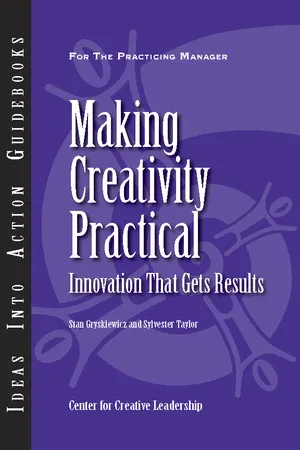
Making Creativity Practical: Innovation That Gets Results
About this book
Information
Making Creativity Practical

There are many idea-generation techniques. Choosing the right one for a particular situation can be daunting. Managers can start by linking the creative process to their organization’s call for innovation. They can state the problem in a way that encourages creative problem solving, for one. They can learn the differences between types of problem solving, for another. Managers can also determine what creative path is best suited to solving the problem, get their work group or team to generate ideas, and then evaluate those ideas to find the ones most likely to produce results. This is the essence of targeted innovation.
Stating the Problem
Problems and challenges make themselves known to managers and work groups in many ways. They can come informally, such as tips gleaned from the suggestion box. They can come from monitoring an external source—changes in the marketplace or a competitor’s new release, for example. Or they can be delivered more formally, as implied in a task the organization has assigned. Consider, for example, the problems and challenges imbedded in these instructions as communicated by the organization.
• Reduce manufacturing costs by 10 percent.
• Find a new use for an obsolete machine or process.
• Envision our manufacturing process five years from now.
• Cure a bottleneck that affects two critical processes.
Learning about a challenge is one thing, but stating the problem can be a little more complex. The language and style of the problem statement are vitally important because they set the stage for the ideas that will eventually bring about a solution. Simply laying out a mandate—reduce costs by 10 percent, for example—to the work group or team designated to solve the problem restricts creative thought. Instead, it’s more effective to state the problem plainly, without value judgments and implied solutions, and in an open-ended style that encourages many possible answers. For example, if you were assigned to solve a bottleneck problem at your organization’s shipping and receiving facility, you wouldn’t want to state the problem to your group as: “How can we get those lazy dockworkers to move faster?” Use the samples below as a guide to stating the current problem your group faces. An open-ended, careful wording of the problem statement can often be enough to generate the creative ideas you need.
Organizational challenge/problem | Creative problem-solving statement |
Reduce manufacturing costs by 10 percent. | How can we reduce the high cost of manufacturing? |
Design a manufacturing process we can implement in five years. | How can we manufacture our products differently? |
Find a new use for an obsolete machine or process. | How can we make money from an obsolete product or process? |
Process A generates twice the output that process B can cope with in a shift. Relieve a bottleneck that occurs between these two critical processes. | How can we put twice as much into the same space? |
By avoiding problem statements that imply a solution, you open the way for unexpected perspectives and solutions. Part of the benefit to creative problem solving is its tendency to take an organization into areas that it hasn’t explored. Even if one answer doesn’t solve the immediate problem, it adds to the organization’s intellectual capital and perhaps even helps to produce new services, processes, perspectives, and products.
Understanding Approaches to Problem Solving
Because it starts with an open-ended problem statement that encourages unrestricted creativity, the targeted innovation process accounts for many ways to solve a problem. Fortunately, managers don’t have to start with an unlimited number of solutions. It’s much easier if they think of solutions as falling into either one of two archetypal styles of problem-solving approaches: incremental and breakaway.
Incremental approach. This approach might be best understood by remembering the coastal sailing route Europeans once took to the East around the horn of Africa. This route meant that ships were never out of sight of land. It was an extension of earlier voyages of discovery down the west coast of Africa. Similarly, when it comes to solving a problem, some people choose to improve on the original idea or perform a process better while never really changing their initial approach. The incremental approach is the more orthodox way to solve a problem.
Breakaway approach. This approach might be explained best using another sailing example, this time Christopher Columbus’s inspiration to sail west to reach the East. European sea voyages in the fifteenth century rarely sailed far from the sight of land, and ocean-crossing voyages were virtually unheard of. What spice or riches could justify taking such unknown risks? Like Columbus, some ...
Table of contents
- Cover
- Copyright
- Title Page
- Table of Contents
- What Is Practical Creativity?
- Why Is Practical Creativity Important?
- Making Creativity Practical
- Making a Place for Creativity at Work
- Suggested Readings
- Background
- Key Point Summary
Trusted by 375,005 students
Access to over 1.5 million titles for a fair monthly price.
Study more efficiently using our study tools.
Frequently asked questions
Yes, you can cancel anytime from the Subscription tab in your account settings on the Perlego website. Your subscription will stay active until the end of your current billing period. Learn how to cancel your subscription
No, books cannot be downloaded as external files, such as PDFs, for use outside of Perlego. However, you can download books within the Perlego app for offline reading on mobile or tablet. Learn how to download books offline
We are an online textbook subscription service, where you can get access to an entire online library for less than the price of a single book per month. With over 1.5 million books across 990+ topics, we’ve got you covered! Learn about our mission
Look out for the read-aloud symbol on your next book to see if you can listen to it. The read-aloud tool reads text aloud for you, highlighting the text as it is being read. You can pause it, speed it up and slow it down. Learn more about Read Aloud
Yes! You can use the Perlego app on both iOS and Android devices to read anytime, anywhere — even offline. Perfect for commutes or when you’re on the go.
Please note we cannot support devices running on iOS 13 and Android 7 or earlier. Learn more about using the app
Please note we cannot support devices running on iOS 13 and Android 7 or earlier. Learn more about using the app
Yes, you can access Making Creativity Practical: Innovation That Gets Results by Gryskiewicz, Taylor in PDF and/or ePUB format, as well as other popular books in Business & Leadership. We have over 1.5 million books available in our catalogue for you to explore.