A great many peer conflicts arise from incompatible goals or from different views on how a task should be accomplished. With honest dialogue these kinds of conflicts can usually be resolved. But other peer conflicts are more troublesome because they involve personal values, office politics and power, and emotional reactions. To resolve these more difficult peer conflicts, managers should examine three key issues that can cause such clashes and also influence their outcome. One, they should assess their emotional "hot buttons" that trigger ineffective behaviors and make conflict difficult to manage. Two, they should examine their personal values and how those might conflict with what their peers find important. Finally, they should assess their power in the organization - which can be related to position, influence, expertise, or some other factor - and learn how to use it to manage conflicts. Navigating these issues won't rid an organization of conflict among peers. But by paying attention to them managers can build effective relationships that will survive these inevitable conflicts and bolster their ability to achieve organizational goals.
- 31 pages
- English
- ePUB (mobile friendly)
- Available on iOS & Android
eBook - ePub
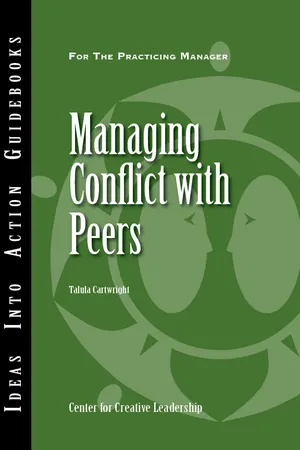
Managing Conflict with Peers
About this book
Information
How Values Affect Conflict

Your values are critically important to your personal well-being. They are the beliefs that you find most meaningful and important. They guide your behavior and are an anchor during hardships or times of change. Conflicts, especially those that occur between peers, often involve differences in values. For example, if you suggest to a colleague that the workgroup stay late at the office to make more progress on a particular assignment but your colleague wants to go to his daughter’s soccer game, that situation might cause a conflict. At that specific moment the sacrifice and camaraderie of peers pitching in above the call of duty to accomplish a goal may be very important to you, while your peer places more importance on a balance between work and family responsibilities. Depending on how closely held these values are and how deeply each person is committed to them, such differences can result in dramatic conflicts.
Identifying Your Values
Because competing values can complicate work relationships and sometimes cause conflicts that are difficult to resolve, it’s important that you have a clear understanding of your own values. One way to gain that understanding is through an activity such as a values sort, which CCL sometimes uses in its work with managers and executives. Using the cards laid out on pages 18–20, you can quickly get a fix on your values and rank them in importance. To get started, photocopy the cards (there are three pages with ten cards each) and then cut them apart. Sort them into five stacks: always very important to me, often very important to me, sometimes very important to me, rarely very important to me, and never very important to me. Be sure to put at least one card in each stack.
Don’t worry if some of your values aren’t included in these thirty cards. You can add your own cards with values that are meaningful to you. After you have dealt your cards, look at the stacks you’ve made. Spread them out so you can see which cards (values) are in each group. What do you notice? Do you see trends, themes, or patterns? Look at the always very important to me column. If you have almost all your cards in that stack, what might that mean? (It’s very stressful to think we always have to value so many things.) Are there contradictory responses in this group? If so, you might be setting yourself up for an internal conflict. What are the things that are clearly the most important to you? Which ones would you be willing to “fall on your sword” for? Do you see how your values might set the stage for conflict with other people who are important to you? After you have studied your stacks of cards, record your rankings on a separate piece of paper.
Identifying Your Peer’s Values
Values are often difficult to recognize in your peers because these values are so personal and ingrained that your peers may not talk about them. Using the same card sort method you used for yourself, try to indicate how deeply one of your peers holds these values. Base your rankings on how you see them acting on their values. Choose a colleague with whom you have a significant working relationship but not necessarily one with whom you have a conflict. You might notice pretty quickly that you don’t know how to sort all of the values – probably because you haven’t discussed them with your peer and because there is sometimes a difference between espoused values and those that are acted on. But if you think about your peer’s behavior at work or off the job, or think about the kinds of statements they have made, you can make a good guess as to how to rank their personal values. It’s not important that your choices be exactly right, because when you review your responses you will be comparing your values with your perception of your peer’s values. If this activity were run the other way, with your peer ranking how important each value is to you, they would likely rank them differently from you.
After you have ranked the values of your colleague, compare these responses to those you recorded for yourself. Where are the biggest differences? Are significant differences related to any conflicts you have had with this peer? If you had been aware of these differences could you have handled that conflict better? Take a few minutes to reflect on that la...
Table of contents
- Cover
- Copyright
- Title Page
- Table of Contents
- Is Conflict Destructive?
- A Process for Managing Conflict
- How Emotional Hot Buttons Affect Conflict
- How Values Affect Conflict
- How Power and Politics Affect Conflict
- Managing Conflict for Results
- Suggested Readings
- Background
- Key Point Summary
Trusted by 375,005 students
Access to over 1.5 million titles for a fair monthly price.
Study more efficiently using our study tools.
Frequently asked questions
Yes, you can cancel anytime from the Subscription tab in your account settings on the Perlego website. Your subscription will stay active until the end of your current billing period. Learn how to cancel your subscription
No, books cannot be downloaded as external files, such as PDFs, for use outside of Perlego. However, you can download books within the Perlego app for offline reading on mobile or tablet. Learn how to download books offline
Perlego offers two plans: Essential and Complete
- Essential is ideal for learners and professionals who enjoy exploring a wide range of subjects. Access the Essential Library with 800,000+ trusted titles and best-sellers across business, personal growth, and the humanities. Includes unlimited reading time and Standard Read Aloud voice.
- Complete: Perfect for advanced learners and researchers needing full, unrestricted access. Unlock 1.5M+ books across hundreds of subjects, including academic and specialized titles. The Complete Plan also includes advanced features like Premium Read Aloud and Research Assistant.
We are an online textbook subscription service, where you can get access to an entire online library for less than the price of a single book per month. With over 1.5 million books across 990+ topics, we’ve got you covered! Learn about our mission
Look out for the read-aloud symbol on your next book to see if you can listen to it. The read-aloud tool reads text aloud for you, highlighting the text as it is being read. You can pause it, speed it up and slow it down. Learn more about Read Aloud
Yes! You can use the Perlego app on both iOS and Android devices to read anytime, anywhere — even offline. Perfect for commutes or when you’re on the go.
Please note we cannot support devices running on iOS 13 and Android 7 or earlier. Learn more about using the app
Please note we cannot support devices running on iOS 13 and Android 7 or earlier. Learn more about using the app
Yes, you can access Managing Conflict with Peers by Cartwright in PDF and/or ePUB format, as well as other popular books in Business & Leadership. We have over 1.5 million books available in our catalogue for you to explore.