Executive coaching is an increasingly popular means for developing organizational leaders. This sourcebook provides a resource for both practioners and researchers interested in gaining or updating their understanding of the current state of the executive coaching field and to enable them to do so in a systematic manner. By focusing on key research and practice in the executive coaching literature, this sourcebook provides not only a mechanism for consolidating our thinking about leadership coaching issues but also a succinct reference for building future research efforts.
eBook - ePub
The Leadership Coaching Sourcebook: A Guide to the Executive Coaching Literature
- 136 pages
- English
- ePUB (mobile friendly)
- Available on iOS & Android
eBook - ePub
The Leadership Coaching Sourcebook: A Guide to the Executive Coaching Literature
About this book
Information
Section 1. Using This Sourcebook
This sourcebook is designed to both provide an introduction to the topic of executive coaching and help guide experienced researchers and practitioners to literature most relevant for their needs. Literature on executive coaching has grown substantially since the annotated bibliography compiled by Douglas and Morley (2000). Due to the growing size and breadth of this literature, rather than simply providing an updated annotated bibliography, this sourcebook strategically compiles key publications as a means to highlight the state of leadership coaching.
This sourcebook can be used in a variety of ways. First, Section 2 provides a brief overview of the past and current state of the executive coaching literature. This material provides a brief synopsis for individuals who have limited or dated knowledge of executive coaching and wish to gain a greater understanding of the major issues in the literature. In addition to this general overview, Section 5 presents a summary of the current literature as well as discussion of the major factors in leadership coaching according to the framework provided in Section 4. We encourage readers to examine Figures 1 and 2 for an overview of the issues and corresponding articles.
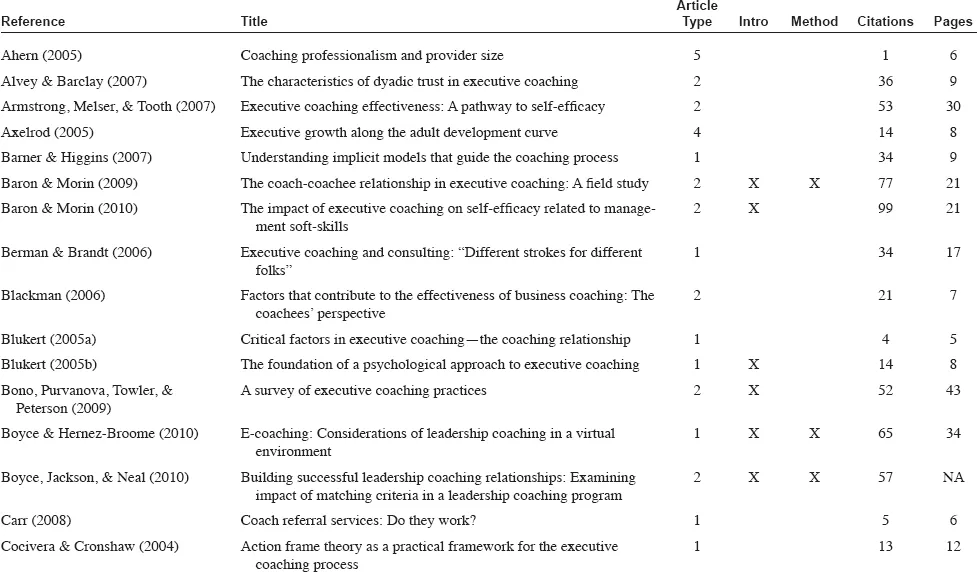
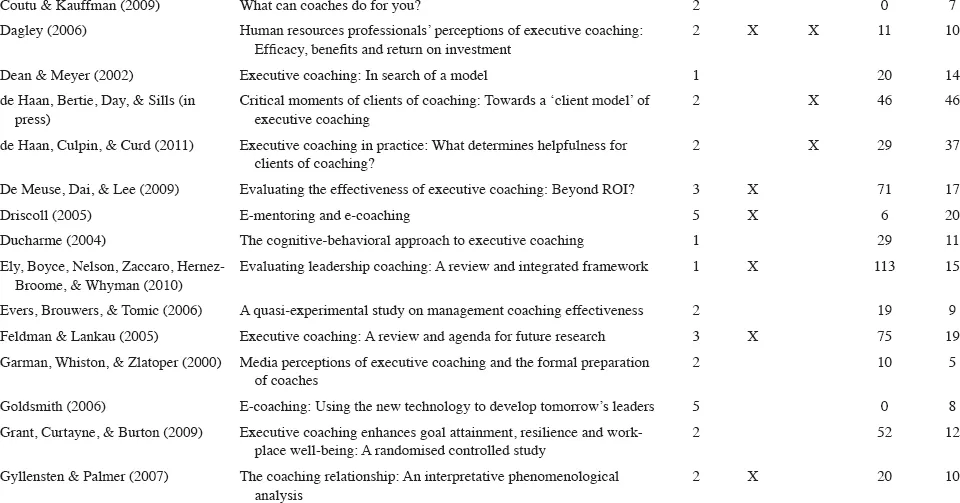
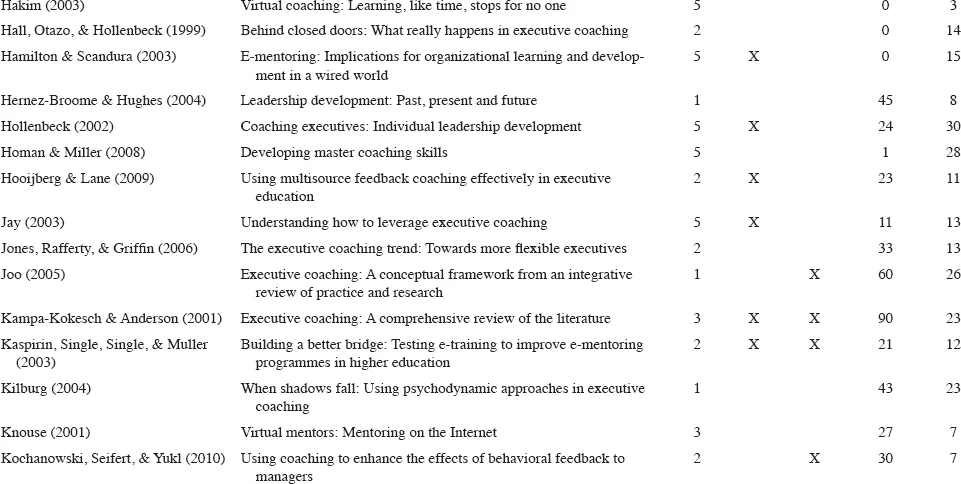
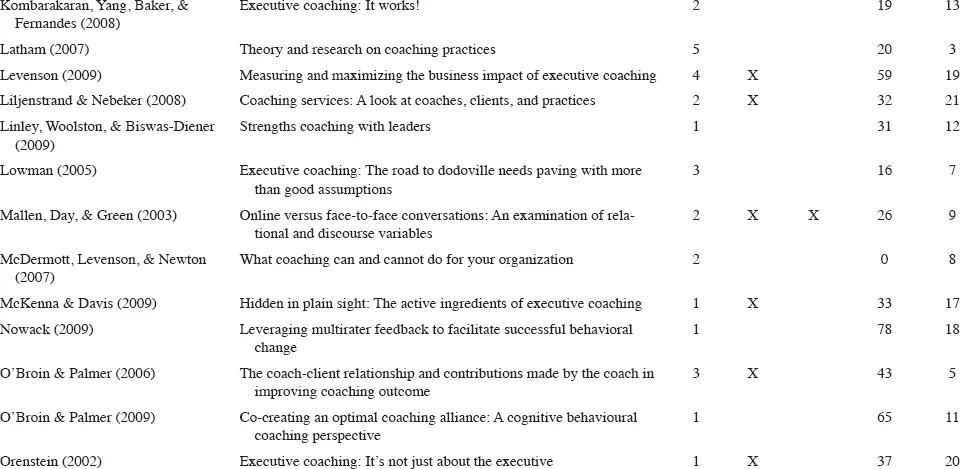
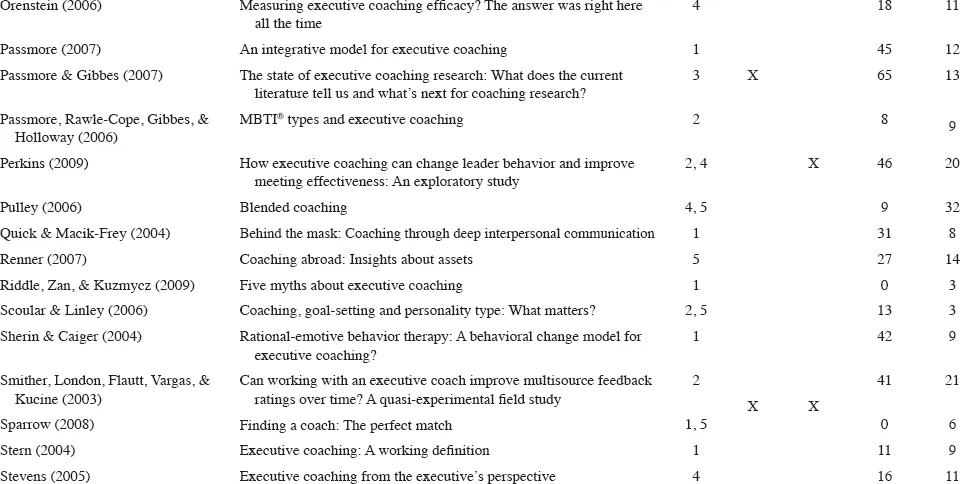
For individuals wishing to develop deeper knowledge of a particular topic related to executive coaching, outlines of topic-specific articles are provided in Section 6. Although not intended to replace the original articles, these outlines were designed to help you identify the articles most relevant to your needs. Additionally, each article has been assigned codes to help readers efficiently identify the type of methodology employed, particularly useful introductions of a topic, number of citations included, number of pages, and the type of article (for example, conceptual or empirical). Table 1 provides a list and definitions of the codes, and Table 2 maps each article according to these codes.
Thus, this sourcebook can be read in its entirety to provide a comprehensive overview of current coaching publications, or it can be used to identify resources specific to an individual reader’s needs.
Table 1. Definitions of codes assigned to articles
Code |
Definition |
Article Type |
|
T1 |
Conceptual article: includes propositions or arguments based on theory |
T2 |
Research article: tests one or more specific hypotheses |
T3 |
Literature review: review of relevant literature with no propositions or hypothesis testing |
T4 |
Case study: based on a limited number of personal experiences; may include some basic descriptive statistics |
T5 |
Viewpoint: provides a point of view on leadership coaching |
Introduction |
|
I |
Article includes an extremely thorough, detailed, and well-written introduction to executive coaching |
Methodology |
|
M |
Article describes a methodologically rigorous study design in enough detail to facilitate replication |
Citations |
|
C# |
Number of citations referenced in the article |
Page Number |
|
P# |
Total page length of the article |
Table 2. Summary of all articles coded

Section 2. The Past and Current State of Executive Coaching
Executive coaching has witnessed an increase in popularity in both practice and research in the past two decades (Dagley, 2006; Passmore 2007). Although coaching and leader development efforts have been used in organizations for the past half century (Day, 2001; Kampa-Kokesch & Anderson, 2001), the term executive coaching was first coined in the 1980s in order to reduce the punitive stigma associated with coaching. However, practices were still predominantly corrective in nature and aimed at ineffective leaders (Kampa-Kokesch & Anderson, 2001). The practice of executive coaching substantially increased in the early 1990s, as faltering organizations attributed organizational problems to poor leadership. As a result, coaching maintained a punitive connotation (Feldman & Lankau, 2005) for another decade.
Only within the past decade has executive coaching evolved into a developmental opportunity and come to be perceived in a positive light for leaders (Feldman & Lankau, 2005). Today, coaches work closely with executives on long-term goals, daily activities, and interpersonal skills (Dean & Meyer, 2002; Hernez-Broome & Hughes, 2004; Jay, 2003). The success and subsequent demand for executive coaching has created an enormous growth in the number of professional coaches and coaching programs in organizations (Day, 2001; Dean & Meyer, 2002; Feldman & Lankau, 2005; Hernez-Broome & Hughes, 2004).
Despite the advent of executive coaching practices, the literature provides little consensus on a definition of executive coaching. However, the field appears to be reaching a convergence regarding the core components, as evidenced by several articles agr...
Table of contents
- Cover
- Title Page
- Copyright
- Table of Contents
- Overview
- Section 1. Using this Sourcebook
- Section 2. The Past and Current State of Executive Coaching
- Section 3. Introduction of the Leadership Coaching Framework
- Section 4. Article Selection Criteria
- Section 5. Emerging Article Themes
- Conclusion
- Section 6. Article Outlines
- Section 7. Additional Resources
Trusted by 375,005 students
Access to over 1.5 million titles for a fair monthly price.
Study more efficiently using our study tools.
Frequently asked questions
Yes, you can cancel anytime from the Subscription tab in your account settings on the Perlego website. Your subscription will stay active until the end of your current billing period. Learn how to cancel your subscription
No, books cannot be downloaded as external files, such as PDFs, for use outside of Perlego. However, you can download books within the Perlego app for offline reading on mobile or tablet. Learn how to download books offline
Perlego offers two plans: Essential and Complete
- Essential is ideal for learners and professionals who enjoy exploring a wide range of subjects. Access the Essential Library with 800,000+ trusted titles and best-sellers across business, personal growth, and the humanities. Includes unlimited reading time and Standard Read Aloud voice.
- Complete: Perfect for advanced learners and researchers needing full, unrestricted access. Unlock 1.5M+ books across hundreds of subjects, including academic and specialized titles. The Complete Plan also includes advanced features like Premium Read Aloud and Research Assistant.
We are an online textbook subscription service, where you can get access to an entire online library for less than the price of a single book per month. With over 1.5 million books across 990+ topics, we’ve got you covered! Learn about our mission
Look out for the read-aloud symbol on your next book to see if you can listen to it. The read-aloud tool reads text aloud for you, highlighting the text as it is being read. You can pause it, speed it up and slow it down. Learn more about Read Aloud
Yes! You can use the Perlego app on both iOS and Android devices to read anytime, anywhere — even offline. Perfect for commutes or when you’re on the go.
Please note we cannot support devices running on iOS 13 and Android 7 or earlier. Learn more about using the app
Please note we cannot support devices running on iOS 13 and Android 7 or earlier. Learn more about using the app
Yes, you can access The Leadership Coaching Sourcebook: A Guide to the Executive Coaching Literature by Nelson, Boyce, Hernaz-Broome, Ely, DiRosa in PDF and/or ePUB format, as well as other popular books in Business & Leadership. We have over 1.5 million books available in our catalogue for you to explore.