Experience is vital for a leader's success, but merely having an experience (such as a challenging new job, a stretch assignment, or an unexpected hardship) isn't enough. The best leaders know not just how to seek out developmental experiences, but how to extract the essential lessons within each experience and apply them to future situations. This book will walk you through a four step process for making the most out of your experiences. You will learn how to seek out beneficial experiences, make sense out of both old and new experiences, internalize the most useful lessons from each experience, and apply those lessons to new, unfamiliar, and challenging situations. By becoming learning agile, you'll be able to use the lessons of experience to meet the challenges headed your way.
- 67 pages
- English
- ePUB (mobile friendly)
- Available on iOS & Android
eBook - ePub
Learning Agility: Unlock the Lessons of Experience
About this book
Information
Learning Agility: Four Practices, Endless Possibilities
Learning agile individuals are distinguished by their willingness and ability to learn from experience. But they also excel at applying that learning to perform successfully in new and challenging situations. Put another way, learning agile people have “learned how to learn” from their experiences and made a strong commitment to seeking new challenges that allow them to both apply what they’ve learned and acquire new lessons for later application.
Few people who are learning agile have been explicitly taught the skills that have helped them become that way. Not surprisingly, they have developed these skills on their own and come to recognize these skills and their value as a result of experience. They are more likely to use terms such as “quick study” or “lifelong learner” to describe their abilities than say they are learning agile. Nor can they easily describe the specific behaviors that make up their approach to learning; it’s simply “what they do when they don’t know what to do.”
CCL’s research into learning from experience and the skills of those who excel at it has allowed us to decode the “unconscious competence” of most learning agile people and separate this competence into four specific sets of behaviors:
SEEKING
Developing learning agility requires an intentional willingness to immerse yourself in new and challenging situations that broaden and expand your experiences. Learning agile individuals see these situations as prime opportunities for new learning and growth. Furthermore, they are opportunities to seek out and embrace, not just to accept as each opportunity comes along.
SENSEMAKING
Learning from experience is a highly active and ongoing process marked by curiosity and a willingness to experiment. Asking “Why?” “How?” and “Why not?” are essential to gaining the insight and perspective that fuels learning. Failed experiments, and the setbacks and criticism that accompany them, are just a part of the ongoing journey for learning agile individuals.
INTERNALIZING
Learning doesn’t end with the experience. Seeking feedback and taking time to reflect are critical for deepening insight and embedding critical lessons for recall and application. They also strengthen self-awareness, which is essential for dealing with future challenges in a realistic manner and staying open to new learning.
APPLYING
A lesson is not truly learned until it is applied. Learning agile individuals excel at adaptive learning—accessing principles and rules of thumb from previous experiences and applying them to navigate new and challenging situations. Swiftly adapting to new circumstances based on an understanding of what has (and hasn’t) worked in other situations is at the heart of what distinguishes learning agile individuals.
These four core components of learning agility occur in sequence over the course of a learning experience.

They also layer onto one another so that as one encounters subsequent learning experiences, simultaneous pairings of Seeking-Internalizing and Sensemaking-Applying occur.

For the purposes of this book, we will treat them separately and sequentially, but it is important to remember that learning agility and experience are intertwined and many of the behaviors we describe flow together in a fluid and seamless manner, especially as you become more familiar with and skilled at them.
As you step back and consider the four components of learning agility, you’ve probably thought to yourself, “That seems pretty basic. So what’s the big deal? Isn’t that something everyone does on a day-to-day basis?”
That’s essentially correct. The four components capture the basic pattern and progression of behaviors that inform experiential learning. The difference is that people who are learning agile engage in these behaviors at a significantly higher level of skill and commitment. And because they are constantly engaged in learning from and applying their experience, they are ratcheting up that level of skill and commitment on an ongoing basis.
It’s the same with any skill that is shaped by and improved with experience. In this case, it’s just the skill of learning from experience.
That’s an advantage with developing learning agility. Experience is the essential ingredient and something we can all access. Since we understand how learning agile people seek learning experiences, make sense of them, internalize the lessons learned and then apply them, we’ll show you how it’s done.
Before we dive into each component of learning agility in more depth, go back to the experiences you recorded in the opening chapter and use the space below to record your memory and impressions of how you proceeded (or maybe didn’t) through Seeking, Sensemaking, Internalizing, and Applying. Don’t worry if you don’t have a lot to record at this time; we’ll dig deeper into each component as we go.
MY POSITIVE EXPERIENCE
Seeking:
Sensemaking:
Internalizing:
Applying:
MY NEGATIVE EXPERIENCE
Seeking:
Sensemaking:
Internalizing:
Applying:
Also, it’s helpful to get an initial sense for where you might currently have some strengths or needs for development in the four areas. A good way to do this is to think of someone you know well who exhibits the highest levels of learning agility you’ve observed and compare yourself to them on key behaviors in the four areas.
Take a moment to identify this person, the type of versatile and adaptable performer they are, and what it is that distinguishes them in how they approach, learn from, and apply their experiences.
Next, for each statement that follows, use the following scale to rate this person you know who demonstrates the highest levels of learning agility (“Learning Agile”). Then rate your own learning agility skills (“Me”). [Note: Selected items can be found in CCL’s Benchmarks for Learning Agility assessment.]
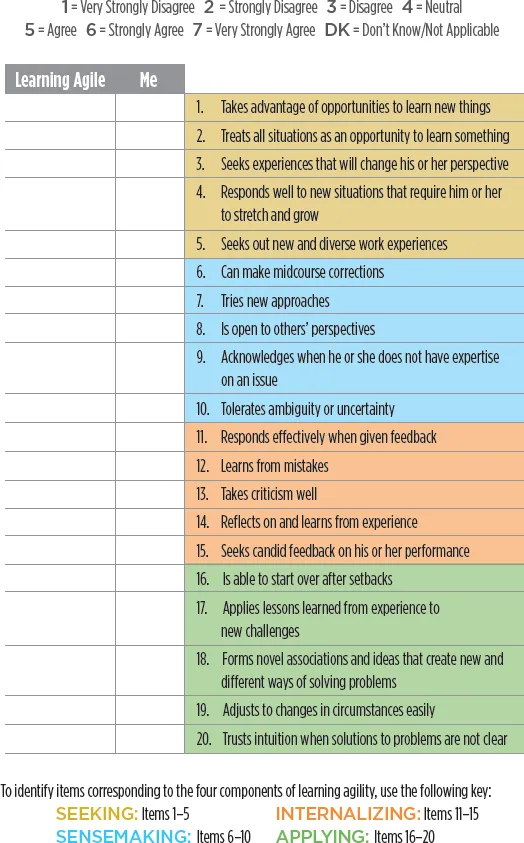
Looking at your ratings, what kind of patterns do you see? Do you rate yourself particularly high or low on one of the four components? What gaps between you and your learning agile colleague would you like to concentrate on closing? What pleases you? Consider these and other related questions as you go through the rest of this book.
The following chapters explore each of the four main components of learning agility. You’ll learn the essential practices utilized by learning agile people that allow them to gain as much as possible from their experiences and enable their ability to tackle new challenges successfully.
Seeking
Learning agile individuals demonstrate the opposite of getting stuck in a rut. They are constantly exploring new pathways for themselves and others. Why? Because new experiences are like fresh air for their continual learning and growth. Without new experiences to challenge, stretch, and inform them, life loses some of its essence. It’s as much a need as it is a desire.
Learning agile people are fortunate. Their track record of success in new situations means they are often sought out to take on fresh challenges, to which they invariably say, “Yes!” In the absence of new challenges being presented to them, they seek the challenges out. That’s no ordinary thing. The seeking behaviors examined in this chapter require a willingness and commitment to take action, as well as considerable courage.
Exploring the an...
Table of contents
- Cover
- Title Page
- Copyright
- Contents
- Learning Agility in Action
- “How do they do that?”
- The Essential (But Incomplete) Role of Experience
- Learning Agility: Four Practices, Endless Possibilities
- Embracing the Learner’s Life
- Background
- Suggested Resources
Trusted by 375,005 students
Access to over 1.5 million titles for a fair monthly price.
Study more efficiently using our study tools.
Frequently asked questions
Yes, you can cancel anytime from the Subscription tab in your account settings on the Perlego website. Your subscription will stay active until the end of your current billing period. Learn how to cancel your subscription
No, books cannot be downloaded as external files, such as PDFs, for use outside of Perlego. However, you can download books within the Perlego app for offline reading on mobile or tablet. Learn how to download books offline
Perlego offers two plans: Essential and Complete
- Essential is ideal for learners and professionals who enjoy exploring a wide range of subjects. Access the Essential Library with 800,000+ trusted titles and best-sellers across business, personal growth, and the humanities. Includes unlimited reading time and Standard Read Aloud voice.
- Complete: Perfect for advanced learners and researchers needing full, unrestricted access. Unlock 1.5M+ books across hundreds of subjects, including academic and specialized titles. The Complete Plan also includes advanced features like Premium Read Aloud and Research Assistant.
We are an online textbook subscription service, where you can get access to an entire online library for less than the price of a single book per month. With over 1.5 million books across 990+ topics, we’ve got you covered! Learn about our mission
Look out for the read-aloud symbol on your next book to see if you can listen to it. The read-aloud tool reads text aloud for you, highlighting the text as it is being read. You can pause it, speed it up and slow it down. Learn more about Read Aloud
Yes! You can use the Perlego app on both iOS and Android devices to read anytime, anywhere — even offline. Perfect for commutes or when you’re on the go.
Please note we cannot support devices running on iOS 13 and Android 7 or earlier. Learn more about using the app
Please note we cannot support devices running on iOS 13 and Android 7 or earlier. Learn more about using the app
Yes, you can access Learning Agility: Unlock the Lessons of Experience by Hallenbeck in PDF and/or ePUB format, as well as other popular books in Business & Leadership. We have over 1.5 million books available in our catalogue for you to explore.