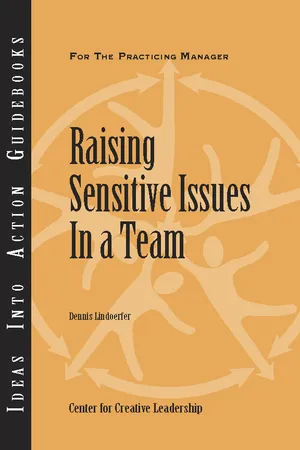
Have you ever wondered how to deal with a sensitive issue within your team? For example, how do you raise the issue that the women rarely get listened to? How do you bring up your observation that the team members from Marketing always dominate the meetings? This guidebook focuses on ways to determine whether to raise such an issue in a team meeting - and if so, how.
- 28 pages
- English
- ePUB (mobile friendly)
- Available on iOS & Android
eBook - ePub
Raising Sensitive Issues in a Team
About this book
Trusted by 375,005 students
Access to over 1 million titles for a fair monthly price.
Study more efficiently using our study tools.
Information
Elements of the Process

The scenario on page 9 captures several core elements of the process we’re exploring. The first element is an awareness of what is transpiring. We use our awareness of our own thoughts, feelings, and behaviors during a meeting of a team to monitor the progression of events. Our reactions in these domains lead us to conclude that things are going well or not so well. Our awareness of the behavior, both verbal and nonverbal, of our teammates and our speculation about the thoughts and feelings these behaviors are tied to are other sources of information we observe and process to evaluate the team’s functioning.
Scenario 1
A team member sitting in a team meeting notices that he is having a hard time getting the opportunity to get his thoughts about the work aired. He recollects that this is more often than not the case in the last few meetings. He begins to pay a bit more attention to which of the team members are doing the most talking and which ones are saying little or nothing.
Over the next half hour of the meeting, he notices that the marketing director (a white male with considerable seniority in the company), an information technology manager (a white male, new to the company but quite senior and previously from a competitor), and the manufacturing director (the team’s nominal leader, a white male who has come up through the ranks over his career) are dominating the conversation. The other five team members are saying little or nothing.
He’s pretty sure that some version of this pattern has been prevalent for the last few team meetings, and he suspects that the three big talkers have joined together in a subgroup of the team to push their shared agenda for the project. They happen to be the only males on the team who are white and the only team members with substantial seniority in their specialties.
He struggles with the judgment about whether this emerging communication pattern is good or bad for the team’s functioning. It makes some sense that these experienced members with considerable credibility are influencing the nature of the team’s work. Yet the relative lack of involvement of himself and the four other team members seems to be blocking the team’s customary operating style and the free-flowing exchange of ideas.
He reaches the judgment that what he’s seeing is a problem at least for him and may be a problem for other members of the team and the team as a whole. He decides to bring the issue up, so he finds an opportunity in the discussion and raises the issue.
The first element is an awareness of what is transpiring.
We also maintain some awareness of how our team is working. Most of our teams have goals established and interim milestones set, and we team members are continually or periodically checking these to see whether the team is making progress. Team maintenance and team learning goals, in addition to the more task-focused goals set by the organization, are particularly useful in this regard. These metrics help us determine whether or not our team is working effectively, both at the moment and over time.
Additionally, conceptual and experience-based frameworks that all of us have accumulated during our working lives provide us with benchmarks against which we measure how our team is working. These frameworks create expectations for how things should go when we work with others in teams.
The point of this is that we have available to us, at any given time in a team’s working life, numerous sources of data we can use to stimulate our awareness of when things are working and when they’re not. (Read and consider the indicators on page 11 to increase your own awareness.) We have to attend to this data, make some sense out of it, and then decide what, if anything, to do about it.
Reading the Signs
Leader thoughts indicating poor teamwork:
• This conversation is going nowhere.
• I’m confused.
• These people are working at cross purposes.
• This isn’t work...
Table of contents
- Cover
- Copyright
- Title Page
- Table of Contents
- From Awareness to Intervention
- Elements of the Process
- Raise or Hold
- How to Raise
- Intervention by a Team Leader
- Stimulation … and Terror
- Suggested Readings
- Background
- Key Point Summary
Frequently asked questions
Yes, you can cancel anytime from the Subscription tab in your account settings on the Perlego website. Your subscription will stay active until the end of your current billing period. Learn how to cancel your subscription
No, books cannot be downloaded as external files, such as PDFs, for use outside of Perlego. However, you can download books within the Perlego app for offline reading on mobile or tablet. Learn how to download books offline
Perlego offers two plans: Essential and Complete
- Essential is ideal for learners and professionals who enjoy exploring a wide range of subjects. Access the Essential Library with 800,000+ trusted titles and best-sellers across business, personal growth, and the humanities. Includes unlimited reading time and Standard Read Aloud voice.
- Complete: Perfect for advanced learners and researchers needing full, unrestricted access. Unlock 1.4M+ books across hundreds of subjects, including academic and specialized titles. The Complete Plan also includes advanced features like Premium Read Aloud and Research Assistant.
We are an online textbook subscription service, where you can get access to an entire online library for less than the price of a single book per month. With over 1 million books across 990+ topics, we’ve got you covered! Learn about our mission
Look out for the read-aloud symbol on your next book to see if you can listen to it. The read-aloud tool reads text aloud for you, highlighting the text as it is being read. You can pause it, speed it up and slow it down. Learn more about Read Aloud
Yes! You can use the Perlego app on both iOS and Android devices to read anytime, anywhere — even offline. Perfect for commutes or when you’re on the go.
Please note we cannot support devices running on iOS 13 and Android 7 or earlier. Learn more about using the app
Please note we cannot support devices running on iOS 13 and Android 7 or earlier. Learn more about using the app
Yes, you can access Raising Sensitive Issues in a Team by Lindoerfer in PDF and/or ePUB format, as well as other popular books in Business & Leadership. We have over one million books available in our catalogue for you to explore.