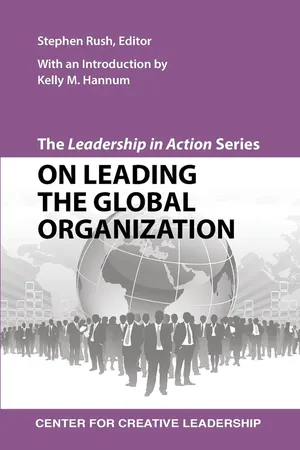
Organizations that have operations around the globe have become the norm rather than the exception. This means they need leaders with the requisite skills-including international business knowledge, cultural adaptability, perspective taking, and innovation-to respond effectively to the challenges and complexity of global leadership. This collection of seventeen pieces-written by the Center for Creative Leadership's highly experienced and knowledgeable faculty members and researchers as well as by prominent practitioners and scholars in the fields of leadership and leadership development-explores the important topic of leading the global organization from a number of angles. What can organizations and leaders do to develop the skills needed to excel in a global context? How can global leaders manage the relationship between corporate headquarters and local offices? How can organizations best handle the challenge of boundary-spanning leadership? Readers will come away with newly found knowledge on these and other questions and newly formed thoughts on how they can successfully meet the demands of leading the global organization.
- 154 pages
- English
- ePUB (mobile friendly)
- Available on iOS & Android
eBook - ePub
The Leadership in Action Series: On Leading the Global Organization
Rush,
About this book
Information
Topic
CommerceSubtopic
LeadershipPart I
BECOMING A GLOBAL LEADER
Global Managing: Mastering the Spin of a Complex World
Christopher Ernst
As the global economy has come of age, many managers have been thrust into leadership roles in which their skills don’t match the requirements of the job. But are the capabilities needed to succeed in a global context really so different from those that are critical for domestic managers? And if there are differences, what can be done to develop these new skills?
As a high-level manager at a U.S.-based manufacturing company, Matthew leads a number of teams. He has just been asked by his boss to turn over responsibility for one of those teams to someone else and take on a different task—managing a new plant in Frankfurt, Germany. The factory was recently acquired in a merger and there’s a lot riding on its success, so Matthew views his selection to manage it as a vote of confidence and another feather in his cap.
He starts to imagine what his life would be like as an expatriate. But reality stops him short—after all, his boss didn’t ask him to move to Frankfurt. He didn’t even ask him to spend a lot of time there. Instead, the boss wants Matthew to continue to manage his domestic teams as he always has and at the same time use the tools of technology—e-mail, videoconferencing, faxes, and the like—to connect with and direct his new team in Germany. The boss says Matthew needs to meet face-to-face with his people in Germany only occasionally.
Matthew believes that although his new task will mean some additional work and an increase in the scope of his job, he’ll be able to manage his new team in much the same way he has managed his domestic teams. But he’s in for a shock. He is about to take on a job that is not only bigger but far more complex.
Global managers are faced with a range of new challenges. They must become integrators of performance results, business acumen, social patterns, and perpetual technological advances, not only in their home bases but around the world. They need to acquire a new set of skills to effectively meet these complex challenges.
For many organizations, succeeding in the global economy has risen to the top of their agendas, and global managers are increasingly being asked to lead the way. And yet many managers find themselves in Matthew’s situation—thrust into a global leadership role in which their skills don’t match the requirements of the job.

What are those requirements? Are the skills required for success in managing a global operation completely different from those needed to effectively manage a domestic operation, or do they overlap? And what can organizations and leaders do to develop the skills needed to excel in a global context? CCL research work with a group of managers (see “Global Versus Local: Comparing the Requisites” on next page) produced some insights that go a long way toward answering these and other questions.
GRAVE NEW WORLD?
For global managers to get a firm grasp of the challenges they face, they must first develop a realistic picture of the new, expanded, and diverse environment in which they operate and how it differs from the relatively homogeneous setting of the domestic manager.
In the best-seller One World, Ready or Not: The Manic Logic of Global Capitalism (Simon & Schuster, 1998), political writer William Greider provides a lucid and vivid description of the crucible in which novice global managers find themselves. It is a world in which managers are required to process, integrate, and make decisions based on huge amounts of disparate information; to negotiate with governments that have very different notions of how business should be done; to interact with a complex web of organizational relationships in multiple and diverse countries; to recruit and develop the best talent from anywhere in the world; and to develop strategic alliances—even with competitors that operate within different models of capitalist systems. Stir all of these ingredients together and one gets a sense of the ambiguity and stress inherent in globally complex work.
Through its research, CCL has identified several dimensions across which the global manager must work simultaneously—even if, like Matthew, the manager spends the majority of his or her career behind a desk at the home office.
Global Versus Local: Comparing the Requisites
In an effort to learn whether managers with global responsibilities and those with purely domestic responsibilities need different types of knowledge and capabilities to be effective, CCL conducted a study of 214 managers from thirty-nine countries working in thirty countries around the world. The managers’ companies represented four industries and had corporate headquarters in Sweden, Switzerland, and the United States. Half the managers had local responsibility (they directed operations within the borders of one country), and half had global responsibility (they directed operations in multiple countries and across various cultures).
The managers completed a number of questionnaires comprising nearly 1,000 items, and each manager’s boss completed a questionnaire about the manager’s job effectiveness. CCL researchers then conducted a series of correlational analyses and found that there is one set of capabilities that all managers need to be seen as effective by their bosses whether their work is global or local in scope. These are the essential capabilities—core business knowledge; the ability to cope with pressure; and the ability to manage people, action, and information. More important to the objectives of the research, CCL also identified four pivotal capabilities that are uniquely related to the effectiveness of global managers—international business knowledge, cultural adaptability, perspective taking, and innovation.
Geographic distance. Global managers must be able to deal with the inconveniences of time differences and the practical and psychological difficulties of not always being able to see the people with whom they work.
National infrastructures. Global managers must negotiate multiple and sometimes antithetical variations in political and economic systems, regulatory and legal frameworks, and civic and labor practices.
Cultural expectations. Global managers must familiarize themselves and comply with a wide range of sometimes startling expectations in regard to behavior—their own and that of their colleagues, employees, customers, suppliers, and distributors—and the ways in which work should be done.
The complexity faced by global managers grows exponentially with the number of countries, cultures, and time zones in which they work. During teleconferences, for instance, each participant could well be in a different time zone. A global manager at a meeting in Tokyo must be aware not only of Japanese exchange rates, corporate culture, laws, investment policy, and labor unions but also of the infrastructures of each other nation in which his or her company does business. When a global manager gets off a plane or sends an e-mail message, a different set of cultural expectations awaits at the arrival gate or the recipient’s computer monitor. Constantly confronted with such Byzantine situations, it’s no wonder that global managers can often be reduced to conducting reality checks—asking themselves, “Where am I?” or, “Who is that sitting across the table from me?” rather than the most critical question: “What do I need to do to be effective in this context?”
What these managers need to sort out the massive and manifold input of a complicated world is more than just a firm command of the essential capabilities that are required of all managers to be effective, whether their work is global or local in scope. They must also learn to nurture and attain four pivotal capabilities that are uniquely related to the effectiveness of global managers.
TURN, TURN, TURN
Think of the axis on which a globe rotates. Just as the globe spins on its axis, the global manager adapts to fluid, complex situations by using the pivotal capabilities—international business knowledge, cultural adaptability, perspective taking, and innovation. The pivotal capabilities are the global manager’s axis—the knowledge, motivation, and skills needed to be effective and adaptable amid the complexity of the global marketplace. Global managers who develop the pivotal capabilities are less likely to become immobilized by that complexity.
International Business Knowledge
To be effective, global managers must have a solid understanding of how business is conducted in each country and culture where they have responsibilities. On the big-picture level, international business knowledge means having a thorough grasp of your organization’s core business and how to leverage that business within and across each country where your organization has markets, vendors, resources, and manufacturing operations. On the grassroots level, it means knowing the laws, histories, and customs of each of those countries.
Gaining international business knowledge involves taking classes, reading books, and talking with experts. Being sophisticated in the realm of international business not only gives global managers the savoir faire to behave appropriately and stay out of trouble, it also guides them in developing a broad, long-range strategy and keeps them aware of how decisions at one location affect possibilities and outcomes at others.
But intellectual knowledge goes only so far. No matter how prestigious a manager’s education and how thorough the data the manager receives from the organization’s information technology, human resources, and legal departments, such knowledge is of limited value if the manager can’t use it to adjust personal behavior to various business contexts and to help co-workers do the same. To capitalize on international business knowledge, global managers must also pay attention to the other pivotal capabilities.
Cultural Adaptability
Global managers must act on their knowledge of cultural differences and use that knowledge to help them interact effectively with people from different cultures. A large part of cultural adaptability is being able to deal with the stress and the perceptions of eccentricity and strangeness that can arise from global complexity.
For instance, a U.S. global manager who faces an important deadline on a project in Mexico may notice during a teleconference that the team members in Mexico seem unconcerned as they deliver an overdue status report. Cultural adaptability would allow the manager not only to know that Mexican business tends to be conducted under a different time orientation than is common in the United States—in Mexico, people take precedence over schedules—but to act on that knowledge in an appropriate way. Similarly, cultural adaptability would allow a female global manager in Europe who is negotiating with a Saudi Arabian to use her knowledge of the role of hierarchy, class status, and gender in Saudi culture and to adjust her words and actions accordingly.
In an article published thirty years ago in the journal International Studies of Management and Organization, Indrei Ratiu of the global business school INSEAD, which has campuses in France and Singapore, was one of the first to examine the role of cultural adaptability in determining the success of global managers, or internationalists.
One characteristic of successful internationalists, wrote Ratiu, is that they begin with general knowledge, or prototypes, of cultures when they first start dealing with those cultures. As they get to know people from those cultures as individuals, however, successful internationalists are able to let go of or adjust elements of their prototypes and gain a less stereotypical knowledge of the cultures and their people. Unsuccessful internationalists either don’t start off with prototypes (and as a result interpret everything based on their own mental frameworks) or are unable to discard their prototypes despite evidence culled from their interrelationships with people from other cultures that ought to dispel preconceptions.
Managers who are culturally adaptable, then, sign on to the notion that logic and truth are relative. In her book International Dimensions of Organizational Behavior (Thomson South-Western, fifth edition, 2008) Nancy J. Adler, a professor of organizational behavior at McGill University in Montreal, writes that “in approaching cross-cultural situations, effective business people … assume differences until similarity is proven. They recognize that all behavior makes sense through the eyes of the person behaving and that logic and rationale are culturally relative.”
This view can create tension for global managers, however, especially if they tend to approach the business world as a nuts-and-bolts environment of budget sheets and Pareto charts. To ease this tension, global managers need to develop the next pivotal capability.
Perspective Taking
Everyone has a personal perspective—images of and beliefs about what things are and should be. But not everyone is adept at taking the perspectives of others—seeing and understanding their views of what things are and should be.
There are several idioms that give a sense of what is meant by perspective taking: Walk a mile in my shoes. I know where you’re coming from. I see what you mean. All of these show that there is a large element of empathy in perspective taking. In the case of global managers it is cultural empathy—knowing, understanding, and acting in accordance with the deeply held values and beliefs of people from other cultures.
Imagine that you and a friend are hiking up a steep, wooded slope. As you near the summit, you both stop to catch your breath and look back at the view. Your friend says she can see a town over the treetops. But she is ten yards ahead of you, and you can see only the trees. Because you and your friend are standing in different places, you literally have different points of view. To see what your friend sees, you must move to where she is standing, and vice versa.
Of course, walking up or down a hill to see the view from a different perspective is easy. Understanding how to act, communicate, and lead while taking into account the perspectives of colleagues, direct reports, and customers from other cultures is not so easy.
Whether the context is global or is confined to a single culture, the processes and behaviors involved in perspective taking are largely the same: listening to and absorbing information skillfully, recognizing that other people’s views of a situation may be different from yours, understanding that other people’s assumptions about what things are and should be may be different from yours, and accepting the limitations of your own point of view.
Yet implementing these processes and practicing these behaviors can be especially difficult for managers operating in a global context, because they do not have the luxury of working from a single, commonly understood cultural framework. The frame of reference held by each individual with whom global managers deal, and which they must strive to understand, changes from culture to culture.
An example of how fundamentally different cultural perspectives can be was offered by Erica Goode in her August 8, 2000, New York Times article “How Culture Molds Habits of Thought,” which reported on a study of U.S. and Japanese managers who were asked to look at the same picture and describe it. The U.S. managers tended to talk about the people in the picture, whereas the Japanese managers were more interested in the setting of the picture. The study underscored how two people looking at the same thing will often focus on different aspects of it because of their cultural perspectives.
Developing the ability to distinguish the moods, temperaments, and intentions of people from other cultures requires a concerted effort, especially in the virtual environment in which global managers typically work. Global managers who interpret and label the behaviors of others based on their own cognitive and interpersonal frameworks will be more likely to make mistakes about others’ motivations, and their own actions and reactions will be liable to leave other people shaking their heads. Howev...
Table of contents
- Cover
- Title Page
- Copyright
- Contents
- In Brief
- Introduction
- Part I: Becoming a Global Leader
- Part II: Why Cultural Adaptability Is Important
- About the Contributors
- Further Reading
Trusted by 375,005 students
Access to over 1.5 million titles for a fair monthly price.
Study more efficiently using our study tools.
Frequently asked questions
Yes, you can cancel anytime from the Subscription tab in your account settings on the Perlego website. Your subscription will stay active until the end of your current billing period. Learn how to cancel your subscription
No, books cannot be downloaded as external files, such as PDFs, for use outside of Perlego. However, you can download books within the Perlego app for offline reading on mobile or tablet. Learn how to download books offline
Perlego offers two plans: Essential and Complete
- Essential is ideal for learners and professionals who enjoy exploring a wide range of subjects. Access the Essential Library with 800,000+ trusted titles and best-sellers across business, personal growth, and the humanities. Includes unlimited reading time and Standard Read Aloud voice.
- Complete: Perfect for advanced learners and researchers needing full, unrestricted access. Unlock 1.5M+ books across hundreds of subjects, including academic and specialized titles. The Complete Plan also includes advanced features like Premium Read Aloud and Research Assistant.
We are an online textbook subscription service, where you can get access to an entire online library for less than the price of a single book per month. With over 1.5 million books across 990+ topics, we’ve got you covered! Learn about our mission
Look out for the read-aloud symbol on your next book to see if you can listen to it. The read-aloud tool reads text aloud for you, highlighting the text as it is being read. You can pause it, speed it up and slow it down. Learn more about Read Aloud
Yes! You can use the Perlego app on both iOS and Android devices to read anytime, anywhere — even offline. Perfect for commutes or when you’re on the go.
Please note we cannot support devices running on iOS 13 and Android 7 or earlier. Learn more about using the app
Please note we cannot support devices running on iOS 13 and Android 7 or earlier. Learn more about using the app
Yes, you can access The Leadership in Action Series: On Leading the Global Organization by Rush in PDF and/or ePUB format, as well as other popular books in Commerce & Leadership. We have over 1.5 million books available in our catalogue for you to explore.