This book helps leaders create a common language and understanding around issues of trust that show up in the organizational environment. It's important for leaders to be clear on how they are experiencing a situation that's causing a lack of trust before they initiate discussions on trust itself. Leaders need to be grounded in the observable actions or behaviors that are affecting their willingness to interact. To identify these behaviors, this book looks at interpersonal trust through factors of perceived trustworthiness, or dimensions of trust. Next, leaders need to prepare for and engage in trust-advancing conversations. This book provides some examples of initiating both individual and team-level trust conversations around specifi c issues that deal with ability, integrity, and loyalty. You'll learn to choose between sharing performance feedback and initiating deeper trust conversations.
- 35 pages
- English
- ePUB (mobile friendly)
- Available on iOS & Android
eBook - ePub
Leadership Trust: Build It, Keep It
About this book
Information
Dimensions of Trust
When leaders say that they need to build trust among their middle managers, the term trust often means different things to different individuals or groups. Sometimes there are differing perceptions, perceived causes, or desired outcomes, yet most leaders tend to work simply with that one word—trust. But having a common language and understanding among the parties involved helps them identify what they mean when some aspect of a relationship, behavior, or performance is amiss.
In the article “An Integrative Model of Organizational Trust” by Roger C. Mayer, James H. Davis, and F. David Schoorman, the authors describe trust as embodying distinct elements of ability, benevolence, and integrity. What they call factors of perceived trustworthiness—dimensions of trust—can appear as three different kinds of trust; more precisely there are three distinct elements of human reasoning that each relate to one’s willingness to be vulnerable in a given situation. This helps people focus on which aspects of individual or team behavior or performance are working well and which are not. In adapting the work of the article’s authors for a global audience, this book uses the term loyalty rather than benevolence, because loyalty captures the essence of the relationship and will be more readily understood by more readers.
Figure 1
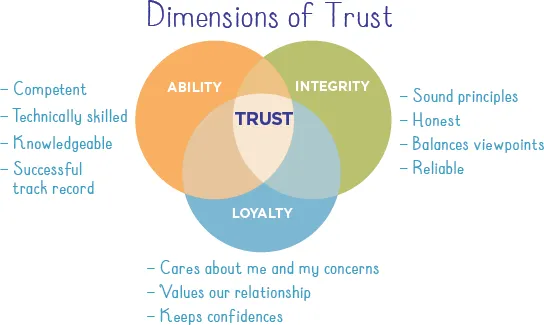
Ability is about technical skills, competencies, and execution. Whenever people ask if someone is able, capable, or skilled, or if he or she can accomplish a specific task, they are considering ability. People interact with one another as leaders, supervisors, and coworkers, and they see technical, interpersonal, and leadership competencies enacted at various skill levels at different levels in the organization. And everyone has seen that people may have expertise in some areas but not in others.
When leaders make judgments about ability—remembering that trust is always specific to the situation—they often think of the skills that lead to effective outcomes for the particular assignment or project. In other words: “Can he do it?” “Does she know the right steps?”
Here’s an example: Walter has offered to write the design architecture for a new project plan, but his last three project designs have required significant rework by the team. Do you as Walter’s manager trust his ability to write a design architecture that won’t need significant rework?
Following are some examples of questions that can help you gauge aspects of ability that might influence the degree of trust you experience during an interaction.
• Can she do what I’m asking her to do?
• Does the team possess the knowledge and understanding of the processes to produce this work?
• What might he need to learn in order to accomplish this task?
• What help might he need to get this done?
• How well did she perform the most recent similar task?
Integrity includes shared values (for example, principles, fairness, and character) and expectations (for example, reliability and consistency) between the parties. When people think about a wise and principled leader, someone esteemed for living the principles they admire, for their tenacity, and for their consistent successes, they are thinking about integrity. They often see humility and a rock-solid ethic to uphold what is true, right, and honorable, even when it makes the leader look a fool, which, oddly, isn’t very often. They see someone they agree with in important ways.
When people make judgments about integrity they often think of strong character, stability, and reliability. Do I agree with the wisdom of his decisions? Can I count on her to deliver on her promise?
The following questions can help leaders gain clarity around aspects of integrity that might be affecting their perception of trust.
• Does her past behavior/history/reputation suggest unswerving, rather than self-serving, ethics?
• Does he deal evenly with others on his projects or does he sometimes have favorites?
• Do I agree with the soundness of his approach on this challenge, and is he open to discussing it?
• What about her as a leader do I really admire? What values do we share?
• Do we agree about what we’re discussing?
• Will he do what he says? Can I count on him, even as busy as he is?
Loyalty is related to truth-telling and a personal relationship between the trustor and trustee. People are considering the trust dimension of loyalty whenever they think about personal connections with others and whether those others will support them or abandon them in tough situations. They wonder if others will m...
Table of contents
- Cover
- Title Page
- Copyright
- Contents
- What Is Trust?
- Types of Trust
- Dimensions of Trust
- Taking Action on Trust Issues
- Individual Trust Conversations
- Team Trust Conversations
- Trust and Decision-Making
- Last Words
- Glossary
- Suggested Resources
Trusted by 375,005 students
Access to over 1.5 million titles for a fair monthly price.
Study more efficiently using our study tools.
Frequently asked questions
Yes, you can cancel anytime from the Subscription tab in your account settings on the Perlego website. Your subscription will stay active until the end of your current billing period. Learn how to cancel your subscription
No, books cannot be downloaded as external files, such as PDFs, for use outside of Perlego. However, you can download books within the Perlego app for offline reading on mobile or tablet. Learn how to download books offline
Perlego offers two plans: Essential and Complete
- Essential is ideal for learners and professionals who enjoy exploring a wide range of subjects. Access the Essential Library with 800,000+ trusted titles and best-sellers across business, personal growth, and the humanities. Includes unlimited reading time and Standard Read Aloud voice.
- Complete: Perfect for advanced learners and researchers needing full, unrestricted access. Unlock 1.5M+ books across hundreds of subjects, including academic and specialized titles. The Complete Plan also includes advanced features like Premium Read Aloud and Research Assistant.
We are an online textbook subscription service, where you can get access to an entire online library for less than the price of a single book per month. With over 1.5 million books across 990+ topics, we’ve got you covered! Learn about our mission
Look out for the read-aloud symbol on your next book to see if you can listen to it. The read-aloud tool reads text aloud for you, highlighting the text as it is being read. You can pause it, speed it up and slow it down. Learn more about Read Aloud
Yes! You can use the Perlego app on both iOS and Android devices to read anytime, anywhere — even offline. Perfect for commutes or when you’re on the go.
Please note we cannot support devices running on iOS 13 and Android 7 or earlier. Learn more about using the app
Please note we cannot support devices running on iOS 13 and Android 7 or earlier. Learn more about using the app
Yes, you can access Leadership Trust: Build It, Keep It by Evans in PDF and/or ePUB format, as well as other popular books in Business & Leadership. We have over 1.5 million books available in our catalogue for you to explore.