The context of leadership has changed. Traditionally, leaders worked in organizations in which people largely shared a common culture and set of values. Today, leaders must bring together groups of people with very different histories, perspectives, values, and cultures. The people you lead are likely to be different from you and from each other in significant ways. Leaders today need an awareness of social identity, their own and that of others.
- 28 pages
- English
- ePUB (mobile friendly)
- Available on iOS & Android
eBook - ePub
Social Identity: Knowing Yourself, Leading Others
About this book
Information
Topic
BetriebswirtschaftSubtopic
LeadershipMapping Your Identity

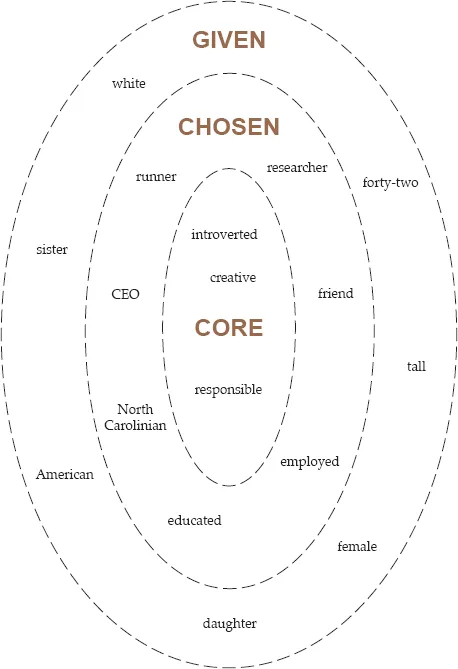
Creating a map of your identity is a way to capture and articulate how you see yourself. You can look clearly at your obvious, surface-level identity and then begin to dig deeper. This can be very useful in exploring how others perceive you as a leader—who will feel more at home with you, who will give your words more weight, and so on. Your identity map should include the three components discussed in the previous section: given identity, chosen identity, and core identity.
Look at the sample map on page 14. Then follow the instructions to map your own identity, using the blank map on page 16.
Instructions
1. In the outer ring, write words that describe your given identity: the attributes or conditions that you had no choice about, from birth or later. You may want to include your nationality, age, gender, physical characteristics, certain family roles, possibly religion. Examples include female, only child, forty-eight, tall, blind, African American, cancer patient, widow.
2. In the next ring, list aspects of your chosen identity. Consider including your occupation, hobbies, political affiliation, where you live, certain family roles, possibly religion. Examples are cyclist, mother, engineer, expatriate, college graduate, wife, leader, New Yorker, Buddhist.
3. In the center, write your core attributes—traits, behaviors, beliefs, values, and skills that you think make you unique as an individual. Select things that are relatively enduring about you or that are key to who you are today. For example, you may see yourself as funny, artistic, kind, conservative, attentive, creative, impatient, musical, family focused, assertive.
4. After you complete your map:
__ | Underline the items that are important to you personally. These are likely to be the terms you would use to describe yourself. |
+ | Put a plus sign beside the items that you believe contribute to your ability to lead effectively in your organization. |
– | Put a minus sign beside the items that you believe detract from your ability to lead effectively in your organization. |
? | Put a question mark beside the items that may vary in how they affect your leadership ability, depending on context. |

Interpreting Your Map
Refer to your map while answering the following questions. They will help you examine your identity in more depth.
1. When you look at the underlined items on your map, what trends do you see? Are they mainly part of your given, chosen, or core identity?
2. When you look at the items with pluses, minuses, and question marks, what trends do you see? Are they mainly part of your given, chosen, or core identity?
3. Of the aspects with pluses, minuses, and question marks, which are things you have in common with other people in the organization? Which are things that only you or a very small number of people possess? What are the leadership implications?
4. What aspects of your identity help you make connections with people at work? What aspects of your identity get in the way of making connections with people at work? What gives you the impression that this is the case?
5. Are there aspects of your identity ...
Table of contents
- Cover
- Copyright
- Title Page
- Table of Contents
- Social Identity in Organizations
- Understanding Social Identity
- Components of Identity
- Mapping Your Identity
- Understanding Other Identity Perspectives
- Social Identity and Power
- Advice for Leading in the Context of Difference
- Going Forward with Awareness
- Suggested Readings
- Background
- Key Point Summary
Trusted by 375,005 students
Access to over 1.5 million titles for a fair monthly price.
Study more efficiently using our study tools.
Frequently asked questions
Yes, you can cancel anytime from the Subscription tab in your account settings on the Perlego website. Your subscription will stay active until the end of your current billing period. Learn how to cancel your subscription
No, books cannot be downloaded as external files, such as PDFs, for use outside of Perlego. However, you can download books within the Perlego app for offline reading on mobile or tablet. Learn how to download books offline
Perlego offers two plans: Essential and Complete
- Essential is ideal for learners and professionals who enjoy exploring a wide range of subjects. Access the Essential Library with 800,000+ trusted titles and best-sellers across business, personal growth, and the humanities. Includes unlimited reading time and Standard Read Aloud voice.
- Complete: Perfect for advanced learners and researchers needing full, unrestricted access. Unlock 1.5M+ books across hundreds of subjects, including academic and specialized titles. The Complete Plan also includes advanced features like Premium Read Aloud and Research Assistant.
We are an online textbook subscription service, where you can get access to an entire online library for less than the price of a single book per month. With over 1.5 million books across 990+ topics, we’ve got you covered! Learn about our mission
Look out for the read-aloud symbol on your next book to see if you can listen to it. The read-aloud tool reads text aloud for you, highlighting the text as it is being read. You can pause it, speed it up and slow it down. Learn more about Read Aloud
Yes! You can use the Perlego app on both iOS and Android devices to read anytime, anywhere — even offline. Perfect for commutes or when you’re on the go.
Please note we cannot support devices running on iOS 13 and Android 7 or earlier. Learn more about using the app
Please note we cannot support devices running on iOS 13 and Android 7 or earlier. Learn more about using the app
Yes, you can access Social Identity: Knowing Yourself, Leading Others by Hannum in PDF and/or ePUB format, as well as other popular books in Betriebswirtschaft & Leadership. We have over 1.5 million books available in our catalogue for you to explore.