Today's turbulent business environment requires strategic leadership that is systemic, focused on the future, and oriented toward change. Leaders who can foster greater strategic clarity, make stronger connections between strategy and tactics, and broaden their own and others' perspectives will contribute to the enduring success of their organizations. This collection of sixteen pieces explores the important and fascinating topic of strategic leadership from a number of angles. Readers will come away with newly formed thoughts on what strategic leadership is and how they might develop it in themselves and others.
- 175 pages
- English
- ePUB (mobile friendly)
- Available on iOS & Android
eBook - ePub
The Leadership in Action Series: On Strategic Leadership
Rush,
About this book
Information
Inside Out: Transforming Your Leadership Culture
John B. McGuire, Gary Rhodes, and Charles J. Palus
Any organizational culture holds tremendous power. Culture is a system of closely held beliefs that require certain behaviors and exclude other behaviors. It sets norms on everything in the organization. To change the organizational culture, senior leaders must begin by acknowledging their place in the culture, engaging fully in the work of advancing the leadership culture, and standing up first so that others can follow.
Belief systems, explicit or not, drive behavior. When executives embark on an organizational change initiative—whether tied to new systems, products, markets, or approaches—they are asking people to alter their beliefs in some way. To implement a strategy that requires people to change the way they do things, leaders need to work beyond the operational plan and learn how to change the culture. External change in operations won’t take hold without internal change in culture to back it up.
The challenge, then, is for an organization to use its leadership culture to create leadership beliefs and practices that support the new operational direction rather than undermine or stall it. Through our research and client work, we have found that when individuals and organizations intentionally unearth and examine beliefs, values, and assumptions, they are able to address the culture factor as a strategic imperative alongside operational tactics. They draw out hidden or unconscious drivers for what is happening—or not happening—in the organization.
By giving attention and weight to internal dimensions, leaders introduce the possibility of new thinking and new beliefs—and therefore new decisions and new behaviors. Leaders practicing together in the leadership culture enlarge the mental and emotional space for change, allowing them to make unexpected and innovative decisions. The bigger the operational change, the more the cultural space needs to expand.
We call this the inside-out approach to transforming an organization. And it starts with you.
POWER OF CULTURE
Mike is a vice president at a prestigious financial organization. “A group of vice presidents were planning a special, all-day meeting at headquarters, bringing in VPs and directors from all our locations,” Mike says. “We needed to use the largest conference room in the building and had to get special permission to do so.”
Permission in this case was not simply an issue of scheduling. The large conference room was on the top floor of the building and was used almost exclusively by senior executives. The VP and director offices were on the floors below, with employees lower in the ranks filling the middle floors and the ground level occupied by administrative and support operations. The furnishings in the building, too, changed by floor. The executive level featured leather chairs, high-quality wood desks and tables, artwork, and attractive kitchen and washroom facilities. The lower floors were fitted with progressively less expensive furnishings.
“The night before the meeting, I was staying late to finalize a presentation,” recalls Mike. “A couple of guys from our maintenance staff kept walking past my office with chairs from the meeting room down the hall. I didn’t think much of it until the next morning when I arrived on the top floor for our big meeting. The maintenance staff had replaced all the leather chairs in the executive conference room with the fabric chairs from our floor.”
The true power of culture is seen in the fact that no one had told the maintenance staff to trade out the chairs. There was no policy or precedent for this action. The maintenance crew made its own decision. It understood that certain chairs go with certain status levels, and it simply followed, without question, that cultural norm. The cultural value of authority and the trappings of status were so embedded in the organization that a group of lower-level VPs simply could not use the top executives’ chairs.
For leaders at the financial organization, this incident revealed unchecked beliefs that were controlling the organization and preventing any meaningful change from taking place. Years of valuing hierarchy, status, authority, and control—even when those values were unstated—had led to assumptions and behaviors that were unnecessary, unhelpful, or at odds with stated goals. Although the executive team was both surprised and somewhat amused when it heard what had happened, it clearly saw that cultural beliefs drive decisions.
We use this illustration not because it is a big example of cultural decision making but rather because it is a small example. If cultural imperatives are so strong when it comes to furniture, imagine how powerful they must be in high-risk, complex, and changing situations.
Here are some questions to consider:
• What are the cultural imperatives in your organization?
• How do your leadership culture’s beliefs and practices enhance or inhibit operational implementation of the business strategy?
• How intentional is your leadership culture in developing the organizational culture toward the organization’s performance goals?
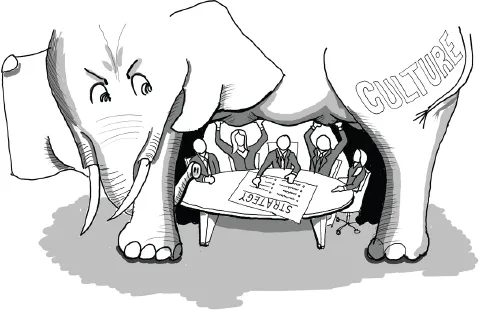
Any organizational culture holds tremendous power. Culture is the big elephant in the room when it comes to the imperative for change. Setting a significantly more complex direction in operations without developing a new culture in parallel can be folly.
Culture is simply a human system of closely held beliefs that require certain behaviors and exclude other behaviors. Mostly, it is a set of unwritten rules. When people describe “the way things are around here,” they’re talking about culture. It is how they have to operate to get things done.
DRIVING BEHAVIOR
Culture sets norms on everything in an organization: how to share bad news, whether to take risks, whether and how people are developed and promoted, how people interact with one another, how problems are solved, and so on. Culture may, for instance, dictate respect for hierarchy, with decision making that goes through clear channels. Operating outside that structure may be unacknowledged or flagged as renegade and unwelcome behavior. In another context, that same back channel or informal approach to getting things done may be the norm. Without knowing how to work in that structure, leaders will be ineffective.
Cultural beliefs drive behavior. Decisions are the go-betweens, interpreting inbound data and translating the cultural beliefs into action. But core beliefs are so strong that they drive decisions in subtle and automatic ways. The decision maker is often not even conscious of them.
Consider the hundreds of decisions—large and small—that are made in daily organizational life. People like to think that these choices are rational, but in fact they are mostly unguided by reason. Emotions and intuitions play a big part in decision making. However, although much of decision making is nonrational, it does have its own “logic.”
That logic is this: the unconscious mind is always a half step ahead of the conscious mind. Many decisions are based on unexamined beliefs, thought patterns, habits, and assumptions. In other words, the inside drives the outside—not the other way around.
But culture produces more than a belief-based decision engine; it also creates a form of assurance. Culture creates a familiar space for getting things done, a sense of “rightness,” and a means of survival. So why change it?
Organizational change begins when strategy is stuck. Something new must be done. Culture, then, will need to make a shift to accommodate the new thing: a shift in direction, market, customer, system, product, personnel, and so on. The organization needs to be filled with the cultural beliefs that will drive the decisions that will create needed changes in actions.
An organization needs all the help it can get to overcome the inertia of the status quo. When the organizational strategy runs counter to the beliefs about “how things are done around here,” then the human system—the culture—will simply reject it. “Culture eats strategy for breakfast,” one client told us. He meant that setting a significantly new organizational direction without developing a new culture is most often useless. That’s why 66 percent to 75 percent of organizational change initiatives fail.
HIDDEN DIMENSIONS
Taking action is often the starting point, end point, and every place in between when it comes to organizational change. When faced with change, senior leaders tend to go on furious, extended sprees on management autopilot. Rolling up their sleeves and bracing themselves for the tough battle ahead, they focus on the technical systems and process changes required in the business operations. A bias for action becomes an obsession filled with activity and the appearance of progress. Many leaders will use language that tiptoes around culture—“innovation is our future,” “in challenging times, we need to pull together,” “people are our most important assets”—but then they quickly move beyond this lip service and on to the operations. It is as if they believe that when the job is done right by action alone, the culture will somehow naturally follow.
Even when senior leaders acknowledge the role of culture in their organization’s success, few have a clear idea of how to change culture. They feel they have little time to focus on culture and little information about steps to take that will open the door to culture change. “We have gone as far as we can go with change management of the operations,” one CEO told us. “Now we believe that the real change is in leadership and the culture, but we just don’t know how to do that.”
The way to successfully implement change in an organization is to give the hidden dimensions of change the same attention as the operational elements. If you change the beliefs, you change the culture. To do something different (an external outcome), the organization must be something different (an internal outcome).
The inside-out approach to culture change fits side by side with conventional outside-in operational strategies. When leaders examine beliefs and thinking, they increase awareness of why and how they make decisions. They gain new insight into what is working operationally and what isn’t. Individuals, senior teams, and whole organizations can begin to consciously build a bridge between the hidden, internal drivers and the visible, external actions. By using reflective learning processes to factor in the power of culture, people are able to view a situation in a new way. This creates the space where genuine change occurs.
Culture change is about the interplay between individual growth and organizational development. Organizations, as well as people, vary in their level of readiness for culture change. (See “Five Factors for Organizational Readiness” on the following page.) Leaders cannot single-handedly reveal the hidden aspects of their leadership and organizational culture. They cannot manage and control culture or fix it and manipulate it the way one can a software system, a business plan, a floor layout, or a budget.
But make no mistake: if leaders expect culture change in others, they must change themselves first. Culture is not an object or a system “out there”; it is something internal, “in here.” We often tell our clients, “You are in the culture and the culture is in you, and in a very real way you are the culture. You can’t change the culture without changing yourself.”
This is the pivot point on which all culture change sits. If senior leadership wants to keep the work of culture change at arm’s length, the change won’t take hold. Colleagues, direct reports, and employees throughout the organization will know that culture change is nothing but a catchphrase and will, in turn, learn to create the appearance of support without investing in change themselves.
To lead organizational change—both operationally and culturally—leaders must first conquer their own opposition to change. By changing themselves first, leaders start to provide themselves and others with an alternative system of beliefs and practices. To effect change, leaders must first invest in changing the leadership culture. In turn, leadership can and will change the organizational culture.
Leaders who buy into their personal role in changing culture will struggle, change beliefs, and likely evolve into different people and different leaders. When leaders engage collectively in this process, they learn to deal with change through public learning and by taking on risk and vulnerability. On the other side of the challenge, however, is the exhilaration of taking a risk that turns out well and the constructive, positive energy that comes from tapping into themselves and others as instruments of change.
Five Factors for Organizational Readiness
Organizational culture change requires both individual development and collective development. Individual effort will have limited impact in the absence of five organizational readiness factors:
The executive team is engaged as both enabler and participant. The executive team understands that it cannot make change happen by itself. Yet it must lead the change, engage t...
Table of contents
- Cover
- Title Page
- Copyright
- Contents
- Introduction
- Strategic Command: Taking the Long View for Organizational Success
- Strategic Aims: Making the Right Moves in Leadership
- Getting It Done: Four Ways to Translate Strategy into Results
- Making Strategy Real: Bringing People Together Toward a Common Cause
- Knowing and Doing: How to Put Learning Where the Work Is
- Learning by Design: Developing an Engine for Transforming Your Company
- Getting It Together: The Leadership Challenge of Mergers and Acquisitions
- Analyze This: Six Steps to Leveraging People Investments
- Leading Together: Complex Challenges Require a New Approach
- Inside Out: Transforming Your Leadership Culture
- Ending the Board Game: New Leadership Solutions for Companies
- Battles and Beliefs: Rethinking the Role of Today’s Leaders
- Being Responsible: Boards Are Reexamining the Bottom Line
- Rising to the Challenge: How to Develop Responsible Leaders
- Capital Ideas: Enhancing the Power of Human Assets
- Good Choices: Making Better Decisions by Knowing How Best to Decide
- About the Contributors
Trusted by 375,005 students
Access to over 1.5 million titles for a fair monthly price.
Study more efficiently using our study tools.
Frequently asked questions
Yes, you can cancel anytime from the Subscription tab in your account settings on the Perlego website. Your subscription will stay active until the end of your current billing period. Learn how to cancel your subscription
No, books cannot be downloaded as external files, such as PDFs, for use outside of Perlego. However, you can download books within the Perlego app for offline reading on mobile or tablet. Learn how to download books offline
Perlego offers two plans: Essential and Complete
- Essential is ideal for learners and professionals who enjoy exploring a wide range of subjects. Access the Essential Library with 800,000+ trusted titles and best-sellers across business, personal growth, and the humanities. Includes unlimited reading time and Standard Read Aloud voice.
- Complete: Perfect for advanced learners and researchers needing full, unrestricted access. Unlock 1.5M+ books across hundreds of subjects, including academic and specialized titles. The Complete Plan also includes advanced features like Premium Read Aloud and Research Assistant.
We are an online textbook subscription service, where you can get access to an entire online library for less than the price of a single book per month. With over 1.5 million books across 990+ topics, we’ve got you covered! Learn about our mission
Look out for the read-aloud symbol on your next book to see if you can listen to it. The read-aloud tool reads text aloud for you, highlighting the text as it is being read. You can pause it, speed it up and slow it down. Learn more about Read Aloud
Yes! You can use the Perlego app on both iOS and Android devices to read anytime, anywhere — even offline. Perfect for commutes or when you’re on the go.
Please note we cannot support devices running on iOS 13 and Android 7 or earlier. Learn more about using the app
Please note we cannot support devices running on iOS 13 and Android 7 or earlier. Learn more about using the app
Yes, you can access The Leadership in Action Series: On Strategic Leadership by Rush in PDF and/or ePUB format, as well as other popular books in Business & Leadership. We have over 1.5 million books available in our catalogue for you to explore.