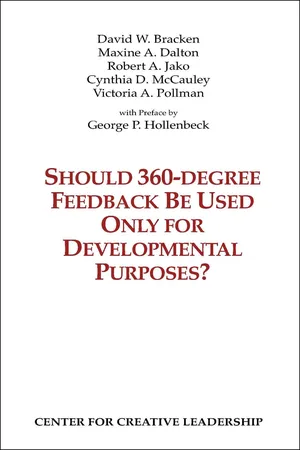
Along with the growing use of 360-degree feedback in organizations today, there is much disagreement over how it should be employed: strictly to help the manager develop or also to help those who work with the manager decide such issues as pay and promotion? This publication features the insights of a group of experienced professionals on both sides of the issue. To set the stage, George P. Hollenbeck, a management psychologist and adjunct faculty member at Boston University's Graduate School of Management, discusses the popularity of 360-degree feedback today.
- 52 pages
- English
- ePUB (mobile friendly)
- Available on iOS & Android
eBook - ePub
About this book
Information
ON CHOOSING SIDES: SEEING THE GOOD IN BOTH
Cynthia D. McCauley
I attended the debate where Dalton, Pollman, Bracken, and Jako presented their views on whether 360-degree assessments should be used only for feedback and development or whether these types of assessments are also appropriate for use in administrative decision-making. At the end of that debate, they asked the audience to take sides. If we agreed with the feedback-for-development-only view, then we were to move to one side of the room. If we agreed that multi-rater assessments should also be used for administrative decision-making, we were to move to the other side. At the end of a heated debate, the debaters wanted some evidence of who had won. Audience opinion seemed a good source of evidence.
However, after hearing four people with a wealth of experience on the topic, I found myself not being able to take one side or the other. I ended up standing in the middle of the room. But the debaters would have none of that! I was told I had to choose. This was very disconcerting. First, both sides had presented what seemed to me to be quite logical arguments for their case. But I was not sure the cases were directly comparable; in other words, I wasn’t sure they were always talking about the same thing. Second, each of the debaters aroused negative emotions in me because of some of the assumptions about human nature and organizational life that seemed to be behind their positions. Each of them made me feel that working inside an organization was pretty horrible. Taking sides would be like choosing between two evils. Finally, I did not have the depth of experience with 360-degree assessments that the debaters did; thus, I did not have a strong framework to use to organize the large amount of information they were throwing at me.
So I wasn’t ready to make a decision about which side I was on. I wasn’t even sure there were opposite sides to choose between. What this debate did do for me was to stimulate me to think more carefully about the issues the debaters were putting on the table. And isn’t this what a good debate is supposed to do? After struggling through my own thoughts, I was surprised to find myself choosing the middle ground again but this time for different reasons—not because I was confused, or not attracted to the views of organizations expressed by each side, or lacked the experiences to decide who was right, but because I see value in multiple uses of 360-degree assessments.
I do think that there is an important place in organizational life for in-depth, confidential 360-degree feedback and that if this feedback is provided in the right context it can be an important stimulus for individual change. I also think that 360-degree assessments can make for better administrative decisions about individuals—decisions that can motivate people to change; but here again, the contextual factors can make or break such uses of 360-degree assessments.
In what follows, I’ll describe how I came to these conclusions—what in the various positions presented by the debaters I found troubling and what I found stimulating, what common themes I found in all the viewpoints, and the emerging framework that helped me make sense of the debate for myself. I do not claim to have found the answer to this debate. I’m sure there are factors and issues I have yet to consider. But for the time being, I have found my answer—one that I feel comfortable testing out as I move forward. What I hope this chapter will do is stimulate your own efforts to make sense of the conflicting points of view presented by the debaters. My clear bias is that you end up with a position that is integrative, one that is less polarized than those presented by the debaters (who I presume tended to present more extreme positions to accentuate the points they were trying to make).
The Viewpoints
Let me begin with how I understood and interpreted each of the viewpoints.
Maxine Dalton is clearly focused on how 360-degree assessments can be used to help individuals learn, grow, and change over time. She posits that for these assessments to have this desired outcome, they need to be based on high-quality data (that is, honest ratings) and be fed back to the individual in a way that he or she can hear and accept the data. To ensure honest ratings, raters need to feel that their ratings are anonymous and that the data will be shared confidentially with the person being assessed. Likewise, confidentiality is an important prerequisite for creating the safe environment a person needs for hearing and accepting the data. She argues that using the 360-degree data for administrative decision-making would violate the conditions needed for honest ratings and a safe environment.
What I feel Dalton is saying is that if we are to make feedback a humane process (and thus one people will respond to), we must take it out of the inhumane context of the modern organization. In the organizational picture she paints, people cannot be honest with one another in terms of what they think about each other’s strengths and weaknesses. They fear that honest feedback will make the other person feel bad, or if that person has more power, he or she will level some retribution toward them. Thus they will provide honest feedback only if the recipient will not know who said what.
In this scenario, providing upward feedback appears to be particularly risky because people with power cannot be trusted to not misuse their power. To me, this is a bleak view of the regard people have for one another in the modern organization—a view that certainly has some basis in reality but surely isn’t that bad in all organizations. Dalton seemed to be responding to the worst-case scenario within organizations. However, toward the end of her presentation, she did give me hope that formal 360-degree assessment and feedback could be a tool to help move organizations toward cultures where negative feedback would not always engender defensive reactions. This does create a challenging dilemma: How can a process that is conducted independent of the normal operations of an organization have an impact on those operations?
Vicki Pollman makes a more pointed attack against using 360-degree assessments in administrative decisions. Whereas Dalton builds the case for why these assessments should be used only in a confidential development process, Pollman focuses more on why they should not be used in one particular administrative process—performance appraisals. She finds fault in the assumptions behind using 360-degree assessments for performance appraisal (raters will be honest, people can be forced to change, improvement in ratings represents real improvement on the job). And then, of course, the real jab: Why add 360-degree assessments to an administrative process that doesn’t work as a mechanism for changing behavior anyway?
Pollman presents an even darker view of organizations than Dalton does: a system that is bent on keeping people in line, evaluating people for the sole purpose of finding out what they are not doing right, using only punitive measures as motivators. In her scenario, organizations are populated by people who are highly motivated to manipulate their ratings and by employees who are gullible enough to fall for this sort of manipulation. Although this view of organizations does seem extreme to me, it certainly highlights some important factors that have to be confronted to prevent the abuse of the 360-degree assessment processes.
David Bracken focuses on how 360-degree assessments can be used to foster “systematic, targeted behavior change resulting in increased organizational effectiveness.” To achieve this result, he argues that 360-degree assessments need to be used for administrative decision-making in addition to their use in feedback for development. He clarifies that the debate is not between using 360-degree assessments for development versus administrative decision-making, but rather between development-only uses versus development plus decision making.
He points out the conditions that are present when 360-degree assessments survive in organizations (for instance, top-management support and participation, relevant competency models, organization-wide implementation) and argues that confidential, development-only feedback processes often don’t meet these conditions. Just as Dalton appears to resist using 360-degree assessments for administrative decision-making because of what could happen in the worst-case scenarios, Bracken seems to resist development-only uses in part because of what these uses don’t do when they are poorly designed. All the factors that he lists as missing in most development-only uses of 360-degree assessment don’t have to be missing from them.
As expected, Bracken does not have a dark view of organizations. He does, however, present organizations as very rational places: If all the systems are in place and people are trained to do the right thing, then everything will work in a logical and fair way. He also doesn’t express much confidence in people’s ability to absorb feedback and change on their own. Just as the dark views of organizations gave me pause, this “rational organization/irrational man” view took me aback.
Robert Jako argues that 360-degree assessments will not survive if they are not linked to an organization’s pay system because rewards determine behavior. Thus, like Bracken, he emphasizes the primacy of external rewards on changing individuals’ behavior. He also uses another line of reasoning that Bracken begins and is expanded upon here: Work is changing (becoming more team-based...
Table of contents
- Cover
- Title Page
- Copyright
- Table of Contents
- Foreword
- Preface
- Development Only
- Development Plus
- On Choosing Sides: Seeing the Good in Both
Trusted by 375,005 students
Access to over 1.5 million titles for a fair monthly price.
Study more efficiently using our study tools.
Frequently asked questions
Yes, you can cancel anytime from the Subscription tab in your account settings on the Perlego website. Your subscription will stay active until the end of your current billing period. Learn how to cancel your subscription
No, books cannot be downloaded as external files, such as PDFs, for use outside of Perlego. However, you can download books within the Perlego app for offline reading on mobile or tablet. Learn how to download books offline
Perlego offers two plans: Essential and Complete
- Essential is ideal for learners and professionals who enjoy exploring a wide range of subjects. Access the Essential Library with 800,000+ trusted titles and best-sellers across business, personal growth, and the humanities. Includes unlimited reading time and Standard Read Aloud voice.
- Complete: Perfect for advanced learners and researchers needing full, unrestricted access. Unlock 1.5M+ books across hundreds of subjects, including academic and specialized titles. The Complete Plan also includes advanced features like Premium Read Aloud and Research Assistant.
We are an online textbook subscription service, where you can get access to an entire online library for less than the price of a single book per month. With over 1.5 million books across 990+ topics, we’ve got you covered! Learn about our mission
Look out for the read-aloud symbol on your next book to see if you can listen to it. The read-aloud tool reads text aloud for you, highlighting the text as it is being read. You can pause it, speed it up and slow it down. Learn more about Read Aloud
Yes! You can use the Perlego app on both iOS and Android devices to read anytime, anywhere — even offline. Perfect for commutes or when you’re on the go.
Please note we cannot support devices running on iOS 13 and Android 7 or earlier. Learn more about using the app
Please note we cannot support devices running on iOS 13 and Android 7 or earlier. Learn more about using the app
Yes, you can access Should 360-degree Feedback Be Used Only for Developmental Purposes? by Bracken, Dalton, McCauley in PDF and/or ePUB format, as well as other popular books in Business & Leadership. We have over 1.5 million books available in our catalogue for you to explore.