A person who works exclusively in staff jobs throughout a career is less likely to develop important leadership competencies than a person who works exclusively in line jobs. This report shows why and offers several specific ways to increase the leadership potential of staff managers.?
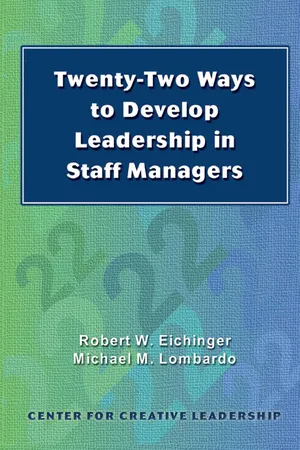
- 27 pages
- English
- ePUB (mobile friendly)
- Available on iOS & Android
eBook - ePub
About this book
Information
Differences Between Staff and Line Development
In looking at staff professionals in terms of the elements of executive development described above, one can see significant differences: They receive far fewer challenging jobs (start-ups, fix-its, etc.) than line managers, and when they do receive them it is later in their careers; they have fewer stark transitions to deal with; and, although the leadership demands they experience are largely the same as those faced by the line, they do not experience some crucial demands. Staff managers do not have the same opportunity to develop as line managers.
These observations are supported by recent research at CCL and by indirect evidence.
CCL Research
Two pieces of CCL research address the differences in staff and line development. In the first case, as a part of the continuing investigations on how executives learn, we asked 250 executives (roughly half line and half staff, all with 15 to 30 years of experience) to describe their most significant learning experiences. Although this study was conducted in one organization, and is limited by that fact, it represents the only systematic comparison of the pivotal experiences of line and staff executives that we know of at this point.
Staff executives reported the same assignments as the line, but with much less frequency. Tables 1 and 2 (page 6) show the statistically significant differences in frequency of experiences for the two groups (these are experiences that were cited significantly more often by one group than the other). Note that the experiences reported by the line are the ones that are most powerful in leadership building: job-based assignments and lessons (which made up 61% of the total events line managers reported, as compared with only 34% of total events reported by staff3). Staff executives report more “soft” assignments and lessons which are more political and indirect in nature.
The typical staff profile has more events involving other people, courses, and early work experiences. Although these are certainly valuable, they are not the ones that normally teach the most leadership lessons. It should also be noted that staff lessons reflect two enduring laments of staff managers. The category “political lessons” shows a concern about getting things done in a complex environment, and “how to work with executives” indicates the necessity of their coping with situations and people beyond their control.
From the standpoint of leadership challenges, CCL research shows that line and staff managers face about 80% similar challenges—although the challenges occur more frequently in the line. Both sides have problem units to turn around, systems to install, teams to build, and so on. The 20% difference, however, is critical.
A unique challenge on the line side is the pressure and feedback of profit-and-loss responsibility. This creates a learning opportunity where success or failure is relatively obvious and finite (see the development value list below). Line managers get a lot of feedback on how they are doing against measurable standards.
Table 1
Highest Frequency Staff Events*
Projects/Task Forces Values Playing Out Role Models
Early Work (Nonmanagement)
Major Staff Lessons Learned*
What Executives Are Like
How to Work With Executives
Be Prepared to Seize Opportunities
How to Cope With Situations Beyond Your Control
Political Lessons
*Significantly higher than reported by line executives.
Table 2
Highest Frequency Line Events*
Fix-its/Turnarounds
Leaps in Scope/Scale
Starting Something From Scratch
Major Line Lessons Learned*
Dealing With People
Technical Knowledge/Business Knowledge
Organizations as Systems/Strategic Thinking
*Significantly higher than reported by staff executives.
Also, the line has more frequent and direct contact with outside customers and therefore line managers can develop a better feel for the business. This probably leads to their developing a better understanding of the market and customers and more effective customer-contact skills.
On the other hand, it should be mentioned that a unique challenge on the staff side is the necessity of dealing with ambiguity—the lack of a bottom line. This can be a developmental plus in the sense that facing ambiguity and the ability to develop strategy is a key aspect of senior management work. Although most line managers spend their entire careers in the line, this developmental value is occasionally taken advantage of by line managers who are moved temporarily into staff jobs. This is not common, accounting for only about 2% of the reported developmental activities, but the converse, staff managers being temporarily moved into line jobs, is rarer still. So even in the area of cross-over development, line managers have an advantage.
The differences between staff and line experiences can be further understood by looking at the sample experiences and lessons given in Table 3 (pages 8 and 9).
In addition to the findings above, we recently evaluated the scores on managerial effectiveness given to 112 line and 80 staff middle managers and executives. These individuals had been participants in CCL programs during the last year, and the instrument used to gather the data was Benchmarks®. Each participant was rated by subordinates, peers, and superiors on a number of items comprising sixteen scales measuring managerial effectiveness (there were 412 ratings of the 112 line executives, and 515 ratings of the staff executives)...
Table of contents
- Cover
- Title Page
- Copyright
- Table of Contents
- Suggestions for the Use of This Report
- Introduction
- How Successful Executives Develop
- Differences Between Staff and Line Development
- Why the Developmental Gap Exists
- Recommendations
- Conclusion
- Notes
- References
Trusted by 375,005 students
Access to over 1.5 million titles for a fair monthly price.
Study more efficiently using our study tools.
Frequently asked questions
Yes, you can cancel anytime from the Subscription tab in your account settings on the Perlego website. Your subscription will stay active until the end of your current billing period. Learn how to cancel your subscription
No, books cannot be downloaded as external files, such as PDFs, for use outside of Perlego. However, you can download books within the Perlego app for offline reading on mobile or tablet. Learn how to download books offline
Perlego offers two plans: Essential and Complete
- Essential is ideal for learners and professionals who enjoy exploring a wide range of subjects. Access the Essential Library with 800,000+ trusted titles and best-sellers across business, personal growth, and the humanities. Includes unlimited reading time and Standard Read Aloud voice.
- Complete: Perfect for advanced learners and researchers needing full, unrestricted access. Unlock 1.5M+ books across hundreds of subjects, including academic and specialized titles. The Complete Plan also includes advanced features like Premium Read Aloud and Research Assistant.
We are an online textbook subscription service, where you can get access to an entire online library for less than the price of a single book per month. With over 1.5 million books across 990+ topics, we’ve got you covered! Learn about our mission
Look out for the read-aloud symbol on your next book to see if you can listen to it. The read-aloud tool reads text aloud for you, highlighting the text as it is being read. You can pause it, speed it up and slow it down. Learn more about Read Aloud
Yes! You can use the Perlego app on both iOS and Android devices to read anytime, anywhere — even offline. Perfect for commutes or when you’re on the go.
Please note we cannot support devices running on iOS 13 and Android 7 or earlier. Learn more about using the app
Please note we cannot support devices running on iOS 13 and Android 7 or earlier. Learn more about using the app
Yes, you can access Twenty-Two Ways to Develop Leadership in Staff Managers by Eichinger, Lombardo in PDF and/or ePUB format, as well as other popular books in Business & Leadership. We have over 1.5 million books available in our catalogue for you to explore.