This book is for leaders and managers looking to develop themselves and others. It is for training & development professionals, inside or working as independent consultants, who can use the book as a coaching tool, a blueprint for leader development plans, and in other ways.For leaders concerned with their development, dedicated to developing their people for more responsibilities, and committed to organizational sustainability, this book will help in those efforts.
- 538 pages
- English
- ePUB (mobile friendly)
- Available on iOS & Android
eBook - ePub
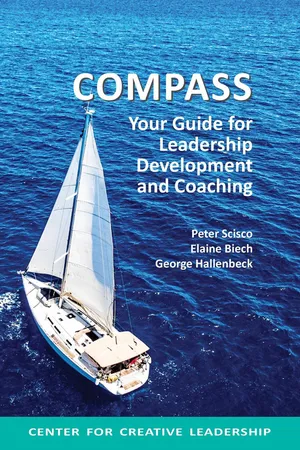
Compass: Your Guide for Leadership Development and Coaching
About this book
Information

Part One
THE FUNDAMENTAL FOUR
Of all the competencies leaders bring to bear on challenges and use to create results, CCL highlights four that are crucial to generating direction, alignment, and commitment. These are communication, influence, learning agility, and self-awareness. The fundamental nature of these four is backed by CCL’s research and its experiences training thousands of leaders. These competencies are relevant to leadership at any stage in your career and at any level of an organization, no matter its size or status (commercial, educational, nonprofit, or community).
As described in this book’s Introduction, CCL believes leadership involves more than the person identified as the leader. It is a social process that enables individuals to work together to produce results they could never achieve working as individuals. Central to the process are the interactions and exchanges between leaders and group members and among group members themselves.
It’s not hard to see, then, why communication, influence, learning agility, and self-awareness are such critical competencies. Plainly, a leader cannot inspire commitment, encourage alignment, or guide others in a common direction without communicating with them. And leadership cannot emerge if leaders don’t remove obstacles to communication so that organizational members can interact freely to establish trust and collaboration. Influence operates similarly—without the skill to influence others and the willingness to be influenced, leaders are hard pressed to move people toward a common goal.
Self-awareness is somewhat more subtle but no less critical. To interact with others and contribute to direction, alignment, and commitment, leaders need a sound idea of how others see them. Self-awareness isn’t navel-gazing. On the contrary, the self in self-awareness is the self that others identify as you. Your attention to how you affect others influences how others respond to you and helps others know what to expect from you.
Rounding out the core four, learning agility accompanies leaders throughout their careers. Leaders who embrace new experiences and who can learn quickly from them and apply those lessons to new situations and challenges will face fewer career roadblocks. No matter how insightful a strategy, unforeseen challenges always occur to potentially disrupt the leadership process. The ability to take what is learned in one situation and use it in a similar situation keeps leadership on track toward results that matter.
1
Communication
Speak, write, and listen clearly and consistently.
The greatest opportunity and greatest challenge for any leader is to communicate effectively. Listen, convey your ideas and emotions with clarity and authenticity, and adapt your personal speaking as needed for the situation and audience to foster an environment of trust. Inspire others not only with your speech but also with your written communications. Write clearly, succinctly, and logically. Avoid jargon, obscure terms, and other distractions that interfere with your readers’ understanding.
Consistently articulate your vision, goals, and objectives for your team and the organization. Demystify your organization’s priorities. Speak and write clearly and with passion. Acknowledge challenges in realistic terms that others readily understand. Connect with others by listening attentively, probing when necessary to get below the surface of conversations. You will find your way to leadership less difficult, because other people want to work with effective communicators and the trust and commitment they inspire. See the effect of skillful communication amid the confusion of a natural disaster in the story that follows.
Leadership in Action

In late October of 2012, Hurricane Sandy made landfall in the northeastern United States, causing billions of dollars in damage and costing dozens of lives. In the aftermath of the storm, neighborhoods and businesses were left without electricity and streets were blocked with snow and debris. As the mayor of Newark, New Jersey, Cory Booker faced an impossible task: returning his city to working order and normalcy after an unprecedented disaster.
In such a situation, public morale is as critical a factor as logistical preparation. To manage the public feeling in his city, Booker led from the front, personally touring snowed-in neighborhoods and tweeting round-the-clock updates. Twitter is a public forum, so all affected citizens (indeed, anyone with a computer or cell phone) could access, repeat, and reply to Booker’s tweets. This created an open network of communication that served two important purposes: keeping Booker informed of trouble spots in the city and keeping the populace informed about the recovery effort. Tweets are necessarily brief, so Booker’s strategy was comparatively low-effort and high-yield. Quoted in an online story by Everett Merrill, Booker says: “The reality is, it doesn’t take as much time as people think it does. For me, [Twitter is] a very powerful tool to connect with hundreds of thousands of New Jerseyans.”
Although the damage left by the storm created an overwhelming strain on resources and staff, Booker was able to supplement recovery efforts with open communication. By maintaining an earnest connection with his constituents, he was able to reduce uncertainty and stress for the citizens of Newark. Although tweets couldn’t make the plows move any faster, Booker’s constituents knew they were heard, understood, and cared for, according to Krissah Thompson of The Washington Post and Gabrielle Levy of UPI. It was the communication citizens needed during and after Sandy.
What High Performance Looks Like

Leaders who communicate well
• are crisp, clear, articulate
• tailor their communications based on others’ needs, motivations, and agendas
• listen carefully to others’ ideas and suggestions
• show a command of nonverbal communication—smile, show confidence, and project calm or enthusiasm as appropriate
• communicate equally well in speech and in writing
• use multiple modes of communication, such as speeches, email, and video
• make organizational goals and plans clear
• motivate others with their speaking and writing
• are forthright in expressing themselves
• practice active listening
• command attention when speaking
• convey ideas through lively examples, stories, and images
• keep people informed of future changes that may affect them
What’s in Your Way?

Communicating is a highly visible skill. It’s readily apparent when leaders can’t present their ideas and intentions clearly and distinctly to others. An inability to communicate well may isolate you from the hum of conversation in your organization and cause you to miss opportunities to build strong and essential personal connections with others. If others perceive a lack of clarity or authenticity in how you communicate, their beliefs can undermine commitment and trust, leading to mistakes, missed goals, and low engagement. Review the following list and note the items that you believe make it diff...
Table of contents
- Cover
- Title Page
- Copyright
- Contents
- About the Authors
- Acknowledgments
- Introduction
- Part One – The Fundamental Four
- Part Two – Competencies for Impact and Achievement
- Part Three – Career Derailers
- Part Four – What’s Next
- About the Center for Creative Leadership
- CCL Press Ideas into Action Series
- Index
Trusted by 375,005 students
Access to over 1.5 million titles for a fair monthly price.
Study more efficiently using our study tools.
Frequently asked questions
Yes, you can cancel anytime from the Subscription tab in your account settings on the Perlego website. Your subscription will stay active until the end of your current billing period. Learn how to cancel your subscription
No, books cannot be downloaded as external files, such as PDFs, for use outside of Perlego. However, you can download books within the Perlego app for offline reading on mobile or tablet. Learn how to download books offline
We are an online textbook subscription service, where you can get access to an entire online library for less than the price of a single book per month. With over 1.5 million books across 990+ topics, we’ve got you covered! Learn about our mission
Look out for the read-aloud symbol on your next book to see if you can listen to it. The read-aloud tool reads text aloud for you, highlighting the text as it is being read. You can pause it, speed it up and slow it down. Learn more about Read Aloud
Yes! You can use the Perlego app on both iOS and Android devices to read anytime, anywhere — even offline. Perfect for commutes or when you’re on the go.
Please note we cannot support devices running on iOS 13 and Android 7 or earlier. Learn more about using the app
Please note we cannot support devices running on iOS 13 and Android 7 or earlier. Learn more about using the app
Yes, you can access Compass: Your Guide for Leadership Development and Coaching by Scisco, Biech, Hallenbeck in PDF and/or ePUB format, as well as other popular books in Business & Leadership. We have over 1.5 million books available in our catalogue for you to explore.