When managers in multinational companies are not properly prepared for assignments in foreign countries, the costs are great--for the managers themselves, for their organizations, and for their home countries. But how can expatriates prepare for such assignments? The selection-development-support framework described in this report not only identifies the important factors to consider when working overseas but also specifies ways to develop a talent pool of effective expatriates. Such factors as personality, early-life experiences, role of the spouse, language and cultural training, and repatriation are discussed in detail and recommendations for expatriate success are provided.

eBook - ePub
International Success: Selecting, Developing, and Supporting Expatriate Managers
- 53 pages
- English
- ePUB (mobile friendly)
- Available on iOS & Android
eBook - ePub
International Success: Selecting, Developing, and Supporting Expatriate Managers
About this book
Information
HOW TO CREATE AND MAINTAIN A TALENT POOL OF EFFECTIVE EXPATRIATES
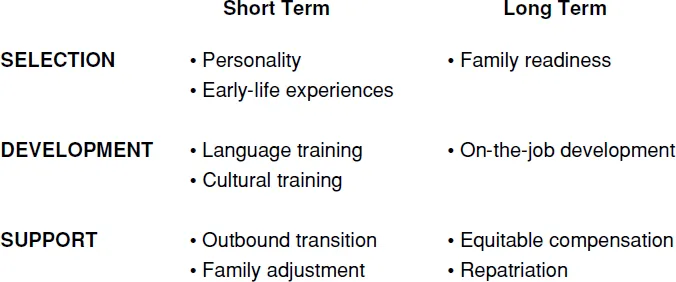
The Selection-Development-Support framework (see Figure 2) introduces the short-term and long-term factors that must be considered for properly managing an expatriation-repatriation system. “Short-term” factors can be addressed by HR managers within months or weeks of the start of the expatriate assignment. “Long-term” factors will need organizational interventions that may take a year or more of sustained observation and planning to design, and can only be implemented over time.
The framework was derived from many hours of conversations with expatriates and repatriates (some of their important comments are quoted in the appropriate sections below), from an analysis of tests and surveys they completed, and from the work of other scholars and practitioners knowledgeable about expatriate effectiveness. We wish to highlight that expatriate effectiveness is the result of a balanced consideration of each of the ten factors displayed in Figure 2. No single factor can predict effectiveness. Rather, these various factors must be brought into alignment.
The SDS framework is also the basis of major recommendations regarding how organizations can develop a talent pool to staff their international positions. For quick reference, see the summary on pages 30-31.
What follows is a detailed explanation of each of the elements of the framework, including quotes by the research participants.
Figure 2. Selection-Development-Support (SDS) Framework
SELECTION
Short-term Considerations: Personality and Early-life Experiences
The contributions of personality and early-life experiences to expatriate effectiveness have not been documented in a dramatic way by the research literature; this is in contrast, for example, to the extensive evidence available about the importance of family readiness. Nonetheless, our own and others’ research has yielded findings that justify further investigation of both personality and early-life experiences as major factors contributing to expatriate effectiveness.
Personality
I can’t really explain it. I grew up in this little tiny town in Alabama where my family had lived since the beginning of time. It’s as if I was born wanting to travel and see new places.
When I was growing up, my best friend’s uncle would come to visit them every year, all the way from France. My friend used to wonder at my wanting to sit and talk with him, because neither she nor her brother ever cared to do that.
We don’t want to overstate the power of personality for predicting effectiveness in the expatriate assignment, but there is evidence linking personality to managerial effectiveness that is worth considering.
By personality, we mean an individual’s typical way of feeling, thinking, and acting. To measure personality in our series of studies with expatriates, we used the NEO PI-R, an instrument developed to be as free of culture bias as possible. The NEO PI-R, as described by Costa and McRae (1992), configures personality in terms of five major factors, also known as the Big Five, each of which includes six facets. The statistically valid and reliable factors identified by this instrument are
• Emotional Stability—a person’s response to stress, anxiety, worry, and anger;
• Extraversion—a person’s sociability and ambition;
• Openness to Experience—a person’s desire to engage in new activities, experiences, and ways of thinking;
• Agreeableness—a person’s caring and concern for others; and
• Conscientiousness—a person’s will or drive to achieve and accomplish goals and objectives.
A number of studies have linked the Big Five personality factors to managerial effectiveness. Research on domestic managers in the U.S., Canada, and Europe demonstrates that Conscientiousness, Extraversion, and sometimes Agreeableness in addition to Emotional Stability are correlated with managerial success. Research on expatriate managers (including our research) confirms that Conscientiousness and Agreeableness correlate with expatriate effectiveness.
How should information on personality be used as a short-term selection consideration? Feedback on personality style can help prospective expatriates assess their suitability for international work and develop coping strategies to overcome their tendencies to behave counterproductively.
For example, a potential expatriate manager who learns that he has a lower-than-average score on Vulnerability (a facet of Emotional Stability) will need to learn some stress-reduction techniques. One who discovers that she has a higher-than-average score on Assertiveness (a facet of Extraversion) may need to curb her tendencies to be dominant and forceful.
We believe that personality is not destiny but predisposition. If individuals understand their predispositions and are motivated to override their hard wiring, they can learn the behaviors necessary to function effectively in other countries.
Early-life Experiences
A second factor to consider when making selection decisions is the early-life experiences of the prospective expatriate. Given our exploratory findings, it seems highly likely that early-life experiences—including those of childhood and adolescence—do influence expatriate managers’ ability to adjust and perform effectively.
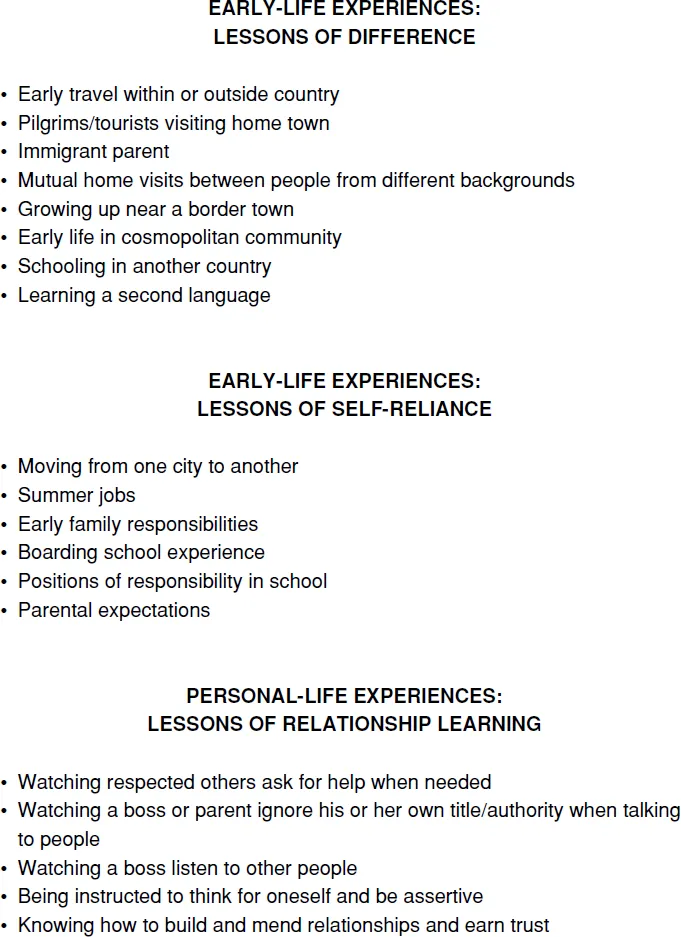
These original, provocative but preliminary findings were developed from interviewee responses to the question, “Are there experiences in your early life or outside work that you believe helped you to be effective as an expatriate?” Thematic analysis of data from the eighty-nine interviewees across all three studies showed that there are three types of events or situations that are most frequently cited. Each seems to lead to a particular insight, or lesson, as described next (see Figure 3). Lessons of differences among people were cited most often and formed the only category of experience that was found to be statistically correlated to the host country boss ratings of overall job performance (see Appendix A). The number of events cited for each of the other two categories of experience was insufficient to make statistical analyses possible.
Figure 3. Early-life Experiences: Lessons Learned from Most Frequently Cited Events
Lessons of difference.
When we were growing up, we read and traveled and mixed with different people. This must be considered because it made me ready to accept new situations and adjust myself.
Many different stories were told of contact with people from different cultures that occurred in a variety of ways. And these were not necessarily stories of fanciful trips to foreign lands. An American’s recollection about the time his family began living in the urban Northeast after moving from the rural South created just as dramatic a memory as an Arab’s recollection of the first time he ever saw a white person walking down the street in his small, remote rural community. Other stories described travel to unfamiliar locations and exposure to foreigners and immigrants in one’s own community.
What our interviewees learned from these experiences was that there were ways of behaving, talking, thinking, and feeling that were different from the ones with which they were familiar. Perhaps this lesson leads an individual to later comfort with novelty and tolerance of difference, both of which are useful for expatriate work.
Lessons of self-reliance.
I grew up very independent. My parents depended on me for getting things done. I learned to make money and help my family. I always had confidence that I could get along with people.
Stories were also told of situations in which a child or adolescent assumed a position of real responsibility, for example by taking on a summer job, working to support the family, or living in boarding school for several years. In many cases parents encouraged or explicitly demanded such self-reliance.
We hypothesize that what was learned from these experiences was an awareness that one must draw on one’s own internal resources and develop the skills needed to deal with particular situations. Perhaps this develops the autonomy and self-confidence needed later by the expatriate when located at a distance from the support of the home office.
Lessons of relationship learning.
My father taught me that everybody deserves respect, wants to be useful, and needs to be encouraged.
Lessons about relating to others and learning from them came from watching family members and mentors. There seem to be cultural differences, however—in our studies, the Middle Eastern managers reported learning from the behaviors of family members starting early in life; in contrast, U.S. managers reported learning from the behaviors of mentors and bosses. Across studies the behavior demonstrated by those in positions of authority was that of ignoring their own status or hierarchical position when relating to other people. As noted by one interviewee, “People who like their titles and like to be in control are not going to make it.” Once learned, through observation of the behaviors of people in positions of authority, this respect for others then led to much additional learning.
We hypothesize that what is learned by watching the behavior of role models is an attitude of respect toward others and oneself, and the awareness that there is much that can be learned from others. Perhaps this develops a valuing of relationships per se and of the ability to learn from others—qualities that make expatriates comfortable with depending on others to learn what they need to know to be successful.
We recommend that potential expatriates be invited to talk about why they are seeking an expatriate assignment and also about the kinds of experiences they have had in their lives that they believe will help them to be successful in cross-cultural settings. Informal conversations can help to reveal—both to the human resources manager and to the prospective expatriate—whether or not there is likely to be a comfort with people different from oneself, a generally self-confident approach to new situations, and a regard for others and what can be learned from them. Provisionally, we think these data can be interpreted to indicate whether prospective expatriates have the ability to admit when they don’t know what to do and to ask others for information, opinions, and guidance.
Long-term Consideration: Family...
Table of contents
- Cover
- Title Page
- Copyright
- Table of Contents
- List of Figures and Tables
- Preface
- Acknowledgments
- Introduction
- The Costs of Failure
- What Does Expatriate Effectiveness Mean?
- How to Create and Maintain a Talent Pool of Effective Expatriates
- Can Global Perspectives Be Learned?
- References and Suggested Readings
- Appendix A: Description of Research
- Appendix B: Interview Protocols
Trusted by 375,005 students
Access to over 1.5 million titles for a fair monthly price.
Study more efficiently using our study tools.
Frequently asked questions
Yes, you can cancel anytime from the Subscription tab in your account settings on the Perlego website. Your subscription will stay active until the end of your current billing period. Learn how to cancel your subscription
No, books cannot be downloaded as external files, such as PDFs, for use outside of Perlego. However, you can download books within the Perlego app for offline reading on mobile or tablet. Learn how to download books offline
Perlego offers two plans: Essential and Complete
- Essential is ideal for learners and professionals who enjoy exploring a wide range of subjects. Access the Essential Library with 800,000+ trusted titles and best-sellers across business, personal growth, and the humanities. Includes unlimited reading time and Standard Read Aloud voice.
- Complete: Perfect for advanced learners and researchers needing full, unrestricted access. Unlock 1.5M+ books across hundreds of subjects, including academic and specialized titles. The Complete Plan also includes advanced features like Premium Read Aloud and Research Assistant.
We are an online textbook subscription service, where you can get access to an entire online library for less than the price of a single book per month. With over 1.5 million books across 990+ topics, we’ve got you covered! Learn about our mission
Look out for the read-aloud symbol on your next book to see if you can listen to it. The read-aloud tool reads text aloud for you, highlighting the text as it is being read. You can pause it, speed it up and slow it down. Learn more about Read Aloud
Yes! You can use the Perlego app on both iOS and Android devices to read anytime, anywhere — even offline. Perfect for commutes or when you’re on the go.
Please note we cannot support devices running on iOS 13 and Android 7 or earlier. Learn more about using the app
Please note we cannot support devices running on iOS 13 and Android 7 or earlier. Learn more about using the app
Yes, you can access International Success: Selecting, Developing, and Supporting Expatriate Managers by Meena S. Wilson, Maxine A. Dalton in PDF and/or ePUB format, as well as other popular books in Business & Leadership. We have over 1.5 million books available in our catalogue for you to explore.