- 128 pages
- English
- ePUB (mobile friendly)
- Available on iOS & Android
eBook - ePub
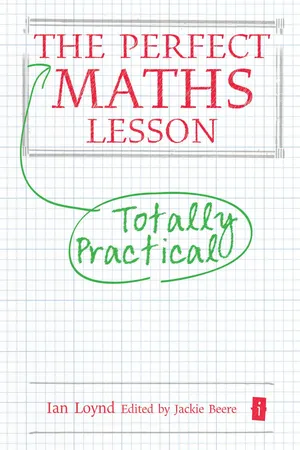
The Perfect Maths Lesson
About this book
The Perfect (Ofsted) Maths Lesson recognises that teaching is hard and that, although no teacher is perfect, their lessons can be. Drawing on his experience as a secondary maths teacher and assistant head teacher Ian Loynd provides practical ideas and common-sense methods that can help every teacher to be outstanding, and uncovers the essential strategies that help teachers appear to walk on water.
Information
Topic
EducationSubtopic
Professional DevelopmentChapter 1
Engaging Learners in Maths Lessons
Engaging learners in their learning is an essential element of the perfect maths lesson. Students who are engaged in the learning process are more likely to maintain focus and attention, are more ambitious in their thinking and are more resilient when making mistakes along the way. This is because they are intrinsically motivated to learn, meaning that students derive pleasure from participation in the mathematical task itself, from the challenge it presents or from finding its solution. The best maths lessons are the ones during which pupils acquire new skills and knowledge – and love every moment of it!
[In outstanding lessons] teachers and other adults authoritatively impart knowledge to ensure students are engaged in learning, and generate high levels of commitment to learning across the school.
Ofsted (2014: 39)
One of the key tasks in engaging learners in maths lessons is to set the pace of the learning correctly. A well-paced lesson enables students to tackle difficult concepts without feeling overwhelmed and maintains momentum through easier tasks before boredom sets in. The pace of learning is very different to the speed at which the lesson moves. In the best maths lessons, teachers do not try to cram too much in and nor do they take too long to get to the main activity. Instead, the pace of the lesson reflects the ability of the learners in the class and the level of mathematics being studied.
The correct pace allows learners to learn without becoming frustrated (your lesson is too easy, too slow or too repetitive) or becoming bewildered (your lesson is too difficult, too fast or too busy). An effective pace is fast enough to maintain focus but not so fast that students become disconnected from the learning. It is slow enough to ensure understanding but not so slow that students become disinterested.
When planning maths lessons, it is useful to think about the following questions:

Another powerful strategy for engaging learners is to link learning to students’ lives. In the perfect maths lesson, students are engaged by solving real-world problems in practical and experimental ways. This might involve planning a holiday, comparing mobile telephone tariffs, plotting routes on a map, breaking a code or monitoring the school’s energy consumption. For example, consider how you might build a lesson (or series of lessons) around the following scenarios:
Table of contents
- Cover
- Praise
- Title Page
- Dedication
- Contents
- Acknowledgements
- Foreword
- Introduction
- Chapter 1: Engaging Learners in Maths Lessons
- Chapter 2: Challenging Learners in Maths Lessons
- Chapter 3: Independent Learning in Maths Lessons
- Chapter 4: Assessment of, for and as Learning in Maths Lessons
- Chapter 5: Relationships for Learning in Maths Lessons
- Chapter 6: The Perfect Maths Lesson Self-Assessment
- The Perfect Maths Lesson Ultimate Checklist
- References and Further Reading
- Copyright
Trusted by 375,005 students
Access to over 1.5 million titles for a fair monthly price.
Study more efficiently using our study tools.
Frequently asked questions
Yes, you can cancel anytime from the Subscription tab in your account settings on the Perlego website. Your subscription will stay active until the end of your current billing period. Learn how to cancel your subscription
No, books cannot be downloaded as external files, such as PDFs, for use outside of Perlego. However, you can download books within the Perlego app for offline reading on mobile or tablet. Learn how to download books offline
Perlego offers two plans: Essential and Complete
- Essential is ideal for learners and professionals who enjoy exploring a wide range of subjects. Access the Essential Library with 800,000+ trusted titles and best-sellers across business, personal growth, and the humanities. Includes unlimited reading time and Standard Read Aloud voice.
- Complete: Perfect for advanced learners and researchers needing full, unrestricted access. Unlock 1.5M+ books across hundreds of subjects, including academic and specialized titles. The Complete Plan also includes advanced features like Premium Read Aloud and Research Assistant.
We are an online textbook subscription service, where you can get access to an entire online library for less than the price of a single book per month. With over 1.5 million books across 990+ topics, we’ve got you covered! Learn about our mission
Look out for the read-aloud symbol on your next book to see if you can listen to it. The read-aloud tool reads text aloud for you, highlighting the text as it is being read. You can pause it, speed it up and slow it down. Learn more about Read Aloud
Yes! You can use the Perlego app on both iOS and Android devices to read anytime, anywhere — even offline. Perfect for commutes or when you’re on the go.
Please note we cannot support devices running on iOS 13 and Android 7 or earlier. Learn more about using the app
Please note we cannot support devices running on iOS 13 and Android 7 or earlier. Learn more about using the app
Yes, you can access The Perfect Maths Lesson by Ian Loynd, Jackie Beere in PDF and/or ePUB format, as well as other popular books in Education & Professional Development. We have over 1.5 million books available in our catalogue for you to explore.