- 300 pages
- English
- ePUB (mobile friendly)
- Available on iOS & Android
eBook - ePub
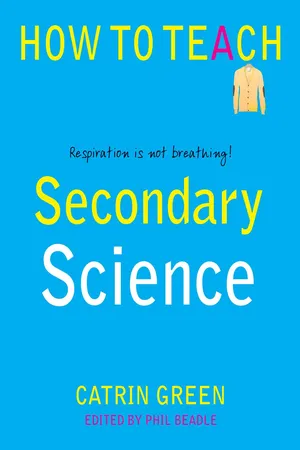
About this book
Part of Phil Beadle's How to Teach Series
So, you have passion for your subject and you get to work with some of the funniest, most surprising and exceptional students. But teaching science isn't always a walk in the park. How do you get students to think scientifically, remember all of those key words and not get acid in their eyes? Secondary Science is chockfull of workable ideas for the secondary science classroom. Ditch the stereotypical view of a science teacher: white coat, slides, teaching the limewater test to the same class for the fifth year in a row, and discover new and creative ways to inspire the next generation to use science.
Areas covered include: the big ideas in science, scientific skills and knowledge, curriculum, practical work, difficult topics, differentiation, assessment, feedback and the science of memory and learning, including the spacing effect and interleaving.
The book is packed with: advice about teacher talk, fun science games, ideas for developing scientific literacy, ideas for embedding mathematical skill in science, advice for extended writing in science, advice to make practical work safe, meaningful and worthwhile, and top tips for teaching the difficult topics that students tend to dislike! Catrin offers tips for teaching areas of the science curriculum including electricity, evolution and balancing equations.
Suitable for all teachers, including NQTs and experienced teachers who are looking for new ideas. If you are looking for quick and easy ideas to make science fun and relevant, while ensuring that all students are successful and confident in your lessons, and not overloaded with facts, then this book is for you.
Information
Topic
EducationSubtopic
Professional DevelopmentChapter 1
THE IMPORTANCE OF THE BIG PICTURE
‘BUT WHAT HAVE PARTICLES GOT TO DO WITH REAL LIFE?!’
The science curriculum can appear as a ‘catalogue’ of discrete ideas, lacking coherence or relevance. There is an over-emphasis on content which is often taught in isolation from the kinds of contexts which would provide essential relevance and meaning.
Robin Millar and Jonathan Osborne1
To engage students in learning we provide them with a peg on which to hook their new learning – usually background knowledge from day-to-day life, from the previous lesson or from a prior topic. What a student already knows about a subject has a much greater impact on achievement than both the interests of the student and the skill of the teacher,2 and whilst it is not possible for a teacher to fully influence a student’s background knowledge, one of the most important factors in its acquisition in the first place is the number of opportunities that we provide students with to understand the content and how we find ways of linking the science to real life.
TELLING THE STORY
Although we would probably all agree that science is an awe inspiring subject, scientists (science teachers included) need to become much better at communicating this awe to those who are not yet scientists. All students are curious – no matter how apathetic they may initially appear – and the trick is to find the hook with which to engage them. One of the best ways of doing this can be to bring the science to life with a story. This isn’t a new idea, of course, as linking knowledge to a story and creating a narrative has long been a key way of developing knowledge and learning. Not only does a story allow students to interconnect ideas they might already have about science, but it also allows them to place their knowledge in a wider context.
Storytelling is perceived as central to learning in English or history lessons, and whilst it might seem slightly more difficult (or even counterintuitive) in science, it’s actually pretty easy. Think about any science documentary you’ve ever seen on TV – this is always the method they use to introduce new topics. Not only is it engaging but it also provides an anchor for the new knowledge. Additionally, provided they are not too bogged down in unnecessary detail, stories are easy to remember: psychologists believe they are treated differently in the memory to any other kind of material.3 Students often struggle with the fine detail, so if we launch straight into the nitty-gritty of any topic they will quickly ask, ‘Why are we doing/learning this?’ Showing them the bigger picture and leading them towards being interested is a good start point. Then the students will start to ask questions: ‘Yes, but how?’ or ‘What next?’ You might wonder what this has to do with learning, but studies have shown that teaching students the cognitive strategy of asking questions results in significant gains in comprehension.4 A random list of 10 numbers with no connections is difficult to learn, but link the numbers to things in your own life and suddenly it’s not quite so hard after all.5 Therefore, a student who is simply taught what electrons, protons and neutrons are (without any surrounding context) may struggle to understand their relevance, but a student who has been taught about how our understanding of the basic building blocks of life has evolved has a connection between the different ideas and gets why they are studying it and how it is relevant to them.
HOW CAN I GET IT RIGHT FROM THE START?
A simple idea to start introducing stories into your teaching is to think pretty hard about the title of your lesson. So, a lesson that might otherwise be called ‘The atom’, could be ‘What are we really made of?’ or ‘What is the smallest thing we know about?’ Bill Bryson’s A Short History of Nearly Everything is a fantastic place to start if you need some inspiration for stories.6
Choose the most interesting sections of the story, litter it with some little side facts that spark interest and employ photos and diagrams to illustrate.7
Here are some examples of how to storify science for students.
Biology: ‘Are we really 97% the same as chimpanzees?’
Evolution can be a tricky topic to teach, mainly because students walk into your classroom with existing ideas and misconceptions about what it is. Starting with evolution as a story is a really good way in: I begin this subject with the story of Darwin during his time at Cambridge. I tell them that he was so curious by nature that he used to eat owls and hawks, and that one of the results of this curiosity was his trip to the Galapagos Islands. At this point, it’s important to note that a story doesn’t have to be told just by you but can be investigated through group work and projects. For instance, allocate each group of students a different segment of Darwin’s story: one group could be given information on his journey, another what he discovered on Galapagos with regards to finches, another how he tried to convince the public and so on. Get them to present these in date order.
Biology: ‘Why do I have to have that injection?’
For an account of Edward Jenner, who pioneered the smallpox vaccine, start with a picture of someone suffering from the later stages of smallpox (warn the students first!) and it is likely you will inspire the awe that you are seeking. Continue by painting the story of how deadly smallpox was (some estimates suggest that between 300–500 million people have died of the disease – a higher fatality rate than both world wars combined8). Next – and this is a great opportunity to show how medical advances can come from thinking outside of the box – explain how Jenner went from hearing that milkmaids who had contracted cowpox almost never contracted smallpox and that this led him to try inoculating subjects with cowpox before exposing them to smallpox to test his hypothesis. Continue this into the present day by observing that smallpox could be used in bio-terrorism and why it is essential that students do not listen to any of the scare stories regarding vaccinations (after all, your students will be parents one day).
Biology: ‘Why do 100,000 people die of cholera every year but I’ve never heard of it?’
John Snow’s (no, not the guy from Game of Thrones) discovery of cholera in 1849 was incredible given that he couldn’t see bacteria. Cholera was originally thought to be airborne until Snow looked into a particular case in Soho, London. Show students the same maps that he looked at of where people had been infected and prompt them with some questions. What patterns can they see? Would this pattern support the theory that the infection was airborne? Why/why not? How else could it have been spread (it’s best if students already have a bit of background on communicable diseases first)? Once students have suggested that it could be spread through water, show them a second map with locations of the various water wells and see if they can identify the one on Broad (now Broadwick) Street as the source of the infection. Follow this up with similar exercises into recent epidemics (e.g. the Zika virus or Ebola).
Biology: ‘How can babies have three parents?’
This is a great way to introduce a Key Stage 4 genetics topic. Teach the role of the mitochondria through the process and ethics of allowing three person babies.9 Start the lesson by providing pairs of students with any news clippings you can find about this type of a story (differentiate your material here – some pairs will be able to understand The Guardian or The New Scientist; others might better engage with a clip from the BBC website). Next, split the pairs so that one student has to oppose the idea whilst the other one agrees. Give them time to prepare before getting them to debate in a ‘debating ring’ (see Chapter 3).
Biology: ‘Why am I like my parents?’
The impact that the discovery of DNA has had on our understanding of inheritance is best started with a clip from Jurassic Park (the original one, obviously – there’s nothing wrong with showing your age). The film can be used to explain how the park brought dinosaurs back from extinction. Use a think–pair–share activity (see Chapter 2) to ask students if they think this would ever be possible and then get them to brainstorm what they already know about DNA. This is important because aspects of this topic are part of everyday life, so you shouldn’t assume the students have little background knowledge. A good activity here is to produce a student timeline at the front of the classroom. Start with a student Charles Darwin at one end of the room (get them to make a Darwin sign to hold up) and ask them to explain what Darwin told us about evolution. The next student along from Darwin should act as Gregor Mendel and should explain his pea experiments (have some YouTube clips up your sleeve to remind the students if they are rusty). Now you need to skip to the 1950s, so leave a largish gap and choose four students to be the pioneers of DNA, using them to play the roles of Rosalind Franklin, Maurice Wilkins, James Watson and Francis Crick. (As an aside, the lack of a Nobel prize for Franklin is a great discussion point to engage the girls.) It’s worth finishing with a task regarding environment and genetics which will allow the students to conclude just how much (unfortunately) they are like their parents.
Chemistry: ‘How have we got such a range of materials?’
Tell the story of the turning points in chemistry, starting with Aristotle believing that the only four elements were fire, earth, air and water through to the modern day and new wonder materials such as graphene. This is a good way to start teaching elements and compounds before introducing students to the periodic table. Hand out some Lego and ask the students to make simple structures (e.g. house, truck, skyscraper). Then ask them why it is possible that a number of different objects can be made from the sa...
Table of contents
- Cover
- Title Page
- Acknowledgements
- Foreword by Phil Beadle
- Contents
- Introduction
- 1: The importance of the big picture: ‘But what have particles got to do with real life?!’
- 2: It’s all in the explanation! ‘So heat rises …’
- 3: Making it memorable: ‘I think we did this last year …’
- 4: The importance of explicitly teaching literacy: ‘Evolution is like that we’re the children of chimps or something’
- 5: The joined-up science curriculum: ‘But what does this have to do with what we did last week?’
- 6: Teaching difficult topics: ‘I can’t do science’
- 7: A guide to practical work: ‘Are we doing a practical today?’
- 8: Moving students forward: ‘I got the same grade – again’
- And finally …
- Bibliography
- Index
- Copyright
Trusted by 375,005 students
Access to over 1.5 million titles for a fair monthly price.
Study more efficiently using our study tools.
Frequently asked questions
Yes, you can cancel anytime from the Subscription tab in your account settings on the Perlego website. Your subscription will stay active until the end of your current billing period. Learn how to cancel your subscription
No, books cannot be downloaded as external files, such as PDFs, for use outside of Perlego. However, you can download books within the Perlego app for offline reading on mobile or tablet. Learn how to download books offline
We are an online textbook subscription service, where you can get access to an entire online library for less than the price of a single book per month. With over 1.5 million books across 990+ topics, we’ve got you covered! Learn about our mission
Look out for the read-aloud symbol on your next book to see if you can listen to it. The read-aloud tool reads text aloud for you, highlighting the text as it is being read. You can pause it, speed it up and slow it down. Learn more about Read Aloud
Yes! You can use the Perlego app on both iOS and Android devices to read anytime, anywhere — even offline. Perfect for commutes or when you’re on the go.
Please note we cannot support devices running on iOS 13 and Android 7 or earlier. Learn more about using the app
Please note we cannot support devices running on iOS 13 and Android 7 or earlier. Learn more about using the app
Yes, you can access Secondary Science by Catrin Green, Phil Beadle in PDF and/or ePUB format, as well as other popular books in Education & Professional Development. We have over 1.5 million books available in our catalogue for you to explore.