Near-death experiences can be profound and life changing. Through hypnotically facilitated waking dreams Schenk shows clients how they can benefit from the life changing effects of a near-death experience without the life-threatening cardiovascular crisis.
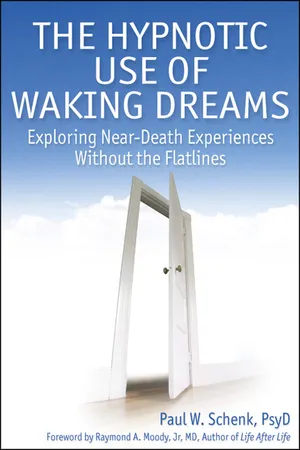
eBook - ePub
The Hypnotic Use of Waking Dreams
Exploring Near-Death Experiences without the Flatlines
- 192 pages
- English
- ePUB (mobile friendly)
- Available on iOS & Android
eBook - ePub
The Hypnotic Use of Waking Dreams
Exploring Near-Death Experiences without the Flatlines
About this book
Trusted by 375,005 students
Access to over 1.5 million titles for a fair monthly price.
Study more efficiently using our study tools.
Information
Topic
MedicineChapter 1
The Things You Can Do with a Good Dream
When I died I had an overwhelming experience of calm and peace. I was floating above the ocean and felt absolute harmony with everything around me.
The light is so bright. I feel like I’m floating. There is a lot of loving presence here.
My parents are worried about the ship sinking, about the storm. They just woke me up. We’re leaving the cabin. People are running. My mother and I lost my dad in the crowd. I’m off the ship now. I seem to be floating up in the air. My mother is next to me, we must have died. We fell into the cold water getting into the lifeboat. I can see my body sinking in the ocean. I was trying to touch my body, but it was too far away and everyone disappeared. [Pause.] My grandmother is there! She took my hand! Now she’s guiding me, telling me to come with her. Mom’s up there with her. I see the Light now, a big sun. I’m so happy to be with my grandmother again!
When I died I saw my funeral … Then I proceeded to float up and I found my wife. She was very excited to see me. I had an overwhelming experience of feeling loved. All of my sad thoughts had left me and I just filled up with happy ones.
If you have previously read about near-death experiences, these descriptions will have a familiar ring to them. For more than three decades now, researchers have provided us with fascinating glimpses of life-after-life that sometimes occur in individuals following a heart attack or other life-threatening crisis. Triggered by potentially fatal situations, survivors report incredible tranquility and peacefulness as they float out of the physical body into an intensely bright light where they are typically greeted lovingly by others: deceased relatives, spirit guides, angels, religious figures, etc. When the experience lasts long enough, these survivors engage in a non-judgmental life review often accompanied by significant insights. Despite the fact that the experience is over in a matter of seconds, most report profound, durable, life-altering aftereffects of a positive nature.
The descriptions above are not from people who have suffered a close call with death, however. What they are describing took place in my office during psychotherapy sessions. Unlike traditional near-death experiences in which the heart often stops, these people were in no distress. They were all sitting or lying comfortably on my couch.
Waking dreams provide a vehicle that enables people to experience many of the phenomena associated with a true near-death experience, but without any of the life-threatening risks. The varied case studies that follow, with their extensive transcripts of actual waking dreams, demonstrate a variety of ways that I have used waking dreams to help people resolve problems ranging from the specific to the existential. Transcripts, of course, are limited in their ability to convey the emotional richness that is so integral to the experience. Nonetheless, as you read each of the case studies, I hope you will increasingly sense the transformative potential of waking dreams.
Aided by straightforward hypnotic techniques, my clients experience vivid dream-like imagery during the psychotherapy session in which they become the main character in a fictional life. The life of the dream character may include insightful parallels to the client’s own life, such as Dorothy experienced in The Wizard of Oz, but the true power of the waking dream typically begins when the dream character dies. At this transitional moment, clients typically report the first of many of the characteristics associated with a true near-death experience. Floating out of the body of the dream character and into the Light, most clients meet what they describe as spirit guides or other non-physical beings whose function seems to replicate that of the figures who present in a true NDE.
Among other things, waking dreams usually include a non-judgmental life review, an opportunity to release faulty beliefs and feelings of guilt, reunion with loved ones, and transforming experiences of being loved unconditionally. Unlike a true NDE, an important part of this experience is a meeting between the dream character and the client in which the dream character offers the client support and guidance for his or her own life struggles. The process often concludes with an assurance that the guides and/or the dream character will remain available to the client in an ongoing relationship, assisting, coaching, and supporting the client’s efforts to change.
Throughout the book, I refer to these after-death beings as “spirit guides” or simply “guides”. In doing so, I wish to be pragmatic without being presumptive. It is certainly possible that these guides are merely creations of the client’s imagination, just like the dream character and others who appear in the waking dream. Because both their function and the emotional responses that their presence elicits seem analogous to similar encounters described in true NDEs, I chose a label descriptive of that function.
Waking dreams allow people to work on a variety of issues:
1. Sometimes they discover previously unrecognized faulty assumptions about a problem.
Once identified, these faulty beliefs fall away. As this happens, new solutions quickly emerge. Consider the example of Matthew who had long perceived power as a kind of magic that only women have. The only way he could have power, therefore, was to be in a relationship with a woman. As a result, he became depressed and anxious whenever he was in between relationships. In one of his waking dreams, he saw himself as a young girl, Antoinette, who spent the rest of her life in a convent as a nun. By the time of her death, she had become the Mother Superior. Comparing the characters in the waking dream with his own life, Matthew noted:
When you asked me to look for people in the nun’s life, I realized I couldn’t … I knew the father in the girl’s story was a parent in my life, but I didn’t know which one. Still don’t. But then I had a set of thoughts that went, “Oh, if it’s my father, and he really had this kind of power, what I saw then was a man who was so afraid of how he would misuse power that he wasn’t going to let himself have any.” And that’s stupid. Power is just another form of magic. You don’t have to be consumed by it. It’s another form of energy. It’s not that big a deal.
What she [Antoinette] saw earlier was—it’s a kinesthetic experience, how the hell do I put it into words … okay, “Magic is external to me. You go out of yourself towards it, grab something outside of yourself, and try to get incorporated by it.” She found that God has to subtract from Himself to create an emptiness into which the magic can enter. The cabalistic statement is, “God created nothing in order for there to be a space into which He could enter.” God subtracted from Himself. What she got was a kinesthetic of, “You let God into you. That creates a space into which the magic enters.” The magic is an energy exchange between you and God—to be prosaic about it. [I interjected, “Did, you get that in a kinesthetic way?”] Oh, yea. Oh, yea. I was flooded with light.
Then, a minute later, he found another faulty assumption. In the waking dream, the young girl had gone through a period of intense loneliness as a teenager in the convent.
That was the shift in me about … Ahhh! This is relevant actually. Two years ago, a woman told me something which I heard, and knew she was absolutely right, but didn’t know what to do with it. She said that I confused loneliness with missing God.
The nun had the experience (of the loneliness) which is why I said I thought I was in exile. I thought I was like being put in “time out,” and He has to take me out of time out. It’s only a separation. I got it. … Oh! He’s been waiting for me to come back!
2. People can safely try out a new solution in the virtual reality of the waking dream, modifying it as needed.
As an analogy, consider the main concept of the 1993 movie Groundhog Day happening in a trance-induced virtual reality. In the movie, the main character finds himself trapped in a 24-hour time loop. Every day when he awakes it is the same calendar day. Each day he experiments with different ways of resolving his problems, drawing on his successes and failures from the previous attempts. When he finally works out a solution he truly likes, he gets out of the time loop.
One client, a middle-aged professional woman, Emily, was wrestling with whether to risk shifting the focus of her work to an area that held much more appeal for her, but that might alienate her from much of the conservative community where she lived. In one of her waking dreams, she was a professor, Winston, and the administrator of a seminary. As the dream went on, she narrated:
I’ve called in another one of the professors, Gilbert, because of pressure from influential parents of some of the students. The parents are complaining that this professor has been filling their sons’ heads with things they don’t want them to think about. He is questioning and promoting questioning in the students. He is arguing with me because he knows from our prior conversations that I agree with him. But I don’t give in. I tell him if he doesn’t stop, I’ll let him go. These people are too important. They give too much money to us. I can’t ignore them. His reaction is surprising, because he looks at me with sadness, almost pity. I’m embarrassed and furious. He leaves, and soon after leaves the seminary.
I find it ironic: the seminary continues to struggle and yet he prospers. Gilbert starts his own small school. Only the brightest, most open-minded students seek him out. Even though he doesn’t have the most money, he still seems to prosper. Meanwhile, I don’t grow and the seminary doesn’t grow. I realize too late there was nothing else in my life, so I retire from the seminary on a small pension. I’m very bored and bitter, and I feel like I sold it all. I just sold out my life. I sold my potential for financial security, but all I bought was boredom.
Soon after this comment in her narration of the waking dream, Winston died. Following his death, I invited Emily to revisit the decision Winston had made that day in the seminary office when he and Gilbert had argued. I suggested she implement an alternative decision and notice what difference it made.
It was not very satisfying to have power over sheep. I have to learn to be true to myself. (If I changed the decision) I’d leave the seminary with Gilbert and start a new one. In that setting I see myself having a challenging, vibrant life, growing and learning and teaching. We took a lot of financial risk—and social risk. We’re very unpopular with the majority of the people, just as he really was. But the best and brightest learned from him and would have learned from me, too. They soak in knowledge like a sponge, never depleting mine but enhancing it, teaching me in return.
Now, five years since that waking dream, Emily is well into the transition in her own work. She is still valued by her traditional referral sources despite having become much more open in her pursuit of this new direction in her career. The fear and apprehension that had plagued her for some time have gradually abated as she has given herself permission to pursue her true interests.
3. In waking dreams, people can develop abilities and relationship skills they currently lack.
A recently divorced woman, Donna, brought her two children to see me for some help dealing with the fallout from the breakup of the family. In one of her individual sessions, she had a waking dream in which she was the wife of a Southern plantation owner in the pre-Civil War period. In her dream, Donna’s husband had died young and left her with two children to raise and a plantation to manage. As she explored the remainder of Donna’s life in the dream, she experienced the confidence and competent manner in which she managed the plantation. She noted with some humor that the other plantation owners in the community, all men, did not take kindly to the undeniable truth that she was more successful than they were. Following her death in that dream, Donna had a strong sense that her own two children were with her to help her remain aware of her own competency as she deals with the stereo-typed expectations of some of her professional colleagues in the traditionally male-dominated field in which she works.
4. Sometimes in a waking dream people experience a problem from an opposing perspective.
This is particularly helpful for clients who have felt “victimized” in some way by life. Emily (see number 2) had not only been looking to move in a new direction professionally, she had also remained somewhat “stuck” following the death of her long-term partner. Previously, she had experienced a number of other losses in her life. In her grieving over her partner’s death, she wrestled with the unfairness that she always seemed to be the one who was left behind. In one of her waking dreams, her partner appeared in the role of a spouse. In Emily’s role as the dream character, this time she was the first of them to die. Floating in the Light, she decided that it was no easier to be the first to die than to be the one left behind.
She had had to deal with other losses as well. As the owner of a small business, Emily had suffered quite a financial loss when a trusted employee embezzled funds. She experienced the other side of this relation...
Table of contents
- Cover
- Title Page
- Table of Contents
- Foreword
- Preface
- Chapter 1 : The Things You Can Do with a Good Dream
- Chapter 2 : Near-Death Experiences: A Brief Review
- Chapter 3 : A Typical Waking Dream
- Chapter 4 : “Now Go Paint the Rest of Your Life”
- Chapter 5 : We Make it Harder than it Needs to Be
- Chapter 6 : “But I Don’t See Anything”
- Chapter 7 : The Sea Captain
- Chapter 8 : Are You Sure I’m Dreaming?
- Chapter 9 : A Typical Past-Life Experience
- Chapter 10 : With a Little Help from Our Friends
- Chapter 11 : A Lesson about Love
- Chapter 12 : Putting the Pieces Together
- Bibliography
- Endnotes
- Index
- Copyright
Frequently asked questions
Yes, you can cancel anytime from the Subscription tab in your account settings on the Perlego website. Your subscription will stay active until the end of your current billing period. Learn how to cancel your subscription
No, books cannot be downloaded as external files, such as PDFs, for use outside of Perlego. However, you can download books within the Perlego app for offline reading on mobile or tablet. Learn how to download books offline
Perlego offers two plans: Essential and Complete
- Essential is ideal for learners and professionals who enjoy exploring a wide range of subjects. Access the Essential Library with 800,000+ trusted titles and best-sellers across business, personal growth, and the humanities. Includes unlimited reading time and Standard Read Aloud voice.
- Complete: Perfect for advanced learners and researchers needing full, unrestricted access. Unlock 1.5M+ books across hundreds of subjects, including academic and specialized titles. The Complete Plan also includes advanced features like Premium Read Aloud and Research Assistant.
We are an online textbook subscription service, where you can get access to an entire online library for less than the price of a single book per month. With over 1.5 million books across 990+ topics, we’ve got you covered! Learn about our mission
Look out for the read-aloud symbol on your next book to see if you can listen to it. The read-aloud tool reads text aloud for you, highlighting the text as it is being read. You can pause it, speed it up and slow it down. Learn more about Read Aloud
Yes! You can use the Perlego app on both iOS and Android devices to read anytime, anywhere — even offline. Perfect for commutes or when you’re on the go.
Please note we cannot support devices running on iOS 13 and Android 7 or earlier. Learn more about using the app
Please note we cannot support devices running on iOS 13 and Android 7 or earlier. Learn more about using the app
Yes, you can access The Hypnotic Use of Waking Dreams by Paul W Schenk in PDF and/or ePUB format, as well as other popular books in Medicine & Medical Theory, Practice & Reference. We have over 1.5 million books available in our catalogue for you to explore.