- 200 pages
- English
- ePUB (mobile friendly)
- Available on iOS & Android
eBook - ePub
About this book
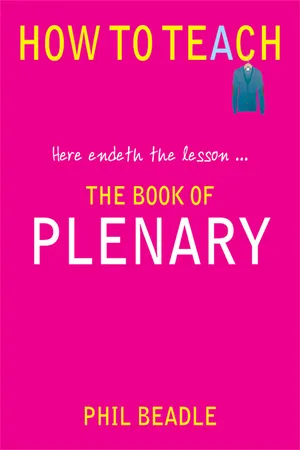
You paint an outside wall. It rains. What happens to the paint? It runs off, of course! So it is with our students. We teach them something. We can't be bothered to do the recap, the plenary, as we don't have any ideas. They leave the lesson. They promptly forget what you have taught them. There was no point their being in the lesson in the first place. The world continues turning. This practical little book of plenaries does what it says. It delivers a series of simple ideas for how to make your lesson endings - or mid-lesson recaps - interesting, engaging and cognitively challenging. Apply the ideas in this book and your students will leave the lesson with the information you have taught them still in their heads.
Information
Topic
EducationSubtopic
Education GeneralPART 1
AN OVERVIEW OF THE PLENARY
Firstly, let us acknowledge that the plenary is not in any way sexy; the word itself is unpleasingly under-erotic, seeming to bring to mind some unpalatable infection of the penis: pleeenary.
‘What’s wrong with it, Doctor?’
‘Aside from the size? Well, sadly, I must inform you that you have a nasty little dose of non-specific plenary.’
And that, dear colleagues, may well be one of the reasons – go on, be honest – that you (or I) do not always do them. In fact, you can pretty well guarantee that if you get working parties together in schools to examine the assorted parts of our professional practice, and give various groups their pick of what they are going to look at, you’ll find, at the end, that the plenary is sat parked, about as popular as a ginger stepson, as the last forlorn car in the garage.
There is also the added weirdness that the word ‘plenary’, to a teacher in the United Kingdom, signifies something that it doesn’t mean to anyone else in sane society or the wider world. To people who inhabit workplaces devoid of staffrooms, a plenary is the compulsory bit of a conference when delegates all come back from the ‘break-out’ rooms or the workshops into the main hall. It is during a ‘plenary’ that you will most likely have to sit through a tedious ‘keynote’ speech from an academic or bore (or both).
Alternatively, if you are in (or of) the Church, you might think of it as a form of authority: the power a Church’s governing body has to set out exactly what it is going to do. It is only in the British staffroom that we hear this word and think immediately, ‘Oh, the ten-minute bit at the end of the lesson that I can never really be bothered to do properly (if at all)!’
The name came about, I think, because plenary is the adjectival version of the Latin noun, plenum, which does not even go so far as to exactly correspond to the concept of ‘fullness’: it merely carries a suggestion of it. The inference here is that in conducting a proper plenary we are giving our students the suggestion of fullness: which is an uncomfortable image, until we remind ourselves that the idea is to set students on the path to being replete with learning.
Another of the reasons that the plenary attracts a certain dwarfism of attention is that it’s extremely difficult to get intellectually interested, or in any way passionate, about the question, ‘So, children, what did you learn today?’
However, if we are to start off with the briefest analysis of what our students might (potentially) get out of a good plenary – and accepting that we all want to be the best teacher we can possibly be – then it becomes a professional dictate (perhaps) that we start taking them seriously and devoting a little imagination and thought to their use, or their implementation, or their management, or their whatever.
WHAT WILL YOUR STUDENTS GET OUT OF A GOOD PLENARY?
‘What’s the point of all this stopping ten minutes before the end of the lesson and then doing some weirdness, Sir, just when we’ve understood what you wanted us to do in the main task?’ Could Denzil be right here? What’s the point? The lesson is going swimmingly. Why stop it, and manage yet another oh-so-bloody-knackering-and-difficult transition, just at the exact part of the lesson at which you are most tired?
Alternatively, what’s the point? The lesson has been a disaster from start to finish; the kids have been fractious all along.4 Why stop it, and manage yet another oh-so-difficult transition, just at the point when you are most tired?
Look at it through another similarly phrased prism: what’s the point? What’s the point of going to all that trouble planning an interesting sequence of activities and inputs when they don’t remember anything from the lesson? You may just as well have got them to do some lovely colouring-in (!). What’s the point of going all the way to 85% and just throwing the last 15% in the waste-bin? What’s the point of having thought really hard about the content of the lesson and then copped out just at the bit where they actually cement the information in their heads? What’s the point of painting something if you aren’t going to varnish it? The colour will all wash off come the first passing shower.
Without the plenary you are arguably just going through the motions and passing time. It was a nice enough experience, but they don’t remember it. And the point of lessons is that they are remembered, otherwise they are not lessons learnt.
The existence of the plenary is to help the students remember what they have learnt in the lesson. If you don’t, erm, do one it is vastly more than likely that they will have substantially less recall of the learning. If we shift the focus to Professor John Hattie, he’s quite categorical:
The lesson does not end when the bell goes. It ends when teachers interpret the evidence of their impact on student(s) during the lessons relative to their intended learning outcomes and initial criteria of success – that is when teachers review the learning through the eyes of their students.5
There are a few elements to this observation that benefit from a brief unpacking. Firstly, Hattie here gives implicit, yet emphatic, confirmation that some checking of the learning must take place; the end of the lesson seems a quite reasonable place at which to do this. Secondly, he is explicit that we’ve somehow to reframe the way that we look at the learning experience so that it is the opinion(s) of the students that lead us to review and alter what we are doing in lessons. (There is a pro forma that will be of help if you want to take Hattie’s observation as being the gospel here, in the first of the digital plenaries in Part 4: Homework’s Holy Grail.)
In performing a task that is specifically related to the learning (and to the objectives), students may come to new realisations and make new connections they hadn’t made earlier on in the lesson. Consequently, a decent plenary will extend and broaden their knowledge of the concept or skill being taught.
However, there is also a quite interesting and entirely reasonable argument that the best thing students will get out of a decent plenary is an understanding of what they do not know. As Darren Mead, whose Pedagogical Purposes blog reveals him to be perhaps the most intellectually engaged of all British teachers, states: ‘Becoming less confident in their knowledge is just as valid a response, as they could either be unlearning a misconception, which is a difficult process or be questioning why they believe something rather just accepting something is right.’6
Mead is bang on here, and his assertion tallies nicely with Hattie’s thoughts (above) about the same: specifically, that what we should be looking for is for the students to be able to identify what they don’t understand and to implement (practised) strategies to obtain that knowledge; to fill that gap.
WHAT DOES MR LESSON INSPECTOR SAY?
Here’s what those who are employed to take out kitchen scales from shiny briefcases and comment on the weight of a thing had to say about our use of plenaries some considerable time ago.7 Ofsted’s evaluation of the Key Stage 3 pilot in English and maths commented that teachers are good at standing at the front of classrooms reading lesson objectives to our students from a PowerPoint, and that we’re also good at giving the students a pointless activity that takes ten minutes at the beginning of a lesson. They are less happy, however, with the plenary; and pointedly use the language ‘lack of well managed’ and ‘weakness’ in a rather unpleasantly pointed manner:
The plenary is an essential part of the lesson, but its quality has not improved since the strategy began. This is a matter of serious concern. As with independent work, part of the problem lies in a lack of understanding of its purposes; for assessment, feedback, consolidation, evaluation and the linking of the lesson to the next one, or to another area of the curriculum.8 The plenary is poorly used if it is simply a bolt-on-extra which provides an opportunity for groups of pupils to present their work daily; it is essential time for making sure that pupils have grasped the objectives and made progress, so that the next lesson can begin on firm foundations.9
Broadly, the problem with the plenary session, as it is currently (or was previously) used in British education, is that they are (or were) not performed with enough seriousness of intent: we tend to just go through the motions when we are being observed and, even then, don’t devote anything like enough time to it. Ofsted go on:10
From the outset, plenaries were often the weakest part of the lesson. Good planning was critical to the success of plenaries. Often there was insufficient time for them, typically because teachers underestimated the time required for activities in the main phase of the lesson. Plenaries were often the least active part of lessons. Teachers tended merely to sum up what happened during the main phase and pupils did not have the opportunity to articulate what they had learned. When pupils had such opportunities, they proved an important part of the learning process.11
If we reverse the box tickers’ conclusions as to why plenaries are poor, we can state fairly conclusively what the fundamentals of a good one would be.
1 It has to be planned
You can’t just go into a lesson with any sense that you will just pull something out of the bottomless well of your imagination. With all the will in the world, if you think you can just magic one up from nowhere, you are kidding yourself and in forty minutes’ time you will be asking them, ‘So what did you learn in this lesson?’ You’ll go into the lesson intent on finding a little moment in which you can rustle up an idea, but you’ll get caught up in something else. Keith will require some tissues for his bottom lip. Everyone will want your attention. You will forget.
You can’t just go into a lesson with any sense that you will just pull something out of the bottomless well of your imagination. With all the will in the world, if you think you can just magic one up from nowhere, you are kidding yourself and in forty minutes’ time you will be asking them, ‘So what did you learn in this lesson?’ You’ll go into the lesson intent on finding a little moment in which you can rustle up an idea, but you’ll get caught up in something else. Keith will require some tissues for his bottom lip. Everyone will want your attention. You will forget.
2 You have to leave sufficient time for them
Key to this is not to see plenaries as the end of the lesson, but as an intrinsic part of it. What tends to happen is that teachers get caught up in the main lesson activity, as they (not unreasonably) give the ‘body’ of the lesson due preference. This has its head on the wrong way round. It is the mindset of seeing the plenary as a tacked-on irrelevance that makes the majority of them ineffective; they should be seen not as a tacked-on imposition, but as a vital part of the lesson’s function. There’s no point whatsoever in teaching good lessons that bring in sparkling and vital new knowledge if the kids have forgotten that information before they have even got as far as the classroom door. So, fundamental to running a decent plenary is to give it a decent fist of time. Ten minutes, not two.12 This will also ensure that, as you have to fill a full, fat chunk of time, you avoid the other key sin: which is not having them active enough!
Key to this is not to see plenaries as the end of the lesson, but as an intrinsic part of it. What tends to happen is that teachers get caught up in the main lesson activity, as they (not unreasonably) give the ‘body’ of the lesson due preference. This has its head on the wrong way round. It is the mindset of seeing the plenary as a tacked-on irrelevance that makes the majority of them ineffective; they should be seen not as a tacked-on imposition, but as a vital part of the lesson’s function. There’s no point whatsoever in teaching good lessons that bring in sparkling and vital new knowledge if the kids have forgotten that information before they have even got as far as the classroom door. So, fundamental to running a decent plenary is to give it a decent fist of time. Ten minutes, not two.12 This will also ensure that, as you have to fill a full, fat chunk of time, you avoid the other key sin: which is not having them active enough!
3 Get the kids to do the work!
In the olden days, when the plenary was but a whelp, the guidance was simple: the kids got their coats on, and before they left the class the teacher asked them what they had learnt. They came up with a few listless replies, because they already had their coats on and they were already somewhere else altogether in their minds. When they did reply they would come up with completely the wrong answer, and would make the teacher look like a berk if that teacher was being observed by the men-in-black. You thought you had taught them some immensely technical and simultaneously spiritual concept and skill. They would reply: ‘I learnt it is proper good to be friendly to uv...
In the olden days, when the plenary was but a whelp, the guidance was simple: the kids got their coats on, and before they left the class the teacher asked them what they had learnt. They came up with a few listless replies, because they already had their coats on and they were already somewhere else altogether in their minds. When they did reply they would come up with completely the wrong answer, and would make the teacher look like a berk if that teacher was being observed by the men-in-black. You thought you had taught them some immensely technical and simultaneously spiritual concept and skill. They would reply: ‘I learnt it is proper good to be friendly to uv...
Table of contents
- Cover
- Title Page
- Dedication
- ACKNOWLEDGEMENTS
- CONTENTS
- INTRODUCTION
- PART 1: AN OVERVIEW OF THE PLENARY
- PART 2: ANALOGUE PLENARIES
- PART 3: METACOGNITION FOR BEGINNERS
- PART 4: DIGITAL PLENARIES
- POTENTIALLY USEFUL RESOURCES FOR SPODS
- BIBLIOGRAPHY
- INDEX
- Copyright
- Advertisement
Trusted by 375,005 students
Access to over 1.5 million titles for a fair monthly price.
Study more efficiently using our study tools.
Frequently asked questions
Yes, you can cancel anytime from the Subscription tab in your account settings on the Perlego website. Your subscription will stay active until the end of your current billing period. Learn how to cancel your subscription
No, books cannot be downloaded as external files, such as PDFs, for use outside of Perlego. However, you can download books within the Perlego app for offline reading on mobile or tablet. Learn how to download books offline
We are an online textbook subscription service, where you can get access to an entire online library for less than the price of a single book per month. With over 1.5 million books across 990+ topics, we’ve got you covered! Learn about our mission
Look out for the read-aloud symbol on your next book to see if you can listen to it. The read-aloud tool reads text aloud for you, highlighting the text as it is being read. You can pause it, speed it up and slow it down. Learn more about Read Aloud
Yes! You can use the Perlego app on both iOS and Android devices to read anytime, anywhere — even offline. Perfect for commutes or when you’re on the go.
Please note we cannot support devices running on iOS 13 and Android 7 or earlier. Learn more about using the app
Please note we cannot support devices running on iOS 13 and Android 7 or earlier. Learn more about using the app
Yes, you can access The Book of Plenary by Phil Beadle in PDF and/or ePUB format, as well as other popular books in Education & Education General. We have over 1.5 million books available in our catalogue for you to explore.