eBook - ePub
Teaching
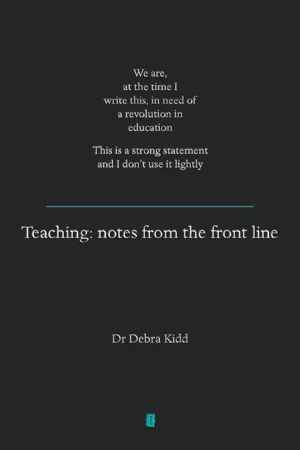
Notes from the front line. We are, at the time I write this, in need of a revolution in education. This is a strong statement and I don't use it lightly
- 160 pages
- English
- ePUB (mobile friendly)
- Available on iOS & Android
eBook - ePub
Teaching
Notes from the front line. We are, at the time I write this, in need of a revolution in education. This is a strong statement and I don't use it lightly
About this book
Our current education system is overloaded with amendments, additions and adjustments which have been designed to keep an outdated model in the air. But it is crashing. And as it comes down, we see the battle of blame begin. It is time to take our vocation back, to learn to trust ourselves and each other and, crucially, to take control of the direction of education and policy. We have allowed powerful institutions to manipulate the fear of parents and teachers to the extent that neither can see how to proceed without being told what to think. Covering education policy, PISA testing, Ofsted, exams, pedagogy and much more, this book explores how the so-called accountability and quality systems in our country have been used to straightjacket teachers into compliance, even when flying in the face of emerging knowledge and understanding about learning. This is a narrative of hope. Of how the system could be different. It offers tales from within the classroom of learning in spite, but without spite. Of hope, of laughter, of gentle subversion. This is a call to arms in a pedagogical revolution. Will you answer it?
Information
Topic
EducationSubtopic
Education GeneralChapter 1
DEAD MAN’S CLOTHING
Bruno took off his overcoat and placed it as gently as possible on the ground. Then he took off his shirt and shivered for a moment in the cold air before putting on the pyjama top. As it slipped over his head he made the mistake of breathing through his nose; it did not smell very nice.
‘When was this last washed?’ he called out and Shmuel turned around.
‘I don’t know if it’s ever been washed,’ said Shmuel.
John Boyne, The Boy in the Striped Pyjamas (2006)
In The Boy in the Striped Pyjamas, lonely Bruno, son of the Commandant, is desperate to join his new friend Shmuel on the other side of the fence. He thinks it will be fun. He has no idea that the other side is Auschwitz or that he is in danger. When Bruno dons his pyjamas and breathes in the odour of their previous occupant(s), he seals his fate. It is a moment of quite extraordinary complexity. It seems that in that whiff we get a compressed slice of time in which all possibilities are present and then closed down. The half-naked, shivering, innocent child stands there to be dressed in a future. Of all the clothes he could wear, he puts on the uniform of the concentration camp inmate. And there, in those clothes, are the past lives of the dead, the present life of Bruno and all his possible futures being narrowed into one awful outcome. It is a small detail packed with power. And one that constantly reminds me of our education system. That is a pretty contentious statement, I know. Perhaps I ought to explain.
Our entire education system is predicated on the appearance of order and uniformity. Perhaps this is most obviously evident in the assumption that children perform in neat, straight lines of progress, roughly in line with their chronological age. This presupposed trajectory is deemed so reliable that every teacher in the country is judged against it. Nowhere on this line is there room for sickness, bereavement, neglect or abuse. Nor is there room for difference, diversity of talent or aptitude. Young people are judged by their ability to keep marching on a straight and narrow pathway, resisting the temptation to follow an interest or question the status quo.
Within this system, examinations have always acted as a sorting hat to send children into their futures – handing out garments labelled A, B, C and so on – and marking out potential. It has always been a blunt and unforgiving tool and none of the numerous attempts to democratise it have ever really worked. There have been changes along the way – from the divisive O level/CSE split to GCSEs, towards the open sharing of criteria, the right to a re-mark and to see the original paper with annotations and comments (one exam board once sent papers back to us on which an examiner had written his comments in Ancient Greek in an attempt to avoid being read), resits, coursework and then back again – each change designed to keep the ‘integrity’ of the system intact without actually questioning the system. Febreze.
It seems that we nearly all accept that examinations are necessary, so what we usually argue about is whether or not they should be washed. I would argue that we need new clothes. This acceptance of examinations being the ‘best’ way to assess our children is as outdated as consulting the oracle, but we persist in the belief because to do anything different just feels too complicated. We ignore evidence that questions the wisdom of the system and blindly accept that which props it up. This is an irresponsible act of neglect. The disproportionately adverse effect of high stakes testing on children with special educational needs (SEN)1 and those children from ethnic minorities2 made a mockery of the notion of No Child Left Behind in the US and Every Child Matters in the UK. Although the slogans have disappeared, the idea of a one-size-fits-all approach to testing has been strengthened by successive governments and is rarely challenged. How often do we, as a profession, really consider the necessity of high stakes national examinations and the impact they have on our practice?
Consider:
♦ How much of your teaching time is dedicated to preparing for the demands of the exam?
♦ How much of your marking feedback focuses on the requirements of the exam?
♦ Have you ever said to an enthusiastic child, ‘You don’t need that for the exam’?
♦ Have you ever stopped teaching something you loved/valued because it was taken off the syllabus?
♦ Do you ever avoid teaching a significant news event because it won’t be relevant to the exam?
♦ Do you ever find that the information on the syllabus is actually out of date because the exam can’t keep pace with the theory or new ideas emerging from your specialist field?
Think about it. What if you were instead judged on:
♦ Whether or not pupils were well rounded and articulate.
♦ Whether they were happy at school and felt stimulated.
♦ Whether they were hopeful about their future.
♦ Whether they had the skills to be active participants in society.
♦ Whether they could spot deception, manipulation and bias in the media.
♦ Whether they were wise.
♦ Whether they were responsible for themselves and others.
♦ Whether they were kind.
♦ Whether they understood how to effect change in the world.
♦ Whether they remembered your lessons five years after they had left school.
How would this change our teaching? This is not an anti-knowledge list – being well rounded includes knowing stuff about the world. But what if we were judged on the long term, meaningful connection of that ‘stuff’ to our lives? What if it was an expectation that children would use, enjoy and retain what we teach? Not only would our pedagogy have to change but the whole basis on which we conduct our research would too. At this moment in time, the vast majority of educational research which claims to tell us ‘what works’ simply uses test performances as an indicator. It is a shamefully short sighted way to look at effectiveness in education.
High stakes testing not only shapes the questions we choose to ask in our research but also it shapes Ofsted judgements and therefore becomes the single most influential factor in the survival of a school. It affects perceptions of staff effectiveness and leads us to manipulate data to play the system. It segregates and cements a child’s perception of self and others. It fails to acknowledge difference, difficulty, diversity and desire. And it survives for one reason: because the individuals who make the decisions did well out of that system, so why change it? Well, that’s exactly why we should change it.
Outside of the classroom, there are strong voices all over the world questioning the wisdom of high stakes testing, and the drum is getting louder. In the US, Daniel Willingham, in his customary balanced way, insists that we need a real debate about the role of testing in schools,3 while Pasi Sahlberg calls for an uncoupling of assessment and accountability structures,4 elsewhere pointing to the importance of trust in ensuring high standards in education:
Shared responsibility has created strong mutual trust within [the] Finnish education system that [sic] is one frequently mentioned success factor of Finnish education. As a result, we don’t need external standardized tests, teacher evaluation or inspection to assure high quality.5
As long ago as 1996, strong doubts were being raised about the reliability of testing, pointing to the discrepancies between the marking even from the same examiner6 – a situation that has only worsened in recent years as exam boards have struggled to cope with multiple entries and schools have become more likely to demand re-marks. Couple these concerns with the interference of various governments and we see the fiascos that beset the GCSE examinations in the UK in 2010 and the SATs examinations in the US in 2009. John Wilmut and colleagues, in their assessment of the reliability of exams, suggest that essay-based examinations are more at risk of unreliable marking than short responses or multiple choice, yet the latter are seen as soft options. Dylan Wiliam’s hinge questions show that intelligent short multiple choice questions can, in fact, reveal key misconceptions in children’s learning and can provide high levels of thinking and reasoning.7 It stands to reason that if tests are to be effective, they should focus on being checkpoints for the understanding of key foundation concepts; used as low stakes internal processes, not external end points. And they should not masquerade as an adequate and reliable means of assessing depth and criticality.
Structural skills, such as writing essays, may well be better assessed in ways other than through examination, but this would rely on building alternative assessment structures and beginning to trust teachers to manage those systems. Until assessment is uncoupled from accountability, and the grades of a child are disconnected from the pay and conditions of their teachers, such trust will be undermined by what some have termed as ‘game play’ and I prefer to call ‘survival strategy’. Whatever the solution, it seems that everyone knows the system is in a mess but few want to clear it up.
As well as removing the high stakes element to examinations for teachers, we need to do the same for children. It may take more than one attempt to get through a checkpoint but the border should always remain open to further attempts. Turning children away from trying again slams a door in the face of their futures. It under...
Table of contents
- Cover
- Title Page
- Dedication
- Epigraph
- Contents
- Introduction
- 1: Dead Man’s Clothing
- 2: The Future: Run or Ride?
- 3: Neo-Narcissism: The Problem with International Comparisons
- 4: The Game of Clones: Ofsted and Accountability
- 5: Teaching: Not for Lily Pad Hoppers
- 6: Moo Cows in Showers: Celebrating Complexity
- 7: (R)evolution: Pedagogical Activism
- Bibliography
- Copyright
Trusted by 375,005 students
Access to over 1.5 million titles for a fair monthly price.
Study more efficiently using our study tools.
Frequently asked questions
Yes, you can cancel anytime from the Subscription tab in your account settings on the Perlego website. Your subscription will stay active until the end of your current billing period. Learn how to cancel your subscription
No, books cannot be downloaded as external files, such as PDFs, for use outside of Perlego. However, you can download books within the Perlego app for offline reading on mobile or tablet. Learn how to download books offline
Perlego offers two plans: Essential and Complete
- Essential is ideal for learners and professionals who enjoy exploring a wide range of subjects. Access the Essential Library with 800,000+ trusted titles and best-sellers across business, personal growth, and the humanities. Includes unlimited reading time and Standard Read Aloud voice.
- Complete: Perfect for advanced learners and researchers needing full, unrestricted access. Unlock 1.5M+ books across hundreds of subjects, including academic and specialized titles. The Complete Plan also includes advanced features like Premium Read Aloud and Research Assistant.
We are an online textbook subscription service, where you can get access to an entire online library for less than the price of a single book per month. With over 1.5 million books across 990+ topics, we’ve got you covered! Learn about our mission
Look out for the read-aloud symbol on your next book to see if you can listen to it. The read-aloud tool reads text aloud for you, highlighting the text as it is being read. You can pause it, speed it up and slow it down. Learn more about Read Aloud
Yes! You can use the Perlego app on both iOS and Android devices to read anytime, anywhere — even offline. Perfect for commutes or when you’re on the go.
Please note we cannot support devices running on iOS 13 and Android 7 or earlier. Learn more about using the app
Please note we cannot support devices running on iOS 13 and Android 7 or earlier. Learn more about using the app
Yes, you can access Teaching by Dr Debra Kidd, Ian Gilbert in PDF and/or ePUB format, as well as other popular books in Education & Education General. We have over 1.5 million books available in our catalogue for you to explore.