- 300 pages
- English
- ePUB (mobile friendly)
- Available on iOS & Android
eBook - ePub
Trivium in Practice
About this book
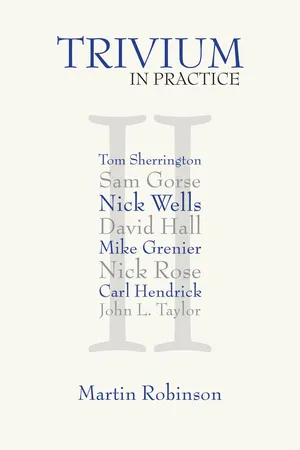
Trivium in Practice brings together a series of case studies written by educators who were inspired by Martin Robinson's first book, Trivium 21c. Taken together, these case studies reveal how, regardless of setting or sector, the trivium can deliver a truly great education for our children. Great teaching has the three elements of the trivium at its centre. Grammar: foundational knowledge and skills. Dialectic: questioning, thinking and practising. Rhetoric: the ability to express oneself beautifully, persuasively and articulately in any form. The trivium is a helpful way for a teacher to think about the art of teaching. Through the model of the trivium traditional values and progressive ideals can coexist; both knowledge and cultural capital matter and skills are interwoven with content. The trivium isn't a gimmick to be imposed on to a curriculum; it is a tried and tested approach to education. It is the key to great teaching and learning, as this group of educators discovered. The case studies are from Tom Sherrington, Sam Gorse, Nick, David Hall, Nigel Matthias, Nick Barnsley, Mike Grenier, Nick Rose and Carl Hendrick. These educators have found that trivium education has brought a range of tangible benefits for their students. These include: greater confidence, enhanced development of rigorous analytical skills, improved oracy and confidence in speaking in front of audiences, an appreciation of the value of acquiring and applying knowledge, refined skills in questioning and debating, developed creativity, independence and critical thinking, the ability to form and express considered opinions and, importantly, the enjoyment of learning. Fundamentally, these educators have found that the trivium has helped them to define and deliver their ideas about the education they want for their students, helping them to become engaged, lifelong learners in the process. There is no one 'right' way to 'do' the trivium: it is a tradition that can be adapted. It is the art of education and engages teachers in the art of being educators. Just as each great artist learns from a tradition and refashions it, adds to it, disrupts it, so do the teachers who have contributed to this book. On their canvas, in their school, each contributor is creating and re-creating trivium education in their own way. Discover the potential of the trivium and be inspired to do the same in your own classroom. Suitable for teachers and leaders in any educational setting.
Information
Topic
EducationSubtopic
Education GeneralChapter 1
Teaching: the Great Debate
One way to think about how the trivium might work in a classroom is to think about how it can be used to teach a topic. For this task I have chosen a simple idea that involves a debate to which there is no clear right or wrong conclusion. If we were to follow trivium principles, we would expect to do something along the following lines:
Grammar: The facts of the topic. Dialectic: The argument(s). Rhetoric: The pupil’s expression of their own opinion about the topic.
Notice here that the opinion comes at the end of the process. I often get into trouble by saying we’re not interested in pupils’ opinions … until I add the yet. For example, I used to teach something and ask pupils’ opinions about it straight away. This yielded responses that, though they may have been varied, were often instant reactions to something ‘unknown’; something which often results in a negative or not altogether enthusiastic response. The trivium works in a different way: this class, and teacher, are only interested in educated opinions, and welcome a broad range of opinions, as long as they are backed up by good knowledge of the debate and encourage pupils to bring their own self to bear within that conversation.
In many subjects there are texts that open themselves up to scrutiny and dialogue. Competing theories and ideas, intractable problems (both political and cultural), competing views of history, even business ideas and how best to manage a football team offer up opportunities where there is no clear-cut answer. Sometimes a single text has a debate running through it, or is open to a variety of interpretations. In theatre, the ‘grammar’ might be the script and also the work of the dramaturg finding out the facts about the play and its themes. The ‘dialectic’ would then come in through an investigation into the grammar – learning the script, practising, workshopping and rehearsing the script ready for the final ‘rhetoric’, or performance of the play to an audience. Even though the script is the same, no two productions of the play will be the same. The process opens up interpretations, and the same should be said for the process of learning in the classroom.
The text could be by Shakespeare, or by Virginia Woolf; it could be about the Civil Rights movement or about the Falklands War. It could be a discussion about the merits of 4-4-2 vs 4-2-3-1 in football, or a look at whether Darwin’s theories are useful in economics. Whatever your subject, there will be some opportunities to open up a text (or texts) to debate.
A Vindication of the Rights of Woman by Mary Wollstonecraft might be such a text. Straight away there might be a problem here, because much of what is included in this text might not be as controversial today as it was when it was published in 1792. Therefore it might not be a good text to choose for this approach – but that is not the point. The trivium can help people understand texts by testing out the strength of an argument within them, so that at first look they might superficially agree with them, at the end of the process they might know why they agree, and, what’s more, they might be able to bring their thoughts to bear in other scenarios. Wollstonecraft’s tome might be looked at alongside the work of John Locke and Jean-Jacques Rousseau. It could be looked at through the lens of contemporary debates about nature vs nurture, and also through contemporary feminist critiques about patriarchy. By learning the arguments, children would get a good grounding in the depth of the debate.
The next stage would be to get children to explore the debate through a technique known as a dissoi logoi. Through this method a pupil would be encouraged to look at two sides of an argument – or more – and be asked to write a single piece that gives equal weight to the ‘rightness’ of both sides. This is the process through which instant opinion is ‘shelved’ and stronger, educated opinion begins to be formed.
The grammar: learn about the text and its background. Learn about opposing viewpoints. The dialectic: bring those opposing viewpoints together in a piece of writing, weighing up the different facts and opinions in a dissoi logoi.
This could then become the basis for a Socratic Circle. The pupils sit in a circle, with the relevant text in their hands, and they discuss the text, responding to questions from the teacher and from each other. The point is to look at and explore ambiguities in the text, to test out its logic and, maybe, to seek to challenge it. The importance of this process, again, is the warding off of ‘opinion’, using instead ‘evidence’ (as written in the text) to justify opinions that each pupil may have. The teacher can play devil’s advocate and/or be a stickler for the use of ‘facts’ as evidenced in the text(s).
The grammar: knowledge of text(s) and other relevant information. The dialectic: a dispassionate look at the argument, drawing from knowledge (the grammar). A testing out of this argument through questioning.
This can be followed by formal classroom debates focusing on a question: ‘this class believes…’ and is one way of opening up the third part of the trivium, rhetoric. One can also begin to see how each part of the trivium overlaps with other parts. Pupils can write speeches and learn them. The teacher can tell pupils which side of the debate they will be speaking for beforehand – something which truly tests the ability to understand, use evidence and persuade others. Once the debate has been conducted, the final ‘rhetorical’ task could be set, which would be an essay stating the true ‘educated’ opinion of each child. This could be read out, open to debate, or remain in essay form to be questioned via a viva, or responded to in more conventional ways.
There are various ways to structure a piece of rhetoric and numerous methods that can be employed. What follows is a ‘classic’ structure which can be taught to pupils to improve both their spoken and written word work.
First, introduce the ‘five parts of rhetoric’. These are:
1 Invention
2 Arrangement
3 Style
4 Memory
5 Delivery.
Then explain what each one is. Again, I want to keep it simple.
1 Invention: this is the content of your speech and the drawing together of your ‘evidence’. It includes ethos, pathos and logos, the three musketeers of rhetoric. Ethos is your credibility. Pathos is the shared emotion between you and the audience. Logos is your use of reasoning and logic. This usefully models critical thinking.
2 Arrangement (the six parts of oratory): this can be a lesson in itself! I believe that if you teach this well, then not only will your pupils speak better, they will also be able to write essays better. Below is the ‘classic’ order for a speech, and it makes a great scaffold for an essay too:
i You begin with the exordium (or ‘hook’): this should catch the audience’s attention and it should also be central to your narrative.
ii Next comes the prothesis, where you present a short history of the subject that you are going to be talking about.
iii This is then followed by partitio (division): here you make the points which are uncontroversial and then the points which are contested.
iv Then confirmatio (proof): here you state the reasons behind your thinking.
v Next is the confutatio (or refutation): you go on to refute any opposing argument.
vi Finally, peroration, where you sum up the argument passionately and not by presenting a simple review.
3 Style: should the style of the talk be low, medium or grand? Low style is ‘down with the kids’; medium is probably the best for day-to-day speaking; but it would be good to introduce the ‘Grand Style’ of great oratory to see if pupils can lift the audience to a higher level through their eloquence.
4 Memory: as a drama teacher, this doesn’t worry me. I think sometimes it is good for pupils to memorize their speeches. It isn’t always necessary, but sometimes it can lift the presentation. Speaking from memory mustn’t be robotic, however; it must have sprezzatura: in other words, the speaker must allow their thoughts and ideas to inhabit them, so that they seem to spring fresh from their mind!
5 Delivery: you will need to work with your pupils on their delivery. This includes the use of space, positioning, posture, presence, communicating the feelings of honesty and truth, gestures, facial expressions and – crucially – the use of their voice: volume, pitch, tempo, pause and inflection are all important.
What you have just read is a classic trivium approach to studying a text or texts. However, I must emphasize that this process is not just one that fits snugly with the humanities and the arts. Every subject has its grammar; it has its logic; it has the need for practice and areas to analyse and debate; it also has its opportunities to ‘perform’ – whether on the sports field, in an exam or in the answering of questions.
The trivium is a helpful way for a teacher to think about the art of teaching, and can help in the design of a curriculum, when one is looking to achieve balance, increase student involvement and understanding, and develop creativity, independence and critical thinking (alongside the need for good academic knowledge and investigation).
Reading maketh a full man; conference a ready man; and writing an exact man.
Francis Bacon
Chapter 2
Philosopher Kids at Highbury Grove School
Sara Stafford, Andrew Fitch, Marie Deer, Becky Hulme, Ruth Ramsden-Karelse, Sukhi Dhillon
Tom Sherrington has been the head teacher at Highbury Grove School (HGS) in north London since August 2014. He had previously worked as a teacher and school leader in a number of different types of school, in a career that started in 1987.
Highbury Grove is a mixed comprehensive of 1,200 students in Islington. The school has a diverse intake spanning the full range of social and ethnic backgrounds and pupils have a wide range of prior attainment on entry to Year 7. A very high proportion of students speak English as an additional language, and over 70% receive Pupil Premium funding.
In this chapter, some Highbury Grove teachers write about how the trivium came to influence their thinking about curriculum and ethos. Each member of staff has their own perspective on the value of the trivium in shaping their thinking as teachers and school leaders, and on the ability of the trivium to influence a wide range of different approaches. Their commitment to the idea of the philosopher kid shines through.
In this chapter we talk about how Trivium 21c has influenced our thinking about teaching and learning and the curriculum at Highbury Grove. More than that, it has influenced our vision for the education we want to provide, and the kind of young people we want to develop at our school. From the outset I want to be clear that we are on a journey that has only just begun. Many of the ideas we’ve explored are in their infancy and, if you came to visit, you might not yet be dazzled by the knowledge and rhetorical fluency of phi...
Table of contents
- Cover
- Praise
- Title Page
- Dedication
- Acknowledgements
- Contents
- Introduction
- 1: Teaching: the Great Debate
- 2: Philosopher Kids at Highbury Grove School
- 3: The Trivium at Turton
- 4: The Trivium as a Prism
- 5: Enriching the Learning Experience
- 6: Slow Education, the Trivium and Eton College
- 7: The Trivium and Human Cultural Evolution
- 8: Dialogue and Dialogic: The Trivium and Bakhtin
- 9: Philosophically Powerful Projects
- Index
- Copyright
Trusted by 375,005 students
Access to over 1.5 million titles for a fair monthly price.
Study more efficiently using our study tools.
Frequently asked questions
Yes, you can cancel anytime from the Subscription tab in your account settings on the Perlego website. Your subscription will stay active until the end of your current billing period. Learn how to cancel your subscription
No, books cannot be downloaded as external files, such as PDFs, for use outside of Perlego. However, you can download books within the Perlego app for offline reading on mobile or tablet. Learn how to download books offline
Perlego offers two plans: Essential and Complete
- Essential is ideal for learners and professionals who enjoy exploring a wide range of subjects. Access the Essential Library with 800,000+ trusted titles and best-sellers across business, personal growth, and the humanities. Includes unlimited reading time and Standard Read Aloud voice.
- Complete: Perfect for advanced learners and researchers needing full, unrestricted access. Unlock 1.5M+ books across hundreds of subjects, including academic and specialized titles. The Complete Plan also includes advanced features like Premium Read Aloud and Research Assistant.
We are an online textbook subscription service, where you can get access to an entire online library for less than the price of a single book per month. With over 1.5 million books across 990+ topics, we’ve got you covered! Learn about our mission
Look out for the read-aloud symbol on your next book to see if you can listen to it. The read-aloud tool reads text aloud for you, highlighting the text as it is being read. You can pause it, speed it up and slow it down. Learn more about Read Aloud
Yes! You can use the Perlego app on both iOS and Android devices to read anytime, anywhere — even offline. Perfect for commutes or when you’re on the go.
Please note we cannot support devices running on iOS 13 and Android 7 or earlier. Learn more about using the app
Please note we cannot support devices running on iOS 13 and Android 7 or earlier. Learn more about using the app
Yes, you can access Trivium in Practice by Martin Robinson in PDF and/or ePUB format, as well as other popular books in Education & Education General. We have over 1.5 million books available in our catalogue for you to explore.