- 200 pages
- English
- ePUB (mobile friendly)
- Available on iOS & Android
eBook - ePub
About this book
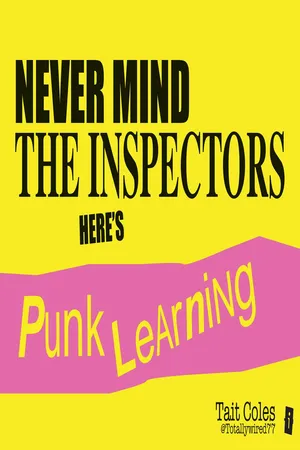
So what is Punk Learning? It details the importance of why all students should be allowed complete control of their learning. In Never Mind the Inspectors Tait justifies why we need Punk Learning, explains the philosophy behind the box ticking lessons that teachers are advised to deliver to appease Ofsted and how we should not be doing anything because the 'inspectors will like it', but because it's the right thing to do in a 21st century classroom to get the best out of all our students. Tait helps you discover how to create Punk Learning, offers ideas on how teachers can creatively inspire students to become self-regulating Punk Learners that take complete control of their learning, making it relative and memorable, so that it matters to them. For anybody with an interest in learning, teaching and doing things differently!
Information
Topic
EducationSubtopic
Education GeneralAWAY FROM THE NUMBERS
– IS WHERE I AM FREE*
– IS WHERE I AM FREE*
Learning is messy. Learning is multifaceted. Learning is not linear. Learning is not incremental. Learning is too complex to hang numbers onto.
‘Student X has achieved a level 5b.’ What does this actually mean? Is student X a good learner? Is student X a level 5b at everything they try to do? How does student X get to the next arbitrary level? Does student X actually know what a level 5b represents? Does the teacher? Is a 5b in English equivalent or as difficult to achieve as a 5b in maths? If I type 5b into a spreadsheet, do I know how good that student is as a learner or what their potential is?
As educators, are we really saying that using numbers is the best way to assess the learning intricacies and complexities of individual students? I shudder when colleagues tell me ‘Student X is a Level 5 student.’ Are we genuinely suggesting that we can pigeonhole our learners as letters and numbers? Do we, in fact, spend too much of our time assessing what our students are rather than who they are? Can we really only measure learning using numbers and letters?
Let’s start thinking about the individual student. As Joey Ramone, from the US pre-punk band the Ramones, said: ‘To me, punk is about being an individual and going against the grain and standing up and saying “This is who I am”.’
And so I find myself angered at what I constantly read, see and hear when it comes to number chasing and classifying learning into neat, singular, arbitrary levels. The two words currently being used in schools at the moment that I detest the most are possibly ‘flight’ and ‘path’.
Rather than blathering on about hypothetical ideal scenarios or about what teachers could do or what schools should do, I’m going to tell you what the punk learners actually do in my classroom and what they could do in yours.
I know my students well. I know which students need more help than others and which students need the freedom to soar. A simple way for the students themselves to acknowledge this to me is to use red and green cards. Red means ‘Leave us alone, Sir, we’re happy to struggle on’ and green tells me that they may require some extra support.
It is crucial for your students to have complete control over their own learning. For example, they should be deciding which questions they will answer and taking full ownership in terms of how they are going to learn. Each group can work successfully answering their own questions, meaning that they will all have the opportunity to fully understand the specific content of the topic they are looking at, but at different depths of understanding.
Creating space and time for your students to study at their own pace is called self-organised differentiation, or SOD.
As we all know, some students will require more support than others. This is not to say that these students need to be told stuff. Punk learning is all about our learners creating and constructing their learning for themselves. Don’t fall into the trap of telling those students who require more assistance what they need to know. This is where the craft of the teacher comes in. Coach them, guide them, scaffold learning for them, chunk it down and chunk it up, but don’t tell them – they can go to the classroom next door for that.
Inspiring your students to have the courage to learn, but with support and assistance from the teacher, is known as self-organised differentiation with outstanding facilitator feedback, or SOD OFF.
We teachers love an acronym, don’t we?
Seeing how well your students are doing and supporting them (or, even better, encouraging their classmates to support them) in how to get better, should be happening all the way through the learning process. Don’t leave the assessment until the final product. It’s vital that your punk learners understand the importance of how much they will learn during the process rather than thinking that their assessment will purely be about the end result. As Ron Berger observes in Alec Patton’s Work That Matters:
Teachers often mistakenly presume that a project’s final product is the only thing they should assess, which leads them to assume that...
Table of contents
- Cover
- Title Page
- Dedication
- Epigraph
- Contents
- Foreword
- DON’T BE TOLD WHAT YOU WANT; DON’T BE TO LD WHAT YOU NEED
- AN’ EVERYBODY’S DOING JUST WHAT THEY’RE TOLD TO
- I WANNA SEE SOME HISTORY
- ACTION TIME VISION
- WE’RE JUST BORED TEENAGERS*
- TWO FINGERS POKING AT THE WORLD, ONE GOLDEN RULE, NO RULES AT ALL
- I AM AN ANARCHIST
- HEY HO, LET’S GO!
- KNOW YOUR RIGHTS
- IF THE KIDS ARE UNITED, THEN WE’LL NEVER BE DIVIDED
- DON’T DICTATE, DICTATE TO ME
- I’M TIRED OF BEING TOLD WHAT TO THINK
- MOVING AWAY FROM THE PULSEBEAT
- SOMETHING BETTER CHANGE
- SMASH IT UP
- NEAT NEAT NEAT
- AWAY FROM THE NUMBERS – IS WHERE I AM FREE
- WHATEVER HAPPENED TO ALL THE HEROES?
- … AND WE DON’T CARE
- THEY PLAY TOO FAST, THEY PLAY OUT OF TUNE
- WHO INVENTED THE TYPICAL GIRL?
- STAY FREE
- FACE FRONT YOU GOT THE FUTURE SHINING
- Bibliography
- Acknowledgements
- Copyright
Trusted by 375,005 students
Access to over 1.5 million titles for a fair monthly price.
Study more efficiently using our study tools.
Frequently asked questions
Yes, you can cancel anytime from the Subscription tab in your account settings on the Perlego website. Your subscription will stay active until the end of your current billing period. Learn how to cancel your subscription
No, books cannot be downloaded as external files, such as PDFs, for use outside of Perlego. However, you can download books within the Perlego app for offline reading on mobile or tablet. Learn how to download books offline
Perlego offers two plans: Essential and Complete
- Essential is ideal for learners and professionals who enjoy exploring a wide range of subjects. Access the Essential Library with 800,000+ trusted titles and best-sellers across business, personal growth, and the humanities. Includes unlimited reading time and Standard Read Aloud voice.
- Complete: Perfect for advanced learners and researchers needing full, unrestricted access. Unlock 1.5M+ books across hundreds of subjects, including academic and specialized titles. The Complete Plan also includes advanced features like Premium Read Aloud and Research Assistant.
We are an online textbook subscription service, where you can get access to an entire online library for less than the price of a single book per month. With over 1.5 million books across 990+ topics, we’ve got you covered! Learn about our mission
Look out for the read-aloud symbol on your next book to see if you can listen to it. The read-aloud tool reads text aloud for you, highlighting the text as it is being read. You can pause it, speed it up and slow it down. Learn more about Read Aloud
Yes! You can use the Perlego app on both iOS and Android devices to read anytime, anywhere — even offline. Perfect for commutes or when you’re on the go.
Please note we cannot support devices running on iOS 13 and Android 7 or earlier. Learn more about using the app
Please note we cannot support devices running on iOS 13 and Android 7 or earlier. Learn more about using the app
Yes, you can access Never Mind the Inspectors by Tait Coles, Ian Gilbert in PDF and/or ePUB format, as well as other popular books in Education & Education General. We have over 1.5 million books available in our catalogue for you to explore.