- 300 pages
- English
- ePUB (mobile friendly)
- Available on iOS & Android
eBook - ePub
About this book
Educational Research by Phil Wood and Joan Smith blends together discussion of some of the main concepts and knowledge concerning educational research with some basic frameworks and approaches for completing your own projects. Research can play an important role in offering ideas and insights into educational issues, but it should always be understood and utilised through the filter of professional values and judgement. This book is suitable for those with little or no research experience: in it, the authors sketch out some of the main features and concepts in educational research, whilst also offering advice on constructing single, small-scale research projects. As such, it will allow readers to engage with some of the basic conceptual elements of research as well as offering a foundation of knowledge and application. Educational Research has two main aims: (1.) To introduce some of the basic concepts and knowledge underlying an understanding of research. This is important as research has a specialist language all of its own. To engage with and critique research we need to be able to understand how and why a piece of research has been developed in the way it has. (2.) To provide some basic frameworks for developing your own small-scale research projects. One of the best ways to deepen your understanding of research is to carry out your own! Educational Research is a comprehensive guide to practitioner research; equipping teachers with the tools to develop their research literacy and conduct their own small-scale research projects. The book covers: the foundations of good educational research, research literacy, ethical issues in educational research, managing researcher bias, critical reading and writing, an introduction to research interests, context and questions, worldviews, philosophies and methodologies of research, research methods, data capture, sampling, methods of data collection, analysing data, descriptive statistics, reliability and validity and developing small-scale research projects.
Information
Topic
EducationSubtopic
Education GeneralChapter 1
What is research?
Introduction
Since 2010 there has been an increasingly wide interest in the role of research in education, particularly in schools. Initially this interest tended to emphasise the idea of uncovering ‘what works’ in classrooms. Such an approach is not surprising as there is a ready appeal in seeing research as a medium for ‘solving’ issues in schools, and particularly in classrooms. The impression can be given that research will ultimately lead to a recipe book from which we can find the ‘correct’ ways to teach or ensure good behaviour in lessons. However, research is a complex process which can be approached in many different ways to offer insights into a very wide range of questions. We argue that research can play an important role in offering ideas and insights into educational issues, but it should always be understood and utilised through the filter of professional values and judgement; it should never be seen as a recipe book to be slavishly followed.
In 1983, Donald Schon wrote The Reflective Practitioner, which was an argument for positioning reflective practice at the centre of teacher work. He identified two forms of reflection:
- Reflection in action: The ability we develop within our own practice which focuses on our constant assessment about what we’re doing as we do it. When we assess that something is not working, we use our experience and knowledge to alter activity in the moment. This often occurs when something out of the ordinary happens, giving us a reason to alter our practice as the event or activity unfolds.
- Reflection on action: This is based on describing, analysing, reviewing and evaluating practice beyond the immediacy of the classroom to gain a deeper understanding of our work, particularly to help identify areas for improvement in the future.
Reflective practice has become an important activity which teachers are expected to undertake to improve their pedagogy. Whilst valuable, these activities predominantly rely on individual perception. There is little to ensure that what we think is an answer to our developmental needs is indeed as we see it, as our own biases and perceptions can give us a very partial view of the challenge or issue we are facing. If we decide we want to gain more structured, and possibly less biased, insights from our reflections as a way of interrogating our own perceptions, or if we want to engage with evidence from beyond our immediate classroom experience, then we are beginning to move from a reflective process to one of research.
In writing this book, we have two main aims in mind:
- To introduce some of the basic concepts and knowledge underlying an understanding of research. This is important as research has a specialist language all of its own. To engage with and critique research we need to be able to understand how and why a piece of research has been developed in the way it has.
- To provide some basic frameworks for developing your own small-scale research projects. As we will demonstrate later in this chapter, we believe that one of the best ways to deepen your understanding of research is to carry out your own!
We will therefore blend together discussion of some of the main concepts and knowledge concerning educational research with some basic frameworks and approaches for completing your own projects.
What are some of the foundations of good educational research?
If research is not synonymous with professional reflection, we need to try to define what it is and what some of the basic features of good research might be. There is no single, accepted definition of research across all subjects (more on that later), and even within education there are a large number of different approaches and traditions which understand research in different ways. Below we offer a definition merely as a starting point to aid discussion of what good research might include:
The systematic investigation into, and study of, materials, sources, situations and people in order to explore and understand identified issues with the aim of reaching new insights.
This definition highlights the central notion that all research should be, in some way, systematic. But what do we mean by ‘systematic’? We take this to mean that the work being undertaken has included some form of thoughtful planning, orientated around a clear focus and with a logical set of activities planned out to capture ‘data’. The research activities which are developed will vary widely depending on the focus of the research. One researcher might be interested in a historic question which requires a lot of work with documents, whilst another may be interested in classroom practice requiring very different, and perhaps multiple, tools. Each research project requires careful consideration of how and why data are collected, and the underlying assumptions on which the research is based.
Research is about exploring and understanding issues. As such, it should not be seen as a linear endeavour that automatically provides continuous improvements to practice. Research can lead to results which are unexpected (often seen as ‘negative’) or find little evidence of change or improvement. In either case, the research should not be seen as a failure; all insights are important, and frequently it is research which turns out to be counter-intuitive that leads to new, interesting questions and foci for further work. To ensure we don’t attempt to second-guess and produce insights which fit with our preconceptions, we need to develop logical and carefully considered approaches to research – approaches which we will eventually share transparently with others. The full disclosure of our research approaches when reporting is crucial so that readers can fairly critique and engage with our work. Much of the research in education will add to our understanding of practical issues, but rarely, if ever, will it give us absolute truths or laws. This is why we suggest that research can help us to gain new insights, but it rarely leads to solid, universal conclusions.
From this consideration of the nature of research, we will outline what we think are the features of good research in education. These principles underlie our discussion of research methods throughout this book:
- Focuses on a definable issue or problem. Research needs to be focused on a clear area for exploration. If it is too broad it becomes unwieldy which makes it difficult to collect meaningful data. In attempting to develop a coherent focus for research, the appropriate use of research questions is extremely important.
- Emphasises an ethical approach. All research in education should be developed with the explicit understanding that it should be an ethical process. The vast majority of research in this field includes human participants in some way. Our research should always protect the well-being and dignity of both participants and researchers. This is often the stated purpose of research ethics, the ‘legal’ aspects of which are the primary focus of review panels. However, we stress that ethical research should also focus on the need for honest and transparent reporting so that work can be read critically and fairly by peers. This includes the reporting of research approaches, any conflicts of interest and the context of the research. It also requires that when we rely on the work of others, we reference them fully so that they are given due recognition for their work.
- Gives a clear outline of the context of research. The process of education is highly complex. Therefore, when writing about research it is always important to give readers a clear context (albeit anonymised). If a small-scale study is completed with a class of 12- and 13-year-olds in an inner-city school composed predominantly of more able students, then it is essential that the reader has this information so they can understand the context of the data gained. This also allows the reader to consider the degree of relevance of the research to their own situation. It is a central part of honest and transparent reporting and educational debate.
- Uses research literature to inform the research design. The vast majority of research builds on work already done. It is important to begin to gain an understanding of the research which has been published previously in an area of interest. We need to be good at reading and assessing research so that we can judge the degree of evidence on which we might build our own work.
- Gives a clear outline/discussion of the methodology and methods which have been used to collect data. Ethical research should make the methodology and methods which have been used to collect data transparent. Readers need to know how our research has been carried out as this is crucial to being able to interpret the data, and therefore engage critically with any claims that are made. By explaining decisions concerning preferred methodologies we give an insight into the way the research is positioned and the nature of the claims made.
An account of the data collection tools (methods) used is equally important for the same reasons. If a study has used interviews, are the questions reported so that we can judge the level of neutrality? Where observations are used, is the focus and method of data capture explained? If these issues are not thought through and reported then a considered, critical reading of the research cannot be achieved.
Where research occurs at a meta-level – for example, through the use of literature reviews – it should include a methodology outlining the search criteria, filtering processes and how publications have been analysed. If a literature review merely presents an area of research with no methodology, it needs to be read with caution as we have no way of assessing its validity. - Uses appropriate methods which clearly link back to the initial issues/problems and research questions. Well-conceived research will be able to make clear how particular methods help in investigating the chosen issues/research questions; this gives the research coherence.
- Analyses collected data in a transparent way. In the same way as it is important to carefully consider the reporting of methodology and methods, so it is with analysing the data which have been collected. Analysis is often not considered to the same level of detail as methodology and data collection, but it is crucial in ensuring a reasoned and valid consideration of the data, particularly when trying to minimise biases and the selective use of data. To make the process transparent, it is again important to report how data have been analysed.
- Develops explanations and discussion derived from the data. Good research develops a clear discussion of the data collected. This is at the centre of reporting research, in the same way as it is when the interpretation of the project is developed. It is crucial that explanations emerge from the data provided and are not dissonant with the evidence. In addition, the discussion of the data should be related to the literature with which you have engaged and which is the foundation on which the research study rests.
- Offers measured insights/conclusions. Good research is measured in the claims made. Small-scale research cannot easily make claims which can be scaled up; in other words, an analysis of one cycle of action research focusing on, for example, improving questioning practices in one class, cannot act as the basis for national policy. However, small-scale research can still provide valuable insights for practitioners by providing useful information as to where good practice might be found. Within large-scale research, projects often rely on quantitative analyses. Insights here tend to be based on statistical manipulations which offer a constructive exploration of patterns and trends. However, in-depth explanations are sometimes more problematic as this type of research is more likely to provide answers to the ‘what’ rather than the ‘why’.
All research has potential shortcomings because no approach is perfect or has all of the answers in a particular area of interest. Often, deep insights occur through the long-term application of a number of qualitative and quantitative approaches which augment understanding and give progressively fuller and more critical perspectives on an issue.
The interdisciplinary nature of educational research
Many academic disciplines have a generally well-understood and accepted philosophical approach to investigation and knowledge generation. As a result, they do not make their philosophical underpinnings an explicit element of training; the underpinning assumptions of what constitutes knowledge and how it is ‘found’ are more often implicit in the research methods. However, education is not a discipline – it is interdisciplinary (see Figure 1.1). This means that education as an area for enquiry is impacted on by different disciplinary perspectives which overlap.
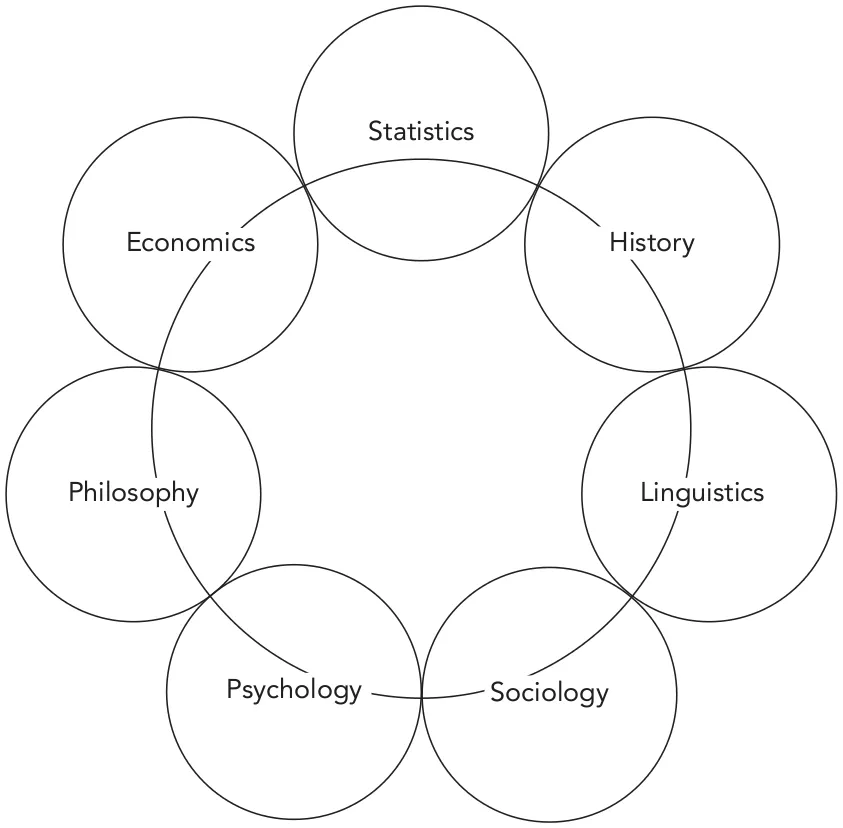
Figure 1.1. Education as an interdisciplinary field – many disciplines converge on educational interests.
This is perhaps what leads to debates about, and sometimes denunciations of, different methodological approaches within educational research. However, it is important when engaging with research in education that we attempt to understand and embrace these different views of knowledge and the methodologies which emerge. It is by developing an understanding of these different perspectives that we can begin to positively engage with and critique the work of others. In this sense, being ‘positively critical’ means to understand and engage with research from other philosophical traditions, even if our own beliefs are quite different. In...
Table of contents
- Cover
- Praise
- Title Page
- Dedication
- Contents
- 1: What is research?
- 2: Ethical issues in educational research
- 3: Critical reading and writing
- 4: Thinking about the basics
- 5: Worldviews and methodologies
- 6: Considering data capture
- 7: Thinking about data
- 8: Developing small-scale research
- Appendix 1: Developing your understanding of research methods – suggested further reading
- Appendix 2: Exemplar research ethics consent form
- References
- Index
- Copyright
Trusted by 375,005 students
Access to over 1.5 million titles for a fair monthly price.
Study more efficiently using our study tools.
Frequently asked questions
Yes, you can cancel anytime from the Subscription tab in your account settings on the Perlego website. Your subscription will stay active until the end of your current billing period. Learn how to cancel your subscription
No, books cannot be downloaded as external files, such as PDFs, for use outside of Perlego. However, you can download books within the Perlego app for offline reading on mobile or tablet. Learn how to download books offline
Perlego offers two plans: Essential and Complete
- Essential is ideal for learners and professionals who enjoy exploring a wide range of subjects. Access the Essential Library with 800,000+ trusted titles and best-sellers across business, personal growth, and the humanities. Includes unlimited reading time and Standard Read Aloud voice.
- Complete: Perfect for advanced learners and researchers needing full, unrestricted access. Unlock 1.5M+ books across hundreds of subjects, including academic and specialized titles. The Complete Plan also includes advanced features like Premium Read Aloud and Research Assistant.
We are an online textbook subscription service, where you can get access to an entire online library for less than the price of a single book per month. With over 1.5 million books across 990+ topics, we’ve got you covered! Learn about our mission
Look out for the read-aloud symbol on your next book to see if you can listen to it. The read-aloud tool reads text aloud for you, highlighting the text as it is being read. You can pause it, speed it up and slow it down. Learn more about Read Aloud
Yes! You can use the Perlego app on both iOS and Android devices to read anytime, anywhere — even offline. Perfect for commutes or when you’re on the go.
Please note we cannot support devices running on iOS 13 and Android 7 or earlier. Learn more about using the app
Please note we cannot support devices running on iOS 13 and Android 7 or earlier. Learn more about using the app
Yes, you can access Educational Research by Phil Wood in PDF and/or ePUB format, as well as other popular books in Education & Education General. We have over 1.5 million books available in our catalogue for you to explore.