- 256 pages
- English
- ePUB (mobile friendly)
- Available on iOS & Android
eBook - ePub
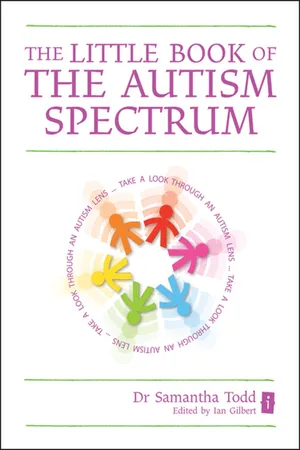
The Little Book of The Autism Spectrum
About this book
This book will allow anyone who lives or works with children with Autism to see the world as they do, and develop strategies for managing and understanding it effectively. It peers through the "Autism lens", allowing us to effect change in terms of the way we deal with autism as a society and in education. It delivers evidence-based support and strategies that enable us to develop young people's abilities to interact with the social world, removing much of the anxiety that often accompanies it.
Information
Topic
EducationSubtopic
Inclusive EducationPart One
Understanding the Autism Spectrum
Chapter 1
Introduction to the Autism Spectrum
The amount of information available about autism can be overwhelming and it can be hard to know where to begin. This section provides a brief overview of the condition.

What is autism?
Autism is often described as a developmental disability. This means that it is usually first noticed during childhood. People with autism have a disability in terms of the way they understand and interact with other people, and this creates challenges when living in a very social world. However, some people do not think of autism as a disability, but simply as a different way of processing information and understanding the world.
Autism is a lifelong condition. This means that someone with an autism diagnosis will always have the condition, but it doesn’t mean they will always be the same. All children change, learn, and develop, so children with autism will also change – they won’t be the same at 15 or 40 as they were at 3. However, it is important to keep in mind that they will experience ongoing challenges with their social interactions, communication, and behaviour.
What is the spectrum of autism?
Throughout this book I use the term ‘autism’ as shorthand for the whole autism spectrum. Autism spectrum diagnoses (also known as autistic spectrum disorders or autistic spectrum conditions) are given to a broad range of children who display significant difficulties in these two areas:
- Social interaction and communication
- Social imagination, along with restricted, repetitive behaviour and interests
Wing’s triad of impairment
Dr Lorna Wing is a psychiatric consultant for the National Autistic Society, the parent of a child with autism, and high profile researcher and writer regarding the condition. In the 1970s she was instrumental in identifying the core difficulties of autism. She described three key ‘impairments’ shared by all children who have an autism spectrum condition: impairments in social interaction, social communication, and social imagination, including restricted and repetitive behaviours and interests. This is called the ‘triad of impairment’ or ‘Wing’s triad’ (Wing and Gould, 1979).
The latest Diagnostic and Statistical Manual of Mental Disorders (DSM-V; APA, 2013) reduces the triad to two.
The spectrum of autism has broadened considerably over time. Going back a half century, autism used to refer only to children who seemed to be ‘in their own world’. These children show highly repetitive behaviours and routines, with very little interest in other people. This is sometimes referred to as ‘childhood autism’ or ‘Kanner’s autism’, after the psychiatrist who first described the condition in 1943. These children often have severe delays in language and very unusual speech, or no speech at all.
As the 20th century went on, the spectrum of autism started to widen. In 1944, the Viennese paediatrician Hans Asperger provided the first description of boys with a particular style of thinking and interacting. He described young people with average or above average intellectual ability, and no delay in language, but who showed specific difficulties in social interaction and imagination. The term ‘Asperger syndrome’ was coined to describe this condition.
So, whilst one person within the autism spectrum may have no spoken language and very little interest in other people, another person within the spectrum may have well-developed language and be keen to make friends, but struggles to do so effectively. What the two individuals share are significant difficulties in their social interaction, communication, and imagination. Both will also have restricted and repetitive interests and behaviour.
The number of terms used to describe children on the autism spectrum can cause confusion. It is important to remember that they are all part of the same ‘family’ of diagnoses, with the same essential difficulties but with differences in terms of intellectual ability and language development.
Diagnostic terms
DSM-V (APA, 2013) uses the term ‘autism spectrum disorder’ to include everyone on the autism spectrum. This sits alongside a description of how much the condition affects the individual and each person’s individual profile of difficulties.
Children and young people who have already been diagnosed, or are diagnosed using different criteria, may receive one of these alternative diagnoses, all of which fall within the autism spectrum:
Is there such as thing as mild or severe autism?
There is a common misconception that people with childhood autism are at the ‘severe’ ...
Table of contents
- Cover
- Praise
- Title Page
- Dedication
- Contents
- Acknowledgements
- Foreword
- Preface
- Part One: Understanding the Autism Spectrum
- Part Two: Developing Skills and Promoting Well-Being in Children and Young People with Autism
- Part Three: Working with Behaviour
- Final Remarks
- Glossary
- References
- Further Reading and Resources
- Index
- Copyright
- Advertisement
Trusted by 375,005 students
Access to over 1.5 million titles for a fair monthly price.
Study more efficiently using our study tools.
Frequently asked questions
Yes, you can cancel anytime from the Subscription tab in your account settings on the Perlego website. Your subscription will stay active until the end of your current billing period. Learn how to cancel your subscription
No, books cannot be downloaded as external files, such as PDFs, for use outside of Perlego. However, you can download books within the Perlego app for offline reading on mobile or tablet. Learn how to download books offline
Perlego offers two plans: Essential and Complete
- Essential is ideal for learners and professionals who enjoy exploring a wide range of subjects. Access the Essential Library with 800,000+ trusted titles and best-sellers across business, personal growth, and the humanities. Includes unlimited reading time and Standard Read Aloud voice.
- Complete: Perfect for advanced learners and researchers needing full, unrestricted access. Unlock 1.5M+ books across hundreds of subjects, including academic and specialized titles. The Complete Plan also includes advanced features like Premium Read Aloud and Research Assistant.
We are an online textbook subscription service, where you can get access to an entire online library for less than the price of a single book per month. With over 1.5 million books across 990+ topics, we’ve got you covered! Learn about our mission
Look out for the read-aloud symbol on your next book to see if you can listen to it. The read-aloud tool reads text aloud for you, highlighting the text as it is being read. You can pause it, speed it up and slow it down. Learn more about Read Aloud
Yes! You can use the Perlego app on both iOS and Android devices to read anytime, anywhere — even offline. Perfect for commutes or when you’re on the go.
Please note we cannot support devices running on iOS 13 and Android 7 or earlier. Learn more about using the app
Please note we cannot support devices running on iOS 13 and Android 7 or earlier. Learn more about using the app
Yes, you can access The Little Book of The Autism Spectrum by Dr Samantha Todd, Ian Gilbert in PDF and/or ePUB format, as well as other popular books in Education & Inclusive Education. We have over 1.5 million books available in our catalogue for you to explore.