- 192 pages
- English
- ePUB (mobile friendly)
- Available on iOS & Android
eBook - ePub
About this book
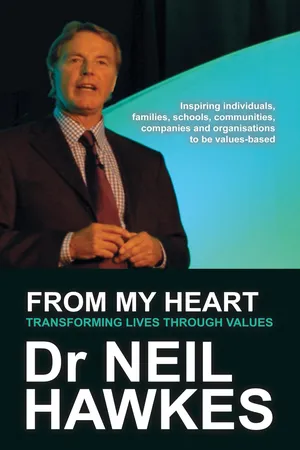
Values Education is the philosophy and practice that inspires both children and adults to be the best that they can be. After all, we are all growing, and it is not only our children that can benefit from education and development, but adults too. In his constant bid for better education, author Dr. Neil Hawkes advocates a positive mental attitude which aims to empower young people with a sense of their own future and their potential to shape it according to their own purpose. Neil discusses the benefits of caring for yourself and others, as well as providing medical evidence to support these ideas. He contextualises his philosophy by demonstrating ways in which teachers, parents and pupils can use it to create a happier and more productive learning environment by raising their self-awareness and self-confidence.
Information
Topic
EducationSubtopic
Education GeneralChapter 1
You and me
Hello! Thank you for choosing to read my book, which is written ‘from my heart’. It is unlikely that you know me, so here is a photo …

Before reading my book, I would like to invite you to find a picture of you to put in the space next to mine or, if you prefer, make a sketch of yourself. You see, this book is about more than just reading a text: it is about you and me, and the relationship we can develop through the exploration of values which this book provides. I believe that good relationships are paramount – they help us to make sense of our complex world, and most of us desire them. They are the fundamental core principle of a values-based family, business and school.
Now, please may I request that you spend a minute or so just being still and quiet, thinking about what you sense about us both. You probably know very little about me, but you will know a great deal about you.

Thank you. I will explain later why it is so important for us to take moments of quiet reflection. I sense that you are someone who has chosen to read this book because you are conscious of your own personal journey through life; you are open to deepening your understanding about how you can help yourself and others to live life with a greater sense of inner peace and harmony.
I am sorry that I can’t be with you personally; nevertheless, I have put the energy of loving good wishes, which I put into my talks about values, into this book. I often begin my talks by spending a little time in silence, just being still and gently making eye contact with individuals in the audience – hopefully each one. I know that some folk may think a variation of, ‘Who the hell is this weirdo?’ Others giggle or glance furtively at the person sitting next to them for reassurance, whilst others adopt a wry, expectant smile. My simple act has a profound purpose, which is for me to make a connection with each person in the room, so that there is a realisation that my thoughts and ideas are not just carried in the words I say, but in the relationships that I establish. I assure the audience that no one is invisible to me during my presentations. I am not just giving a talk; I am trying to inspire people to adopt a living philosophy and its practices.
I shy away from calling myself an ‘inspirational speaker’, because I have experienced sitting in audiences when speakers have used techniques and content to engage their audiences, but have not engaged with individuals at a personal level; thereby leaving them disempowered to really engage with the subject of their talk. Have you had similar experiences when you have felt ‘missed’ and left with the impression that the presenter has given the same talk umpteen times before?
I believe that deep learning occurs in the space between people, so authentic modelling of the process of being a values-based person is vital if the messages contained in my words are going to resonate with people who are just like you and me. When I was a schoolteacher, I soon realised that I might think I was teaching one lesson, but each student was hearing it differently and learning different things, because they were hearing my words through the filter of their own experience, upbringing and culture. It is the same for each person who reads this book: each individual will sense different meanings as my words interact with their life experiences.
Thus, this simple act of silent connection helps to establish the beginning of a relationship and intimacy. I have noticed that people who are genuinely interested in others, on initial meetings, take time to make eye contact and just be present for a few seconds before speaking. I remember being made extremely aware of this process when taking an active part in an education conference in Edinburgh. The principal guest was the Dalai Lama, who had this gift in abundance, and he made each new meeting very special for each of us. I would recommend that you make this a part of your awareness when you are meeting both friends and strangers. They will sense a pleasant difference in you.
Are you a people-watcher? I often turn a visit to my local supermarket into a rich experience of people-watching, especially of parents/carers with their children in tow. My observations have led me to the conclusion that if you want to learn about parenting in its many diverse forms, then watch as children are taken shopping. For instance, the parent with the misbehaving child, who is shouting and running amok in the aisles, and whom other shoppers are pretending to ignore, suddenly shouts out, ‘Shut up you little brat. I’ll tell your Dad when I get you home. You’re really a nasty bit of work.’ Or the parent you overhear saying, ‘Now Jessica, where are the baked beans? It’s spelt b-e-a-n-s. Ah yes, well done dear, you are clever.’ Of course, these examples are caricatures, extremes, but they illustrate the range of parenting that makes up our society.
I would suggest that there are simple key skills/understandings about parenting that, if generally adopted, could transform relationships for the better in so many homes and classrooms. The central maxim to remember is that adults should never tell off a child, only (if appropriate) the child’s behaviour. In the first example, the child is told that they are ‘a nasty bit of work’. In hearing this, probably repeatedly, the child will develop an understanding that they are not liked for who they are. Subconsciously, they say to themselves, ‘If I can’t be noticed for being good, then I’ll get attention by being bad.’ Often they will carry this self-perception throughout life, because they have been thwarted in their efforts to cultivate a meaningful attachment with significant adults, such as their parents.
I think that we need to invest in finding ways of supporting the development of parenting skills across the whole of society. I remember talking with a secondary school teacher in Merthyr Tydfil (in South Wales), who pointed out to me that, in her community, they had children who had been parented by children, who had been parented by children, who had been parented by children – three generations! These individuals hadn’t had the chance to develop many basic parenting skills, because they had been expected to raise their children alone and not as part of an extended family. Do you notice that, despite many examples to the contrary, there is a current lack of understanding about how to be an effective and loving parent? The teacher in Wales was not being unnecessarily critical – she loved the people in her community. However, she recognised that the community was no longer raising its children as it once did, when there was shared responsibility with grandparents, aunts, uncles and friends living locally, who passed on the wisdom of parenting and shared in that responsibility.
Without such cultural wisdom, we have, at one end of the spectrum, neglected and even abused children and, at the other end, overindulged, potentially selfish children (demanding the latest iPad) who actually seek meaningful relationships, based on love and trust.
My intention is not to paint a picture of doom and gloom, because I am optimistic – as this book will show – that we can help and support all parents and adults in all societies to be at ease in the role of a parent/caregiver.
So, what do I hope that you will gain from reading this book? My main purpose is to inspire you to adopt universal, positive human values in your work and life and be a role model for them. I would like you to be so inspired that you will want to be an active part of a growing worldwide movement for transformational change. I hope that, as you take the journey with me through the pages of this book, you will conclude that the movement is not just an idealist’s dream. You will gain the understanding needed to transform your own life and read the evidence about how values-based education (VbE) is transforming the lives of individuals and institutions, such as schools, and reaching out into all aspects of society.
One such school is Revoe (in Blackpool). Whenever I give a presentation about values-based education, I usually begin by showing a picture of a pupil at Revoe School. His name is Trev and I met him when I was invited to the school’s ‘Grand Opening of Parliament’. Revoe has moved on from the notion of a school council to ensuring that the children feel really involved in the leadership and management of the school (a key to how they have transformed pupil behaviour).
Firstly, a bit of background. A few years ago Revoe was judged by the English inspection service, Ofsted, to be a failing school; in fact, one of the worst in the country. It sits within what is described as a socially challenged catchment area. It was at this point that Cath Woodall was appointed to be the head teacher and began the task of transformation. On first meeting Cath, after a values presentation for Lancashire head teachers, I was aware that I was in the presence of an outstanding, optimistic leader with huge determination and the necessary practical skills to create a learning environment that would transform the school. She knew that, to provide a rich education for the pupils, she would need to embrace the community and demonstrate that Revoe was a good school. One of the first tasks was to ensure that the children came to school, so each morning she asked her teaching assistants to form a series of human buses. They would go out into the community and call at the children’s homes to collect the pupils, who, for whatever reason, may have been reluctant to come to school. At first, the teaching assistants were met with a varied reception but, as the weeks passed, the community began to understand that Cath wanted the very best for their children, so they began to support her innovative initiatives.
Back to Trev. I spotted him by himself, waiting for the Parliament to begin. He seemed very glum, so I asked him if he was OK. He paused, eyeing me suspiciously, and then he said in a tearful voice, ‘Mrs Woodall says that you are the important visitor who gives talks. My name is Trev; I’m in Year 4. You know, I am the Minister of Finance, but my Mum and Dad can’t be bothered to come and see me today. They never come!’ He then looked down at the ground and, for a moment, I considered what I could say that might be of some help. I then said, ‘OK, can I be here for you? What’s more, can I take your picture and, whenever I begin a talk, I will show your picture?’ He glanced at me with a look that conveyed a mixture of hope and disbelief. We then went into the school’s hall for the Grand Opening of Parliament, which was terrific, with all the staff and children entering into the spirit of the occasion. A wonderful moment was when Cath came in as the Queen to open Parliament – inducing a ripple of laughter from the parents and community members attending. Trev was great.
I have kept my promise to Trev and I have proved it to him because, some while ago, a professional development day was being held at the school by the National Education Trust (NET) and I had been asked to speak about the growing number of schools that are becoming values-based. Before I began, I asked Cath if Trev could be asked to come to the hall. He was now in Year 6. Without question she agreed and, with a broad smile, Trev arrived in the hall, and I invited him to sit at the front as I began my talk – with his smiling picture on the screen. I wish you could have seen the expression on Trev’s face as it lit up with pride. Later, Cath confided in me that my two simple acts had done wonders to raise the self-esteem of this boy, who so desperately needed the approbation of adults. Healthy attachments and good relationships are the cornerstone of a values-based school.
Trev and Revoe School represent what I hope will be gained by people and organisations that adopt values-based education. In a nutshell, this is inspiration to want to be the best people that we can be, in our personal, family, community and work life. So, as I set out on the journey of writing this book, my purpose is to inspire you and to give you some important practical tools that will help you transform both your own life and the life of the school, business or company in which you work. Although the majority of my examples will be from my own background, which is in education, they can equally and effectively be applied to any business or institution – the core principles are the same.
How can you get the most from reading this book? May I make a few suggestions? Firstly, let me check: Do you know where your heart is?
Please take a moment to place one of your hands over your heart and just leave it there for a few seconds – can you feel your heart beating?
In so many countries now, young people are encouraged to think cognitively and apply deductive logic to problem-solving. We learn to use objective, scientific methods which we bring to our listening and reading. We are taught to break down argument and to be critical, looking for the flaws in reasoning. This is a great skill which I use myself, but I believe that we no longer have the correct balance between the cognitive and affective domains. By affective, I mean the area of feelings and emotions that fuel our creativity and help us to be fully integrated human beings. So, when reading this book, ask yourself how you feel about what you are reading, not just what you think about it. Maintain an open mind and sense what could help you to see the world through a different or adjusted lens; this will enhance your awareness and your consciousness.
Next, can you remain positive whilst you read this book? What is your mood at the moment?
Keep a check on yourself, as you will absorb more from my words if you are in a positive, relaxed state of mind. Research shows that children learn best when teaching is fuelled with positive emotion and when there is challenge, tempered with humour and fun.
Finally, are you a perfect person?
There was a man in an audience once, who, on hearing this question, put up his hand. I asked him why he thought he was perfect. His reply brought a roar of laughter when he said, ‘I think I’m perfect, because my Mum says I am!’ I don’t know if he was saying this with his tongue in his cheek – I suspect that he was. The truth is that none of us have reached perfection. I know I haven’t – my family and friends often remind me of my many flaws. The point is that talking about values can make some of us feel uncomfortable, because we are fully aware of our foibles. Please accept yourself for who you are today and join me on a lifetime’s journey of self-improvement.
You are entitled to ask the question, ‘Who is Neil Hawkes and what gives him the right to write a book with a focus on values?’ Those who know me well will appreciate that I avoid the spotlight being turned on me, preferring instead to be a king-maker rather than a king. The reason for this is that I observe what happens when a person’s ego takes control of them. It often causes people to cease being in touch with their innate human qualities and, instead, become deluded by power, wealth or fame. TV reality shows feed th...
Table of contents
- Cover
- Praise
- Title Page
- Acknowledgements
- Author’s letter
- Contents
- Chapter 1: You and me
- Chapter 2: Your values journey
- Chapter 3: What is the starting point for values-based education?
- Chapter 4: The philosophy of values-based education
- Chapter 5: Children see, children do
- Chapter 6: So what’s a value?
- Chapter 7: Focus on environment, atmosphere and routines
- Chapter 8: Focus on you
- Chapter 9: Focus on your relationships
- Chapter 10: Focus on adopting reflective practices
- Chapter 11: Focus on an ethical vocabulary
- Chapter 12: Focus on being a role model for values
- Chapter 13: Focus on school assemblies
- Chapter 14: Focus on the school’s curriculum and its leadership
- Chapter 15: Focus on community
- Chapter 16: Focus on values assessment
- Chapter 17: From my heart
- Bibliography
- Copyright
Trusted by 375,005 students
Access to over 1.5 million titles for a fair monthly price.
Study more efficiently using our study tools.
Frequently asked questions
Yes, you can cancel anytime from the Subscription tab in your account settings on the Perlego website. Your subscription will stay active until the end of your current billing period. Learn how to cancel your subscription
No, books cannot be downloaded as external files, such as PDFs, for use outside of Perlego. However, you can download books within the Perlego app for offline reading on mobile or tablet. Learn how to download books offline
Perlego offers two plans: Essential and Complete
- Essential is ideal for learners and professionals who enjoy exploring a wide range of subjects. Access the Essential Library with 800,000+ trusted titles and best-sellers across business, personal growth, and the humanities. Includes unlimited reading time and Standard Read Aloud voice.
- Complete: Perfect for advanced learners and researchers needing full, unrestricted access. Unlock 1.5M+ books across hundreds of subjects, including academic and specialized titles. The Complete Plan also includes advanced features like Premium Read Aloud and Research Assistant.
We are an online textbook subscription service, where you can get access to an entire online library for less than the price of a single book per month. With over 1.5 million books across 990+ topics, we’ve got you covered! Learn about our mission
Look out for the read-aloud symbol on your next book to see if you can listen to it. The read-aloud tool reads text aloud for you, highlighting the text as it is being read. You can pause it, speed it up and slow it down. Learn more about Read Aloud
Yes! You can use the Perlego app on both iOS and Android devices to read anytime, anywhere — even offline. Perfect for commutes or when you’re on the go.
Please note we cannot support devices running on iOS 13 and Android 7 or earlier. Learn more about using the app
Please note we cannot support devices running on iOS 13 and Android 7 or earlier. Learn more about using the app
Yes, you can access From My Heart by Dr Neil Hawkes in PDF and/or ePUB format, as well as other popular books in Education & Education General. We have over 1.5 million books available in our catalogue for you to explore.